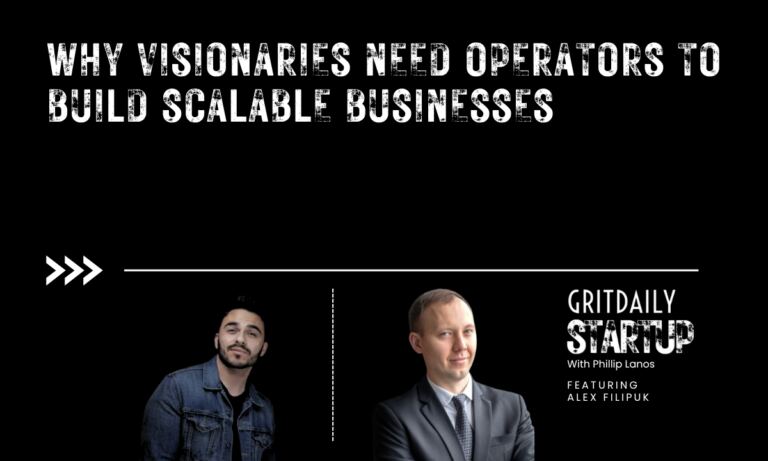
Entrepreneurs are often celebrated for seeing opportunities other people miss. But Alex Filipuk, CEO of Ideal Siding, believes the ability to envision a business is fundamentally different from the ability to build one.
Filipuk knows the distinction because he considers himself a visionary. He started building businesses at 17, experimenting with everything from social media and digital marketing to translation, publishing, and construction. Some worked. Others failed dramatically.
Those experiences eventually led him to an important conclusion: a strong idea only becomes valuable when someone can execute it.
That principle has shaped how he built Ideal Siding from an initial test location into a franchise organization with more than 100 locations.
Strategy Is Only the Beginning
Filipuk’s entrepreneurial instincts emerged early. One of his first ventures attempted to build a social network for Russian-speaking users. The problem was that he and his fellow students had roughly $100 to spend on an idea that required millions of dollars in infrastructure and development.
The failure changed how he evaluated opportunities. Instead of simply pursuing interesting ideas, he began looking for businesses where he believed he had a strong probability of succeeding.
Eventually, his experience generating leads for siding companies exposed an opportunity in home renovation. Filipuk saw an industry fragmented among local operators, with inconsistent customer experiences and, in some cases, troubling business practices.
He believed a recognizable siding brand could offer homeowners something the industry lacked: consistency, accountability, and a company that would still be there when something went wrong.
Yet having the strategy was not enough. Someone still had to turn it into a functioning organization.
Visionaries Can Become Their Own Bottleneck
Filipuk uses the concept of the visionary and integrator to explain a common entrepreneurial problem.
Visionaries are often excellent at spotting opportunities. They generate ideas, imagine new products, recognize market gaps, and think about where a company could go next. Those qualities are useful, particularly during the earliest stages of a business.
They can also become liabilities without execution.
“If you have a friend who has five ideas a week and he didn’t build anything,” Filipuk said, “that’s a perfect visionary.”
For aspiring entrepreneurs who love strategy but dislike operations, his message is straightforward. In the beginning, founders usually do not have the luxury of choosing only the work they enjoy.
Before there is a team, the founder may need to handle sales, operations, recruiting, customer problems, and dozens of other responsibilities. The strategic role comes later, after the organization has enough people and systems to support it.
Otherwise, the founder risks becoming someone who continually creates possibilities without building anything durable.
Find People Who Think Differently
Filipuk believes one solution is to deliberately partner with people whose abilities differ from your own.
A visionary may wonder how an operator can tolerate focusing on processes, details, and repetitive execution. The operator may wonder why the visionary cannot stop generating new ideas long enough to finish the existing ones.
That tension can be productive.
Filipuk argues that businesses need multiple types of people, including visionaries, processors, operators, and those capable of bringing groups together. A founder does not need to embody every role indefinitely, but someone eventually needs to own each one.
His own experience reinforced that lesson. As his businesses grew, Filipuk sought managers, partners, investors, and eventually franchisees who could help turn the larger strategy into repeatable execution.
Big Goals Are Built Through Small Wins
Filipuk applies the same philosophy to long-term growth.
Ideal Siding’s ambition is to become the leading siding renovation company in every market it enters, but Filipuk deliberately avoids attaching an arbitrary deadline to that goal. One market might develop quickly. Another could require years.
What matters is continued progress.
He recalls participating in business groups where weekly goals were recorded and reviewed. In any individual week, the progress could feel insignificant. Looking back over an entire year revealed how much those small accomplishments had compounded.
That experience changed how he thinks about ambitious goals.
Entrepreneurs can overestimate what they will accomplish quickly while dramatically underestimating what consistent execution can produce over five or ten years.
For Filipuk, that is the bridge between having a vision and actually building a company around it. The idea provides direction. The team supplies capabilities the founder does not possess. Daily execution turns both into something real.
Strategy may determine where a business is going, but businesses are built during the hundreds of ordinary days between deciding on the destination and finally arriving there.
Want more Grit Daily Startup Show? Take a look at past articles, head over to YouTube, or listen on Apple Podcasts or Spotify.