The next wave of artificial intelligence will not live exclusively on computer screens.
It will roll down neighborhood streets, navigate front walkways, and quietly complete physical tasks that today require millions of hours of human labor.
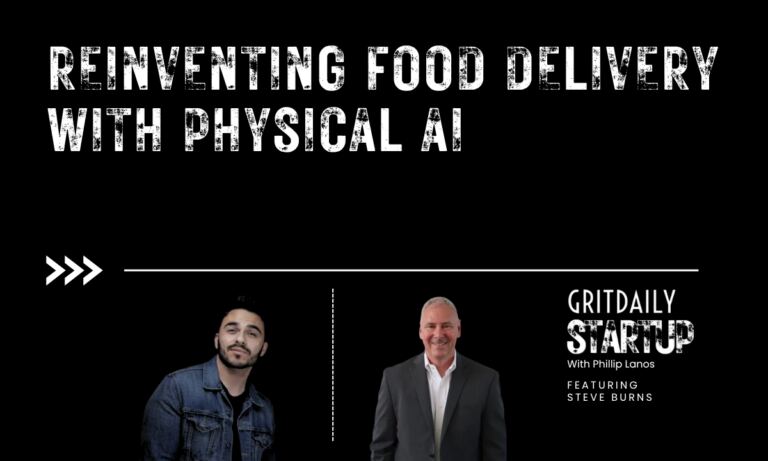
That is the vision driving serial entrepreneur Steve Burns, whose latest venture, NoTip, applies robotics and artificial intelligence to one of the most expensive and overlooked parts of modern commerce: food delivery.
While much of the AI conversation centers on chatbots and software, Burns is focused on what he calls physical AI, where intelligent machines interact with the real world to solve practical problems.
The Biggest Opportunity Was Never the App
Food delivery has become incredibly convenient, but convenience has come at a price.
For many consumers, a meal that costs around $30 at a restaurant can easily approach $60 after delivery fees, service charges, markups, and tips. Burns argues that the economics are broken because the process remains almost entirely manual.
Drivers use personal vehicles, navigate unfamiliar neighborhoods, absorb fuel and maintenance costs, and spend much of their time completing a single delivery.
Rather than building another marketplace, Burns started by asking a different question: what if the delivery system itself was redesigned?
His company’s solution combines a purpose-built electric delivery vehicle with a small autonomous robot that carries food from the curb to the customer’s doorstep. Instead of replacing one driver with another, the goal is to eliminate unnecessary costs throughout the entire process.
The result is a delivery model designed to reduce fees dramatically while maintaining the convenience consumers already expect.
Specialization Beats Generalization
One of the biggest lessons from robotics is that purpose-built machines often outperform general-purpose ones.
Burns does not envision a humanoid robot capable of performing dozens of household chores. Instead, his delivery robot is designed to accomplish one job exceptionally well: transporting food the final stretch from the street to the front door.
That narrow focus creates significant advantages.
The robot requires fewer components, consumes less energy, and can be manufactured more affordably than broader robotic systems attempting to solve every possible task.
Specialization also accelerates development. Rather than waiting for perfect technology, companies can deploy machines that solve valuable problems today while improving capabilities over time.
Physical AI Has a Different Innovation Curve
Software startups can launch globally with little physical infrastructure.
Building physical AI is fundamentally different.
Every improvement requires coordination across hardware, sensors, batteries, navigation systems, manufacturing, software, and real-world testing. Success depends on balancing engineering ambition with practical execution.
Burns believes founders often delay launches while chasing perfection.
His philosophy favors getting products into the field, learning from real-world conditions, and improving continuously. If a robot accomplishes its core mission reliably, incremental refinements can follow after customers begin using the service.
For physical AI companies, shipping often teaches more than endless development cycles ever could.
Automation Can Improve Safety Alongside Efficiency
The business case for automation initially centered on economics.
As development progressed, Burns discovered another benefit.
Food delivery ranks among the more hazardous occupations because drivers spend long hours navigating traffic, rushing between deliveries, looking at navigation apps, entering unfamiliar properties, and encountering unpredictable situations.
Reducing those repetitive risks creates value that extends beyond lower operating costs.
Automation, in this context, is not simply about replacing manual work. It is about redesigning workflows that expose people to unnecessary danger while creating a more consistent customer experience.
The Hardest Engineering Problem May Be Simplicity
Consumers will likely judge autonomous delivery on one simple question: did my food arrive?
Behind that seemingly straightforward experience lies an enormous amount of engineering.
Robots must navigate different driveway layouts, avoid obstacles, recognize changing environments, communicate with vehicles, process payments securely, integrate with ordering platforms, and recover gracefully when unexpected situations occur.
Ironically, the better the technology becomes, the less customers notice it.
That simplicity is precisely the goal.
For Burns, innovation is successful when sophisticated engineering disappears behind an experience that feels effortless. If autonomous delivery eventually becomes as ordinary as using an ATM or ordering online, consumers may never appreciate the countless technical decisions that made it possible.
They will simply enjoy affordable delivery that arrives safely at their door, powered by physical AI quietly doing exactly what it was designed to do.
Want more Grit Daily Startup Show? Take a look at past articles, head over to YouTube, or listen on Apple Podcasts or Spotify.