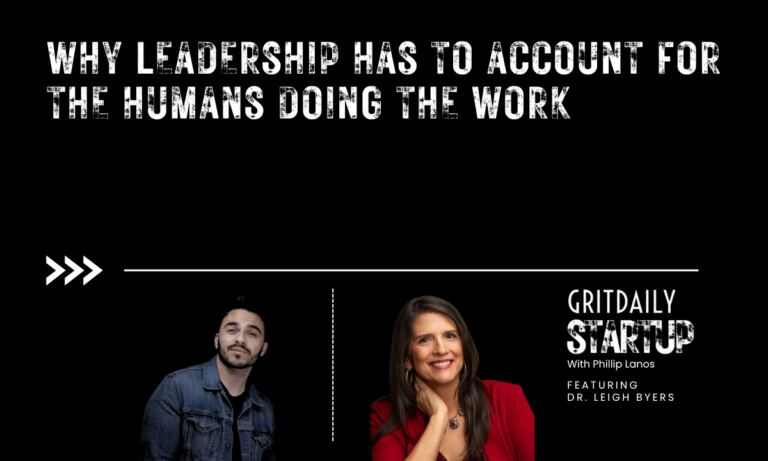
Leadership problems do not always begin with a bad strategy. A founder can identify the right priority, assign capable people, establish deadlines, and still watch an initiative create resistance instead of progress. Dr. Leigh Byers believes the problem often begins with what the plan leaves out: the humans expected to execute it.
Byers, a leadership coach, consultant, author, Certified PQ Coach, and university professor, has worked across business, nonprofits, academia, and organizational leadership. That experience has shaped an inside-out view of leadership in which managing other people starts with understanding how the leader is showing up.
For founders, that distinction becomes particularly important as a company grows. The habits that help one person push an early business forward can become liabilities when progress increasingly depends on other people.
Strategy Still Has to Pass Through People
Founders are routinely encouraged to concentrate on strategy, hiring, execution, and growth. Byers does not dismiss those priorities. She argues that leaders get into trouble when they treat execution primarily as a sequence of tasks.
A new initiative may look logical from the founder’s perspective while appearing very different to an employee who works directly with customers every day. That employee may understand a practical constraint the founder cannot see. When leadership becomes overly attached to its original plan, useful information from elsewhere in the organization can start to look like resistance.
Byers encourages leaders to become more deliberate about listening, including when they disagree with what they hear. Even if only a small part of someone’s feedback proves useful, that piece can reveal something the leader had missed.
This changes collaboration from a courtesy into part of the decision-making process. A leader still has to make decisions, but those decisions can incorporate information distributed throughout the organization rather than relying entirely on the view from the top.
Self-Leadership Changes What a Team Experiences
The same principle applies internally. Founders working under pressure can become so consumed by what needs to happen next that they stop noticing the mental state they bring into conversations.
Byers encountered Positive Intelligence during a period when she was simultaneously navigating relocation, a new job, family loss, and other major changes. She says the practices helped her recognize reactive thought patterns and return her attention to what was happening in the present.
That experience informs how she approaches leadership now. A founder’s stress does not remain neatly contained inside the founder. It can influence communication, judgment, expectations, and eventually the working environment of an entire team.
Being present does not mean eliminating pressure or suppressing reactions. Byers describes it more practically as developing enough awareness to notice a reaction, reconsider it, and respond differently when necessary. Sometimes that even means returning to a conversation and acknowledging that the first response came from a reactive state.
A Framework Creates More Than One Way to Examine Leadership
Byers developed her Seventh Level Leadership framework after doctoral research into succession planning among baby boomer leaders in faith-based nonprofits. Reviewing the themes in her research led her to seven qualities: sustainable, ethical, vision-oriented, empowering, non-discriminatory, targeted, and holistic.
The value of the framework is not that every leader will perform equally well in all seven areas. Byers uses it as a way to identify what may be missing.
A founder might have a compelling vision but struggle to build an organization that can sustain the pace required to pursue it. Another might be highly targeted and execution-oriented while failing to consider perspectives outside a familiar circle. Empowerment can involve giving employees room to contribute, but Byers also applies it to leaders themselves. Someone who is chronically depleted will eventually have difficulty providing useful leadership to others.
Her distinction between having a vision and being “vision-oriented” is particularly relevant to entrepreneurship. A vision has limited organizational value if the people responsible for carrying it forward cannot translate it into action.
Progress Needs Recognition Too
Byers also sees a quieter leadership problem in organizations that are always moving toward the next milestone. Founders can finish one task and immediately concentrate on everything that remains undone.
That habit can spread through a company. Employees complete difficult work only to encounter the next deadline, with little acknowledgment that meaningful progress occurred.
Byers recommends deliberately recognizing smaller accomplishments, both personally and across a team. The purpose is not constant praise. It is to prevent a long-term effort from feeling like an endless collection of unfinished obligations.
That idea fits the broader principle behind her approach. Leadership is not demonstrated by how completely a founder can remain involved in everything. As an organization grows, leadership increasingly depends on creating the conditions in which other people can contribute their judgment, capabilities, and perspective. The founder’s job becomes less about supplying every answer and more about building an organization capable of continuing the work when the founder is not in the room.
Want more Grit Daily Startup Show? Take a look at past articles, head over to YouTube, or listen on Apple Podcasts or Spotify.