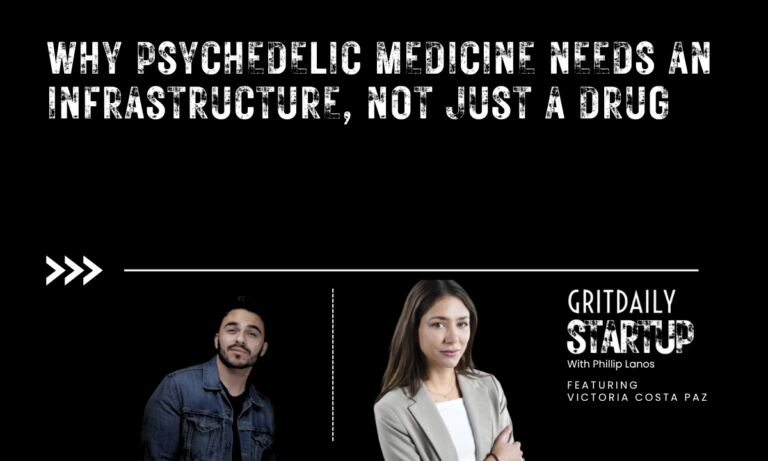
Victoria Costa Paz originally became interested in biotechnology through bioplastics. During the pandemic, that interest led her into the scientific community, where she encountered a research group in Uruguay using synthetic biology to work with psychedelics. The technology caught her attention, but the problem it addressed had a much longer history in her life.
Costa Paz had watched her mother live with depression for years, including repeated changes in medication and the accompanying changes in mood. Only later did she fully connect that experience to the company she was building.
Five years into Eywa Biotech, her ambition has expanded beyond producing psilocybin. Costa Paz believes psychedelic medicine will need an entire infrastructure around it if it is going to become a practical part of mental health care.
A Precise Dose Changes the Problem
Mushrooms present a fundamental challenge for pharmaceutical development. The amount of psilocybin can vary, making it difficult to produce the precise, repeatable doses required for clinical research and regulated treatment.
Eywa is using synthetic biology to approach the problem differently. Costa Paz says the company has developed 99% purified psilocybin using a biosynthesis process in which bacteria produce the compound. The objective is to create consistent pharmaceutical-grade material that can be supplied in precise doses.
That distinction matters because Costa Paz is not trying to replace the existing cultural or spiritual use of mushrooms. She repeatedly returns to the idea of “optionality.” People may choose plant or mushroom experiences for personal reasons, while someone living with severe depression may want a treatment prescribed and supervised by a medical professional.
For that second path to become widely available, however, producing the compound is only one requirement.
Treatment Cannot End With the Dose
Costa Paz sees a structural difference between psychedelic medicine and the conventional model of taking a medication home and continuing treatment independently.
In psychedelic-assisted treatment, preparation and integration can become part of the experience surrounding the dose. Researchers are still studying how much therapeutic value comes from the subjective psychedelic experience itself and how much comes from biological mechanisms such as increased neuroplasticity. For Costa Paz, that uncertainty reinforces the need to think about treatment as a process rather than a pill.
It has also changed Eywa’s business.
The company is developing software that allows people and mental health professionals to follow information such as sleep, movement, stress indicators, medication use, journaling, and other relevant measures. Wearable data can provide another layer of information. A patient who feels that nothing has improved, for example, may be able to see that sleep or activity has changed over the preceding months.
The purpose is to create continuity around treatment, giving patients and professionals more visibility into what happens before and after an intervention.
Building the Infrastructure Around Psychedelic Medicine
Education presents another constraint. Costa Paz points to markets where psychedelic treatment has begun to emerge but where the number of professionals prepared to administer it remains limited. A medicine cannot become broadly useful if there are too few trained clinicians or appropriate treatment settings to deliver it.
Eywa Academy is intended to address part of that gap. Costa Paz interviews scientists working in psychedelics and mental health and translates complex research into more accessible material, including Spanish-language subtitles for audiences in Latin America. Longer term, she envisions education supporting professionals who want to practice psychedelic-assisted therapy.
The pieces begin to form a larger system: biosynthesis for pharmaceutical-grade psilocybin, precise doses, software for tracking patients, professional education, and eventually a network of clinics or independently operated facilities working under Eywa standards.
Costa Paz believes connecting those pieces could also create a useful feedback loop. Information from treatment could help improve protocols, software, education, and future product development rather than leaving each part of the patient experience isolated.
It is a much larger undertaking than the company she initially imagined. That expansion reflects what Costa Paz has learned from trying to commercialize a promising molecule in a complicated area of medicine. Scientific progress alone does not create access. A treatment also needs trained people, reliable production, appropriate clinical environments, patient information, and a workable delivery model.
For Eywa, psilocybin is therefore only one piece of the problem. The larger work is building the system that could allow psychedelic medicine to function as medicine.
Want more Grit Daily Startup Show? Take a look at past articles, head over to YouTube, or listen on Apple Podcasts or Spotify.