
A founder can describe her product in her sleep. Ask her to say, in one clean sentence, why a buyer should choose it over the near-identical option beside it, and the room tends to go quiet. Ashton Bishop has watched that silence for years. His firm has now built a way to score it.
Bishop is the founder and chief executive of Step Change, a Sydney strategy and marketing consultancy whose published client list includes Commonwealth Bank and Sony Pictures. In July, the agency released the Value Gap Audit, a free online tool that reads a company’s website, a couple of competitors, and optional marketing assets, then returns a score for where its pitch is strong, where it is blind, and where it is quietly leaking value. The whole thing takes about two minutes.
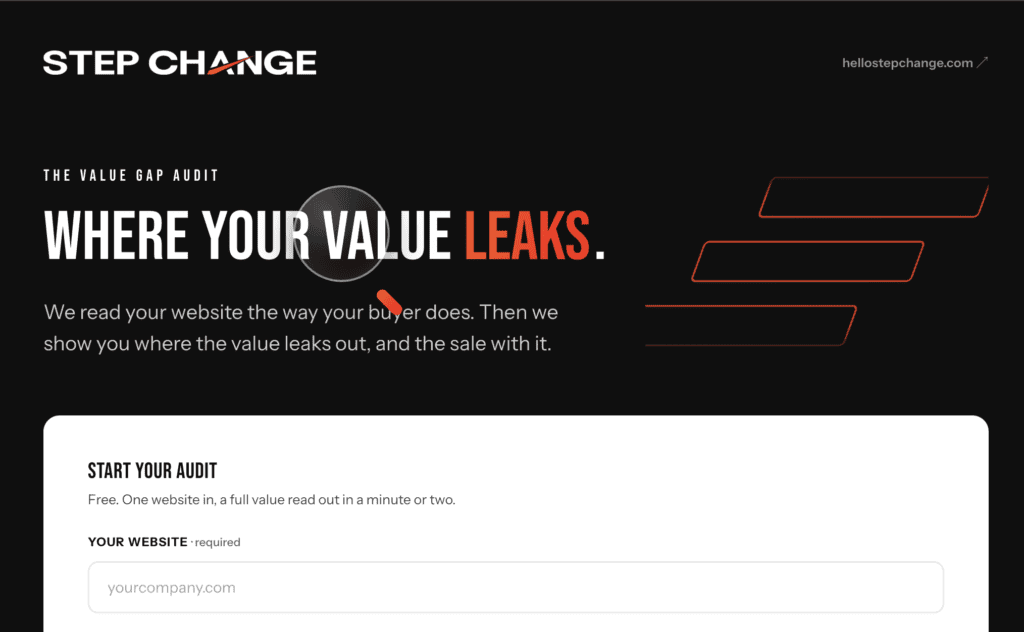
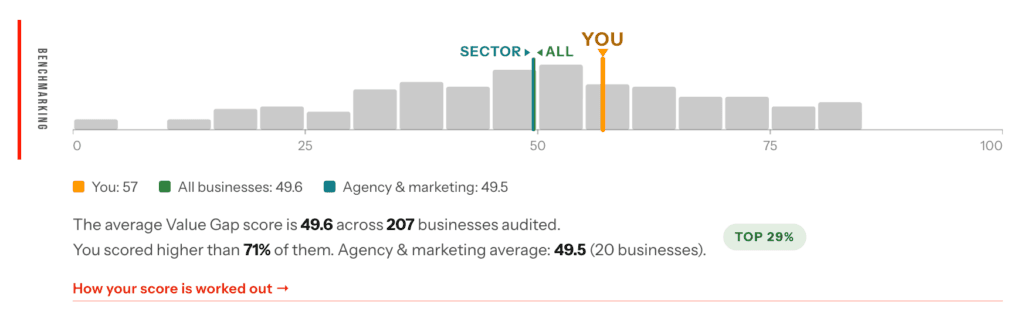
The early results are not kind. Across roughly 290 Australian businesses that have run the audit, Step Change reports its own findings from an early, self-selected sample, and presents them as such. Read them beside the wider research, though, and they stop looking like a marketing hook.
Because the problem the audit measures is not a Step Change invention. It is one of the best-documented failures in modern selling. In a December 2020 survey of more than 1,100 business buyers on digital experience, Gartner found that 64 percent could not tell one brand’s digital experience apart from another’s. When buyers cannot see a difference, they reach for the one variable left to them, which is price. A whole category of competent companies competes itself into a discount because it never made its own worth legible.
The Problem Was Always There. Nobody Had a Number for It.
For decades, “your messaging is off” was the kind of note a consultant delivered by feel, in a workshop, for a fee, over a week. It was a judgment, and judgments about your own business are easy to wave away. Step Change’s bet is that a number is harder to argue with.
“It’s about seeing where your value gaps are,” Bishop said. The audit does not try to be subtle. It reads the inputs with a large language model layered over the firm’s own scoring framework, then hands back a figure and a map of where the pitch holds and where it leaks. The design choice that matters is not the model. It is the price and the speed. A week-long paid diagnostic gets postponed forever. A free two-minute score gets run at a desk, by the owner who would never have booked the workshop.
The specific leak the tool hunts for shows up in the buyer data too. Gartner’s June 2025 sales survey found that 69 percent of B2B buyers report inconsistencies between what a company’s website says and what its salespeople tell them. That gap, between what the site promises and what the person in the room actually says, is where trust drains out of a deal, and most businesses cannot see it from the inside.
A Market of 2.7 Million, Mostly Flying Blind
The scale of who this touches is easy to underestimate. The Australian Bureau of Statistics counted 2,729,648 actively trading businesses in the country as of June 2025. Most of those firms have no brand team and no messaging budget. They have a website someone wrote in a hurry and a founder too close to the product to hear how it lands. That is the exact population a two-minute, no-cost score is built for.
The Catch, Which Step Change Says Out Loud
There is an obvious objection, and Bishop does not dodge it. A free audit built by the strategy and marketing consultancy is a front door, and a low score is a reason to hire the firm that just handed it to you. He is blunt about the tool’s youth as well. “It’s new to the market, so we don’t have any real credibility behind it, other than who’s launched it,” he said. The caveats are real. The sample is small and self-selecting, skewed toward owners curious enough to try something new. A score is only ever as good as the framework behind it, and that framework is proprietary, so the market cannot yet inspect the math. What would turn the audit from one agency’s opinion into a benchmark is scale and a published method, and neither exists yet.
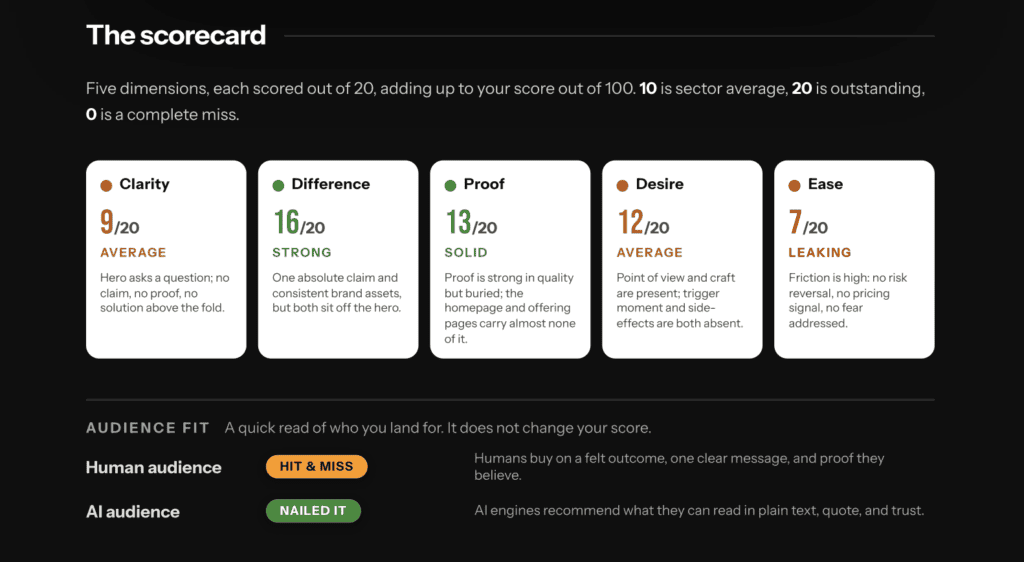
What the early numbers do have going for them is that they point the same way as the independent research. Buyers already report they cannot tell vendors apart, and that the website and the salesperson contradict each other. Step Change’s tool simply scores the cause and puts most companies below half on the one skill that would fix both.
For now, the audit’s most useful output isn’t the score. It is the second or two after a confident founder pastes in her own website, watches the number load, and goes quiet.