
Artificial intelligence has become familiar to most Americans, though regular use remains less common than the attention surrounding the technology might suggest. According to Lorka AI’s State of AI 2026 study, 35% of Americans use AI tools regularly, while 20% use them occasionally and 13% use them infrequently. Another 8% have tried AI and stopped using it, and 24% have never used an AI tool.
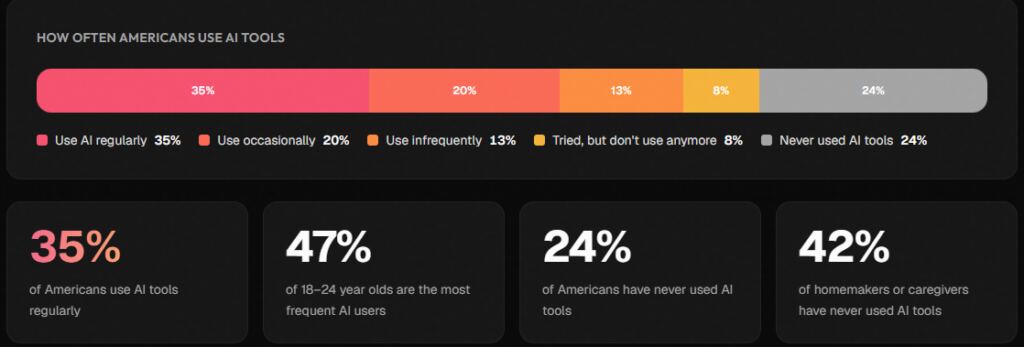
The findings come from an online survey of 1,000 US adults conducted by OnePoll between June 4 and June 9, 2026. They describe a market with substantial reach, although much of that reach still consists of people who use AI selectively rather than as a fixed part of their daily routine. Trying a chatbot requires little time or commitment, while returning to it regularly depends on whether it can solve a recurring problem without creating additional work.
Usage is highest among younger adults, with 47% of respondents between 18 and 24 saying they use AI regularly. The survey also found meaningful use among older adults who have adopted the technology, since 72% of users over 65 turn to AI for research or learning, compared with 59% of users overall.
Research and Learning Are Leading AI Use
Research or learning was the most common use case in the survey, well ahead of writing or editing at 36%. Health or wellness information was selected by 33%, while entertainment or casual conversation and creative projects each reached 31%.
These results give AI a broader role than the automated writing tool it is sometimes assumed to be. People are using it to understand unfamiliar subjects, organize information, and reach a workable starting point before conducting further research. Those activities apply across age groups because they do not require technical expertise or a detailed understanding of how the underlying model works.
That accessibility is especially important because most users still describe themselves as relatively inexperienced. Among respondents who use AI at least infrequently, 44% consider themselves beginners and 39% place themselves at the intermediate level. Advanced users account for 13%, while only 4% describe themselves as power users or early adopters.
AI companies are therefore building products mainly for people who may struggle to evaluate the quality of an answer or understand why two models produce different results. Clear explanations and a manageable interface become more valuable in that setting because users need to judge an answer without having deep knowledge of the system producing it.
Accuracy Matters More Than Additional Features
When respondents were asked what they consider when choosing an AI tool, accuracy or reliability ranked first at 48%. Ease of use followed at 40%, and data privacy was selected by 35%. Price mattered to 26%, while 25% cited trust in the brand and 24% focused on available features.
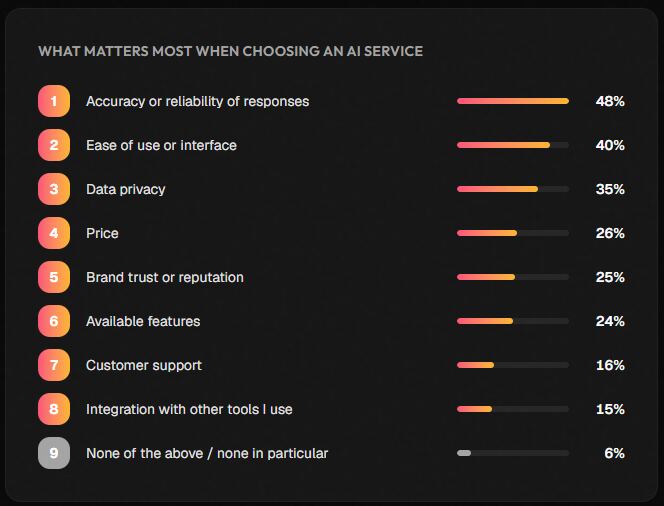
The ranking places pressure on providers that have spent much of their marketing effort promoting new capabilities. Additional features may attract attention, though they have limited value when users cannot depend on the answers they receive. An inaccurate response can require more time to verify than the original task would have taken, which weakens the basic promise that AI will make research or work more efficient.
Reliability becomes more important when people use AI for health information or professional tasks, where a confident mistake can influence a meaningful decision. Users may accept some uncertainty in casual conversation or entertainment, but they are likely to apply a higher standard when the response concerns their work or personal well-being.
The Lorka survey on how Americans choose AI tools also found that regular and occasional users rely on an average of two products. Thirty-two percent use one tool, 42% use two, and 22% use three or more. With several free services available, users can compare responses and move between products according to the task, which gives providers less room to rely on brand recognition alone.
Free Tools Still Support Most AI Use
More than half of the users surveyed, or 56%, rely entirely on free AI tools. Nineteen percent spend between $1 and $19 per month, while 22% spend $20 or more. Lorka reported average monthly spending of $47.88, rising to $82.66 among full-time employees and $124.42 among households earning at least $100,000.
The average spending figure requires some caution because the report does not include a median, and higher-spending users may raise the overall number considerably. The results suggest that spending is concentrated among a smaller portion of the market, while most people continue to use free services or remain within the price range of a single lower-cost subscription.
Paying users are generally satisfied with the value they receive. Sixty-seven percent said they get good value for their money, compared with 15% who believe they pay too much and 14% who think they could receive more from their subscriptions.
The challenge for providers is converting occasional free use into a habit that justifies a recurring payment. A subscription becomes easier to defend when the tool supports frequent work, produces consistently stronger results, or saves enough time each month to make the cost feel minor.
Wider Adoption Depends on Clearer Value
Cost appears to be a relatively small barrier among people who remain outside the market. Among non-users, 21% said they do not know enough to get started, while 20% cited privacy or security concerns. Another 15% said they do not see the value, and only 3% identified expense as the reason they avoid AI.
These responses suggest that broader adoption will depend on clearer guidance about what AI is useful for and how personal information is handled. People who cannot connect the product to a recognizable task are unlikely to be persuaded by another technical improvement, especially when they remain uncertain about what happens to the information they enter.
The outlook among existing users is comparatively stable. Twenty-three percent expect to use AI more during the next year, while 38% expect their usage to remain about the same. Only 7% are considering cutting back, and 1% plan to cancel paid subscriptions.
The full State of AI 2026 report from Lorka shows that AI has established a practical role for a substantial share of Americans, though continued use will depend on performance that people can evaluate and trust. Providers have already made AI easy to try. Their more difficult task is making it reliable enough to become part of an ordinary routine.