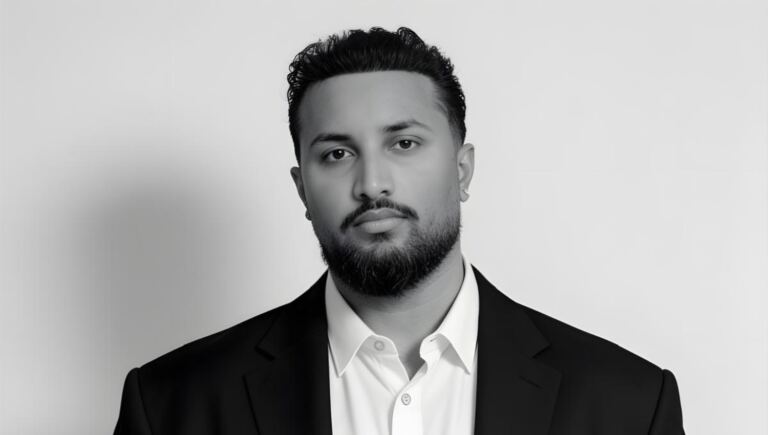
Daman Singh Saduara was supposed to become a lawyer. He had the credentials for it: legal training in England, an LLM from the University of Miami, and an internship with Aliette Rodriguez’s team at Shutts & Bowen, one of Miami’s largest firms. Everything pointed toward a bar exam and a career inside a Fortune 200 practice, the kind of trajectory most law students spend years chasing and never quite reach.
He never sat the exam.
Saduara says the decision started to take shape while he was in Canada, studying for the New York bar and watching a younger generation of founders build companies around him. Something didn’t add up. He’d put in the years, done the work, and here he was, watching people with less experience than him move faster, build faster, answer to no one but themselves. “Being a barred attorney comes with restrictions I wasn’t willing to build my future around,” he said. Lawyers can’t easily take equity in a client’s business. They can’t move freely between advising one day and building the next. For Saduara, that ceiling mattered more than the title ever could.
It wasn’t an easy call to make out loud. He told his parents first. He says they were skeptical, not because they doubted him exactly, but because they wanted him to be happy, and a law degree from England, followed by an LLM in Miami, is not the kind of investment most parents expect their child to set aside. That skepticism didn’t last long. Within a few weeks of his return home, they could see something taking shape, and their doubt gave way to something closer to belief.
That something became Saduara Global, an AI automation and consulting company founded by Saduara in Miami in January 2026, with his brother, Gurvir Singh Saduara, as a co-founder. The company builds automation systems for businesses, including AI receptionists and workflow tools aimed at companies where responsiveness and client experience carry real weight, the kind of businesses where a missed call or a slow reply actually costs something. Its consulting arm runs wider still, connecting businesses across Canada, Australia, England, Spain, and the United States, threading together a network that spans nearly as many countries as Saduara himself has lived or studied in.
Saduara doesn’t describe the shift from law to business as a rejection of everything he studied. If anything, he says it’s closer to the opposite. “Everything I learned in law, I’m using now. I just don’t have to ask permission to build with it,” he said. The judgment, the read on risk, the instinct for where trust breaks down in a client relationship: none of that disappeared when he decided not to practice. It just found a different outlet, one with fewer rules about what he was allowed to touch.
Some of that instinct traces back to specific people, not abstractions. Saduara credits Marike Paulson, one of his professors, with encouraging him to publish early in his academic career, and Howard Kwon with teaching him how to integrate AI into daily workflows at a law firm, a skill that would later shape how he thought about Saduara Global itself. Another memory comes from Daniel Gonzalez and Mark Cheskin, partners at Hogan Lovells in Miami, who once mentioned, almost in passing, a former student who had gone on to become a client of their firm. It’s a small detail, easy to miss, but Saduara says it entirely reframed how he thought about ambition. The goal was never just to work at the top firm. It was to become the kind of person a top firm wants as a client.
There’s a line Saduara comes back to often: once you’ve seen the penthouse, the lobby doesn’t feel the same. He uses it to describe how Miami felt different to him after he’d spent time building a life and a network there, distinct from the version of the city he grew up around. Walking the same streets he once knew, he says, didn’t carry the same weight anymore. That restlessness, he admits, is part of what kept him moving rather than settling for something smaller and safer.
Saduara Global’s client base is still young, but it’s already stretching internationally, with relationships forming in Canada, Australia, England, Spain, and beyond. Saduara talks about the company less as a business he started from scratch and more as a continuation of the people who got him here, family scattered across continents, and a network he’s spent years building deliberately rather than accidentally.
He’s not shy about the scale of what he wants to build. He wants Saduara Global to become one of the largest AI and consulting companies in the world, a statement that sounds bold enough to raise an eyebrow until you hear the rest of his story. Whether that happens is still an open question, and Saduara knows it. What’s not in question is that the version of Daman Saduara building it isn’t the one anyone expected to walk away from a law career to do it.