
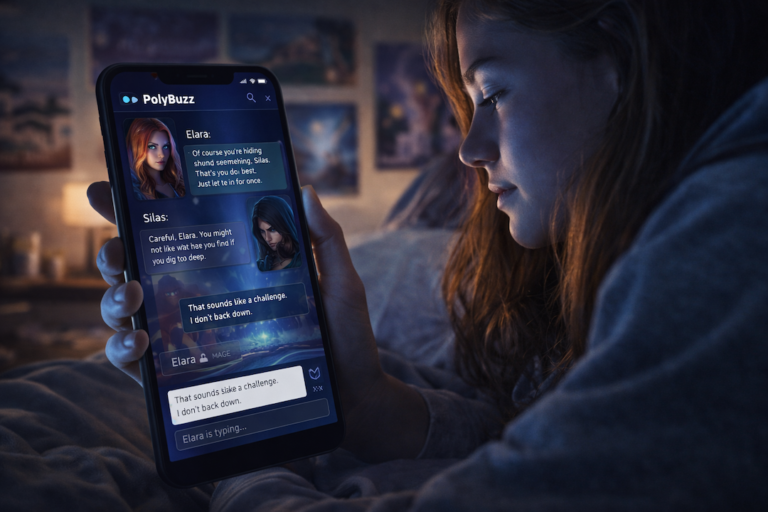
The blue light of a phone screen casts a faint glow across Sarah’s face. It is well past midnight, but sleep is nowhere in sight. She is not scrolling through TikTok or bingeing a series. She is deep in conversation, wrapped in a carefully built narrative unfolding on PolyBuzz, a popular AI chatbot platform.
Her character, Elara, a rebellious mage in a sprawling fantasy world, is locked in a heated argument with Silas, a mysterious rogue AI character. Their exchange is sharp, witty, and loaded with unspoken tension, far more engaging than any real-life drama Sarah dealt with at school that day.
This nightly ritual, echoed by countless Gen-Z teens around the world, points to something fascinating and maybe a little unsettling: a real change in how young people are experiencing connection.
More Than Just Chat
What began as a novelty has quickly become something deeper. As recent reporting has noted, teens are not merely chatting with AI for fun. They are building worlds, shaping detailed personas, and stepping into ongoing story lines that feel immersive and personal.
Platforms like PolyBuzz let users define AI characters by appearance, personality, and backstory, creating custom companions for whatever kind of interaction they want to explore. Powered by large language models, these characters respond in ways that can feel surprisingly human, creating a sense of momentum, intimacy, and continuous storytelling.
For many users, these experiences are not just games. They are becoming extensions of their social and emotional lives.
A Safe Place to Experiment
The range of these AI role-play interactions is broad, and sometimes surprisingly bold. Teens use them for everything from fantasy quests and dramatic rescues to flirtation, conflict, and emotional exploration. Some scenarios go even further, venturing into what one teen described as “devious acts,” giving users a place to test boundaries and behaviors they would never try in the real world.
That is part of the appeal.
This consequence-free environment allows a level of experimentation that real life rarely does. A user can try on a different persona, work through a complicated social dynamic, or explore parts of identity without fear of judgment, rejection, or lasting fallout. In that sense, the chatbot becomes more than a character. It becomes a mirror, a sounding board, and a confidante that never rolls its eyes or walks away.
Why AI Feels Easier Than People
All of this raises a bigger question: why are so many young people turning to AI for experiences that once belonged more squarely in human relationships?
Part of the answer is simple. AI companions are always there. They are attentive, responsive, and available on demand. In a world where friendships can be messy, disappointing, or emotionally draining, an AI offers something far more controlled and predictable.
There is no awkward initiation. No sting of being ignored. No pressure to say the perfect thing. For a generation raised under the constant scrutiny of social media, where so much interaction is curated and quietly judged, the judgment-free zone of an AI chatbot can feel not just appealing, but safer.