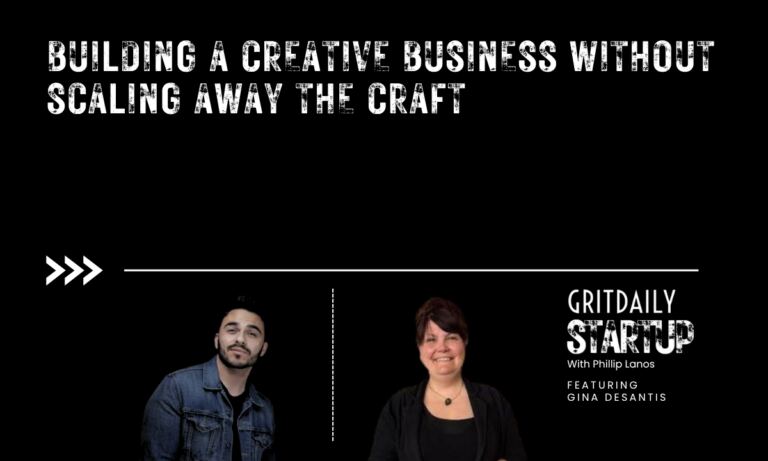
For many business owners, growth means producing more. For Gina DeSantis, owner of Gina DeSantis Ceramics, that definition eventually runs into a physical limit.
She can throw only so many cups in a day. Each one still needs to be trimmed, handled, dried, fired, glazed, fired again, sanded, photographed, sold, packed, and shipped. Staff can help with parts of that process, but the work begins with DeSantis and remains tied to the pace of handmade production.
That constraint has shaped how she thinks about growth. Rather than trying to turn her studio into a small factory, DeSantis has learned to build a business around the fact that craftsmanship does not scale the same way software or mass manufacturing does.
Growth Can Create the Wrong Business
DeSantis began working in ceramics before Etsy, social media, and the current maker economy had fully developed. When she was completing her master’s degree in the mid-2000s, the conventional career path for an artist was still relatively narrow: teach during the day and make personal work afterward.
The rise of online marketplaces and independent craft shows changed the possibilities. DeSantis sold through Etsy, worked with local businesses, taught, and eventually opened a classroom space. In 2013, she moved into self-employment full time.
That same year, a wholesale show led to a relationship with Uncommon Goods. A personalized tree-trunk mug became a significant product, and DeSantis suddenly faced the challenge many makers say they want until it actually arrives: demand that exceeded what one person could reasonably produce by hand.
She adapted through mold-making, outside production partners, and eventually overseas manufacturing for certain components. But the experience also clarified something important. She did not want to spend her career operating a factory.
“I want to be mostly creative,” she says.
That preference sounds simple, but it affects nearly every business decision she makes.
Saying No Protects the Product
DeSantis sees the ability to say no as one of the most important business skills she has developed.
Large orders can be exciting, particularly when several arrive at once. Recently, she found herself balancing a 300-piece corporate gift order, an international client, and a restaurant collaboration. Taking those projects meant reducing availability for some smaller wholesale accounts.
The alternative would have been to accept everything and risk damaging the work itself.
Ceramics makes the consequences of overextension visible. Pieces need enough time to dry. Kilns have finite capacity. Certain forms cannot be stacked efficiently. Rushing production can lead to warping, inconsistent finishes, or other quality problems.
That makes capacity more than a scheduling issue. It is part of the product.
DeSantis now evaluates opportunities partly by whether the timeline allows her team to make the work properly. A client may want 300 pieces in six weeks, but if producing them well is unrealistic, she would rather lose the order than promise something the studio cannot deliver.
Creative Businesses Need Their Own Economics
The same thinking applies to pricing.
DeSantis does not reduce her work to a simple hourly rate because an hour at the pottery wheel represents only one stage of production. A mug thrown today may move through several days of labor before it is ready to sell.
Instead, she looks at how much work she can realistically produce, the retail value of those pieces, the market for comparable ceramics, and the years of skill embedded in the finished object.
That final piece is often overlooked in creative businesses. DeSantis started working with clay at 19 and is now in her mid-40s. A customer is not paying only for the minutes required to form one mug. They are paying for decades of judgment that make those minutes productive.
Her next business shift reflects that understanding. Wholesale has helped build the company, but it also requires more production for lower margins. DeSantis is increasingly interested in direct retail, where she may be able to produce less while earning more from each piece.
That does not mean abandoning wholesale or large collaborations. It means becoming more deliberate about which channels deserve the studio’s limited capacity.
For DeSantis, sustainable growth is not about forcing handmade work into an industrial model. It is about designing the business around what makes the work valuable in the first place. The studio can become more efficient, staff can take on more responsibility, and outside manufacturers can support selected products. But the goal is not infinite output.
The goal is to create enough structure around the artist that the artist still has time to make the work.
Want more Grit Daily Startup Show? Take a look at past articles, head over to YouTube, or listen on Apple Podcasts or Spotify.