
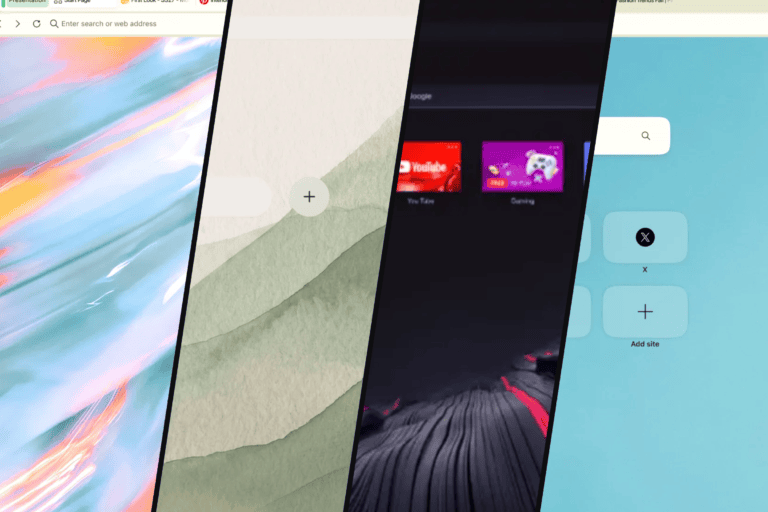
The browser may be the most important piece of software most people never choose. It holds their passwords and payment cards, it decides what they see when they search, and it is where much of their workday now happens. Yet for most people it simply arrived with the phone or laptop. Chrome, Safari, and Edge together accounted for just over 90% of browsing worldwide in September 2026, according to StatCounter. Each of the three ships as the default on a major platform.
Opera has spent three decades building browsers for people who want to make that decision for themselves. Founded in Oslo in 1995 and listed on Nasdaq since 2018, Opera (NASDAQ: OPRA) says around 300 million people use its browsers, and every one of them chose to download it.
It’s an interesting time to be a maker of alternative browsers. Courts and regulators are questioning how browsers become defaults, AI is starting to take actions inside the browser, and a growing number of people who are accustomed to digital everything now just want the internet to serve a purpose and then get out of the way. The latter was the inspiration behind Opera’s reimagined Opera Air, which reduces unnecessary stimuli by hiding anything that isn’t essential.
Together, those developments are putting a long-ignored question back in front of people: Which browser should they actually be using?
Most People Inherited Their Browser Rather Than Chose It
Before buying a phone, laptop, headphones, or even a password manager, people research and compare. They rarely do the same when adopting a browser. That’s because browsers come preinstalled and set as the default, and most people never question what’s there.
This is in part due to the fact that many people still don’t realize there’s a choice to make. Opera recently surveyed 925 U.S. computer users and found that one in six people whose main browser is Chrome, Edge, or Safari didn’t know they could change it. Another 20% knew they could but had always used the same browser. Together, that’s more than a third of mainstream browser users who have never made a choice at all.
That makes distribution, not head-to-head comparison, the biggest driver of browser market share. The economics behind defaults have been central to the U.S. government’s search case against Google. In September 2025, a federal judge barred Google from signing exclusive distribution deals for Search, Chrome, Google Assistant, and the Gemini app for six years, while still allowing it to pay partners such as Apple and Mozilla for placement. Google has appealed to the D.C. Circuit, and in July 2026 the Justice Department and a coalition of states asked that court to go further and end those payments.
Europe offers a glimpse of what happens when the default browser is removed and users are presented with a choice. When the Digital Markets Act required smartphone makers to show EU users a browser choice screen in March 2024, alternative browsers saw an immediate lift. Opera reported a 164% jump in new iOS users in the EU over the first days of the ballot screen, and a fivefold increase in France. The message was clear: When given a fuller range of options, people increasingly opted for alternative browsers.
What a Browser Actually Does Now
People have rarely chosen their browser, partly because it comes preinstalled and partly because its job has been underplayed as simply a way to display web pages. Today it does far more than that.
The browser holds credentials. The browser stores passwords, saved cards, addresses, and the sessions that keep people logged in to email, banking, and work tools. That makes how a browser handles identity a central part of the decision. Does it store this information on the device or send it to a server? Is it encrypted, or kept in plain text? Opera doesn’t require an account to use its browsers, and its sync accounts don’t include sensitive details such as a real name or an address. Devices are assigned an anonymous ID instead.
The browser protects data. For many people, the browser is the center of their digital lives. Email, streaming, shopping, and work apps all run through it, so a great deal of data passes through it too. Yet many users don’t have a clear picture of what happens to that data. Is it collected by the browser, by the websites they visit, by both or neither? In Opera’s survey, 46% of respondents said they believe their browser tracks the websites they visit, and only 8% think it collects no data at all.
In fact, a browser doesn’t need to collect much. Opera, for example, says it doesn’t track or collect the sites people visit, their browsing history, their passwords, or their exact location. It may collect limited data to show ads, which is part of how it makes money, but only with a user’s consent. Pawel Kurzelewski, Opera’s Head of Security, told Grit Daily that privacy shapes the decisions Opera makes about data. “The best way to safeguard user privacy is to limit what data you need to collect in the first place,” he said. That makes it worth checking what a browser collects and why, and its privacy policy is a good place to start.
The browser decides what people see first. Browsers set the default search engine, fill in autocomplete suggestions, and determine what gets blocked before a page loads. These amount to dozens of small editorial calls a day, and they can change without users noticing. In July 2025, Chrome began disabling the full version of uBlock Origin, one of the most popular ad blockers, as part of a shift in how its extensions work. Other browsers hand more of those decisions back to the user. Opera’s browsers, for instance, include a built-in ad blocker that can be customized according to the user’s needs, including using uBlock filter lists, so people can decide what gets blocked rather than leaving it to the browser’s defaults.
The browser is the front door to work, and attacks. For many people, email, documents, customer databases, and project trackers aren’t separate programs anymore – they’re browser tabs. That turns the browser into a target. Attacks such as ClickFix, which trick people into pasting malicious commands, now run through it. That puts the browser on the front line of defending against them. Opera’s Paste Protect feature detects these types of attempts locally on the device, and the company says it also doesn’t read or store the clipboard content these attacks are targeting.
The browser manages the machine. On many laptops, the browser is among the heaviest users of memory and battery, which makes resource handling a product decision rather than a technicality. Browser companies can make specific judgment calls about these resources based on what their users are doing on their browsers. Whereas a one-size-fits-all browser might optimize for a generic user profile, a browser like Opera GX, which is built for gamers, lets people set their own limits on how much CPU, RAM, and network bandwidth the browser can use so it doesn’t compete with whatever else is running.
The browser is a privacy layer. More browsers now build in privacy tools rather than leaving them to add-ons. Tracker blocking, secure DNS, and VPNs used to be things people installed separately. Now many browsers ship with at least some of them, though what’s included, and what it costs, varies widely from one browser to the next. Opera has offered a free, built-in VPN since 2016. It protects traffic inside the browser, and its no-log policy has been independently audited by Deloitte.
Where a browser company is based also shapes how it handles data. Opera’s user data is controlled by Opera Norway, a company registered in Oslo and subject to Norwegian and European law. That places its handling of personal data under the GDPR, one of the strictest privacy frameworks in the world – a consideration that carries more weight as browsers hold more of people’s digital lives.
Increasingly, the browser acts. The newest job is the one that raises the stakes most. AI agents are starting to fill in forms, compare options, and complete tasks inside people’s logged-in sessions. More on that below.
Why Do People Switch Away From Chrome, Edge, or Safari?
When people do leave the default browser, they tend to have a specific reason. Some want stronger privacy settings. Some want a browser that uses fewer resources. Others want features built for how they work or play, a calmer interface or AI tools that run on their own terms.
In Opera’s survey, respondents said the most common reasons they would switch were if a browser had become too slow (27%), they discovered one with better privacy features (26%), they suspected security vulnerabilities (24%), or they found a browser with more useful features (23%). Across all users, 71% said they use more than one browser on their computer.
The alternative browsers they move to vary widely. Firefox, from Mozilla, remains a familiar, long-standing option for everyday and work browsing. Vivaldi builds email, a calendar, and a feed reader directly into the browser for people who want to keep everything in one window. Brave has built its reputation on blocking ads and trackers by default, though its own defaults have drawn scrutiny. In 2023, it was found installing VPN services on Windows PCs, including for people who had never signed up for its VPN.
Chrome, Edge, and Safari, meanwhile, keep most of their users through distribution. They are good, widely compatible browsers, and they are also the ones already there by default.
Opera’s argument is less about any single browser being the best and more about fit. The right browser depends on who someone is and what they do online, and the company has organized its business around that idea.
Different Browsers for Different People
Consumer brands figured out long ago that one product rarely serves everyone. A shampoo company sells different formulas for different hair, and a carmaker sells a sedan, a pickup, and an SUV. Software has mostly gone the other way, with each major tech company offering one browser and expecting it to suit billions of people. But the appetite is there: In Opera’s survey, 53% said they’d be interested in a browser designed around their interests or hobbies, and only 8% said they just want a browser that works.
Few browser makers ship more than one browser, yet Opera has built its business around doing exactly that. Its roughly 300 million users are spread across four desktop and four mobile browsers, each designed with a particular audience in mind.
The flagship Opera One browser is a feature-rich everyday browser with a built-in VPN, ad blocker, AI assistant, and messaging apps such as WhatsApp and Telegram in the sidebar.
Opera GX, launched in 2019 as the first browser built for gamers, includes the resource limits described earlier, Twitch and Discord integrations, and more than 12,000 mods. It has 37 million monthly users, up 10% year over year as of Opera’s Q2 results.
Opera Air, which the company reimagined this October, takes the opposite approach to most software. Guided by minimalism, it is designed for people who want the internet to serve a purpose and then get out of the way. Notifications are out of sight by default, and it includes built-in Soundscapes and Breaks.
This multi-browser approach appears to be working. Opera reported record revenue in the second quarter of 2026, up 25% year over year.
Krystian Kolondra, EVP of Browsers and AI at Opera, told Grit Daily that people’s mindset toward their browsers is shifting. “Niche is not a consolation prize,” he said. “People become far more loyal to products that were clearly built for them than to those built for everyone, and the browser is personal enough that the difference shows up quickly.”
What Separates One Browser From Another?
To understand how browsers differ, it helps to know how they’re built. A browser is roughly a dozen systems working together, including a rendering engine that draws the page, a JavaScript engine that runs the code, a networking stack, a security sandbox, an extensions system, sync services, and an update pipeline that ships changes to millions of machines without breaking the web.
Only three organizations build the rendering engines nearly all browsing runs on. Google maintains Blink, the engine inside the open-source Chromium project. Apple builds WebKit, which powers Safari, and Mozilla builds Gecko, which underpins Firefox. Most browsers today, including Chrome, Edge, Brave, Vivaldi, and Opera, run on Chromium.
Opera built its own engine, Presto, for a decade before moving to Chromium’s engine in 2013, a path much of the industry has followed since. Building on a shared engine has become the norm because it keeps websites working the same way everywhere.
The real differences live in the layer above the engine, where a couple of dozen companies make very different choices. Opera GX’s limits on CPU, RAM, and network use are one example of a subsystem built for a specific audience – in this case gamers who don’t want a browser slowing down a game. Opera’s built-in sidebar messengers reflect a bet that people want their chats beside their tabs rather than in a separate app. Opera Air’s decision to turn notifications off by default is another.
Choosing a Browser Matters Even More When Browsers Are Acting for People
AI is about to raise the stakes of browser choice again. A browser that displays pages is one thing. An AI agent that works inside someone’s logged-in email, bank, and shopping accounts is a very different proposition. Choosing a browser has always mattered. With agents, it becomes even more consequential.
The industry is splitting into two broad approaches. One sends requests to AI models running in the cloud, where the agent’s work happens on someone else’s servers. The other runs AI on the user’s own computer, so the information it handles can stay on the device. Opera does both, but is making a bigger best than most on the second.
In October, Opera began shipping local AI models directly in its browsers through WebAI, an early preview that lets websites and extensions use AI running on the user’s own machine. Opera’s version is built around free models that people choose themselves, including open-weight models and, on Macs, Apple’s on-device model, so no one is tied to a single AI provider, and it requires no account, subscription, or fee. It is also opt-in. Nothing downloads until a user turns it on, and Opera says it is developing site-by-site permissions so people can decide which websites get access.
WebAI itself is a proposed web standard backed by companies including Google and Microsoft, a sign that local AI is headed for browsers broadly. Opera’s twist is letting people pick the model.
The move builds on several years of AI work inside the browser. Opera introduced its AI assistant, originally called Aria, in 2023, describing it as the first native AI assistant in a major browser. In 2024, it became the first major browser to offer built-in access to local AI models, in an experimental developer build. It followed in 2025 with Browser Operator, an agentic browsing feature, and Opera Neon, an agentic AI browser that opened to the public in December. In April 2026, it introduced Browser Connector, an early-access feature in Opera One and Opera GX that lets AI tools such as ChatGPT and Claude, once a user connects them, read open tabs and page content and use them as context.
For anyone weighing an AI-capable browser, a few questions are worth asking. What can the agent see? Where does it run – on the device or in the cloud? What does it keep afterward? And which actions require a person’s approval before the agent goes ahead?
People may already be handing over more responsibility than they realize. More than a quarter (27%) of respondents in Opera’s survey who use AI chatbots said they give them full access to their browser, and another 12% weren’t sure how to check. That trust has limits. Just over half (55%) said they’d trust an AI browser with at least some tasks, but among them, only 11% would let it move money between their accounts.
Where Browser Choice Goes From Here
The question of browser choice is unlikely to go away. The European Commission continues to review how the Digital Markets Act’s choice screens are working. The D.C. Circuit is weighing whether Google can keep paying for default placement. And AI agents are giving people a new reason to care what is running underneath their tabs.
None of that means everyone should switch. Plenty of people will be well served by the browser that came with their device. But with the industry at a crossroads and the browser playing an ever more active role in people’s lives online, the decision carries more weight than it used to.
As AI companies launch browsers of their own and incumbents fold assistants into theirs, much of the market is racing toward a single browser that can do everything for everyone. Opera is making the opposite bet. It’s wagering that as browsers take on more of people’s lives, people will care more, not less, about whether a browser was built for them. Considering that for three decades Opera has been organized around the idea that people from all walks of life should be able to find a browser built for them, the company is ready for them when they make the leap.
While Opera’s position has been a contrarian one for most of its existence, its bet on giving people alternatives is now likely to pay off as everyday users become increasingly aware they have a choice when it comes to their browser.