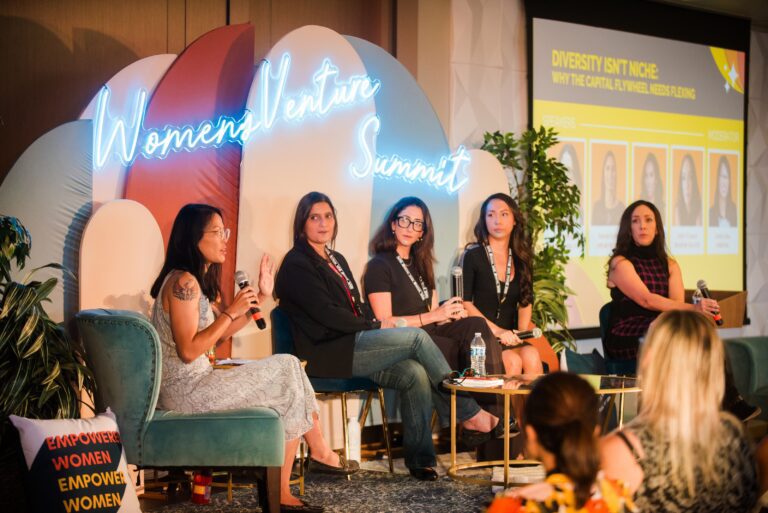
With women poised to control trillions in wealth but still receiving a fraction of venture funding, the 2026 Summit is testing new ways to connect female founders with investors and financing.
Women are starting businesses, developing technologies, and preparing to control an unprecedented share of America’s wealth. Yet startups founded exclusively by women continue to receive less than 2% of U.S. venture capital funding.
The disconnect raises an increasingly important question: If women are building companies and gaining financial power, why does so little venture capital reach them?
At the 2026 Women’s Venture Summit, taking place November 2–5 in San Diego, organizers will address that gap through a combination of equity crowdfunding, investor education, and new financing opportunities designed to extend beyond the conference itself.
Now in its 13th year, the Summit has helped facilitate more than $200 million in funding for women-led companies. This year’s gathering, themed Rise & Fund: Women Continuing the Charge, places particular emphasis on converting investor relationships into actual investments.
The approach reflects a challenge facing the broader startup ecosystem: Creating opportunities for founders to pitch is relatively straightforward. Building the financial infrastructure and investor relationships that allow those companies to secure capital is considerably more difficult.
From Pitch Competition to Investment Syndicate
One of the Summit’s most significant changes involves its national Women’s Fast Pitch competition. From 282 applicants, seven finalists have been selected to present businesses spanning healthcare, renewable energy, food innovation, and other industries.
Among them is Rachell Dumas, founder of HEARD, an AI-enabled healthcare navigation and patient advocacy platform designed to help people document medical experiences and navigate complex healthcare systems.
Meghan Wood, co-founder of Raya Power, is developing modular solar and battery systems intended to make renewable energy more accessible to renters and households underserved by traditional residential solar providers.
Meanwhile, Jane Lim, founder of Thallus Foods, is developing high-protein mushrooms with a meat-like texture as an alternative to conventional animal proteins.
The range of businesses illustrates the diversity of industries in which women are innovating, as well as the limitations of treating female-founded companies as a single investment category.
This year, the competition is designed to continue after the pitches conclude. Through Wefunder, finalists will have opportunities to pursue equity crowdfunding campaigns, supported by a new WVS investment syndicate.
Organizers are targeting at least $10,000 in potential investment for each of the seven finalists, representing more than $70,000 in prospective funding. The capital is not guaranteed, but the structure is intended to give founders an ongoing fundraising pathway and encourage investors to participate beyond the event.
The eventual Women’s Fast Pitch champion will also receive a growth package valued at more than $55,000, including at least $10,000 in investment commitments from angel investors Lex Lewis and Dr. Silvia Mah, legal services from Cooley, marketing and advisory support, and a company spotlight through Marble Collective.
“Women founders do not need another room full of applause. They need true advocates and investors ready to take action,” Silvia Mah, PhD, founder of Women’s Venture Summit, said in announcing this year’s event.
Different Businesses Need Different Capital
The Summit is also expanding its approach beyond traditional equity investment.
Through a Kiva crowdfunding initiative, two San Diego entrepreneurs, Regina King, founder of Soul Scent, and Maria-Nicole Marino, founder of Panic Panties, will have opportunities to pursue crowdfunded loans.
Meanwhile, Women in Cloud, founded by Chaitra Vedullapalli, will host Frontier Tech Meets Capital, featuring entrepreneurs developing technologies across artificial intelligence, robotics, energy, healthcare, and blockchain.
Rather than focusing exclusively on polished pitch presentations, the program is designed to give investors a closer look at companies’ competitive advantages, commercial readiness, risk management, and growth strategies.
The different initiatives address a fundamental reality of entrepreneurship: A technology startup pursuing rapid expansion may require a very different financing strategy from a consumer business or local enterprise.
Broadening access to capital requires more than persuading traditional venture firms to invest in additional women-led companies. It also means expanding the financing options available to founders whose businesses may not fit conventional venture capital expectations.
Women Are Inheriting Wealth. Will They Inherit Access?
The question of who gets to invest is becoming as consequential as who receives funding.
Women are projected to control $34 trillion in U.S. investable assets by 2030. At the same time, companies are remaining private longer, potentially concentrating early-stage investment opportunities among a relatively narrow group of investors.
That tension will frame the Summit’s opening fireside conversation, Women Are Inheriting Wealth. Will They Inherit Access?, featuring Marcia Dawood, angel investor and author of Unapologetic Wealth, and Amy Reischauer of the U.S. Securities and Exchange Commission.
“Women are poised to control more wealth than ever before, but that doesn’t necessarily mean they’ll have access to the best investment opportunities,” says Dawood. “If we want to change who gets funded, we need to change who gets to invest. That starts with education, access, and confidence.”
The discussion will examine the widening divide between public and private markets, the balance between investor protection and accessibility, and what these changes mean for women as investors, entrepreneurs, and capital allocators.
The Summit’s Angel Academy, offering introductory and more advanced investing education, addresses another part of the equation: helping prospective investors better understand the opportunities and risks associated with early-stage companies.
Beyond Funding: The Challenge of Growth
Access to capital alone does not guarantee business success. Founders must also build the operational capabilities, leadership teams, and financial discipline required to translate investment into sustainable growth.
That challenge will be explored in The $1M to $10M Playbook: Numbers & Breakthroughs, moderated by Terri Eagle, a five-time CEO, founder of Terri Eagle Group, and author of The Champagne CEO. The discussion will examine the decisions behind significant revenue growth, including hiring, customer acquisition, operational systems, and strategies founders ultimately abandoned.
For companies moving beyond their startup phase, the capabilities required to reach the first million dollars in revenue can differ substantially from those needed to reach $10 million.
The broader importance of relationships and influence will also feature in an Election Day conversation between Kristin Thomas, founder of Marble Collective, and two-time Emmy Award-winning journalist Linda Lorelle, co-founder of Civil Dialogues.
Their discussion, Power Through Voice and Visibility, will explore the intersection of women’s leadership, civic participation, and collective influence, including how networks and public visibility can help women shape decisions affecting their communities and economic futures.
The Real Test Comes After the Summit
The most meaningful outcomes of this year’s Women’s Venture Summit may not be visible until well after the event concludes. Will the investment syndicate translate into meaningful funding for the seven finalists? Will first-time investors become active participants in private markets? Will new relationships help founders secure customers, partnerships, and additional capital?
Those questions matter because the gap between entrepreneurial activity and investment remains substantial.
The Summit’s approach offers a potentially useful model: connect founders with different sources of capital, educate investors, and create mechanisms that encourage relationships to develop into financial commitments.
Whether those mechanisms deliver meaningful results remains to be seen. But as women gain greater control over wealth and continue building companies across industries, the opportunity to influence where capital flows is expanding.
For an entrepreneurial ecosystem that has spent years discussing the need to fund more women, the next measure of progress may be less about the commitments made onstage and more about the investments that follow.