A vineyard canopy does not care how sophisticated an autonomous algorithm is if the chassis carrying it gets high-centered on an irrigation rut. Before robotics engineer Venkateshh Miryalkar could deploy neural networks or zero-copy data pipelines into the field, he had to solve a much harsher physical problem: building a machine that could actually survive the mud, ruts, and steep inclines of real agricultural ground.
Over eighteen months of solo development, Miryalkar took Maas Robot 1 from a blank-canvas concept to a fully operational, heavy-payload Four-Wheel Drive (4WD) rover. With no external mechanical team or outsourced electrical fabrication, he handled the end-to-end build alone. “Building Maas Robot 1 required bridging the gap between theoretical autonomy and rugged physical application,” Miryalkar explains. The result is a platform engineered from the ground up for terrain that stalls conventional farm machinery.
A Chassis Built for Ground, Other Machines Cannot Handle
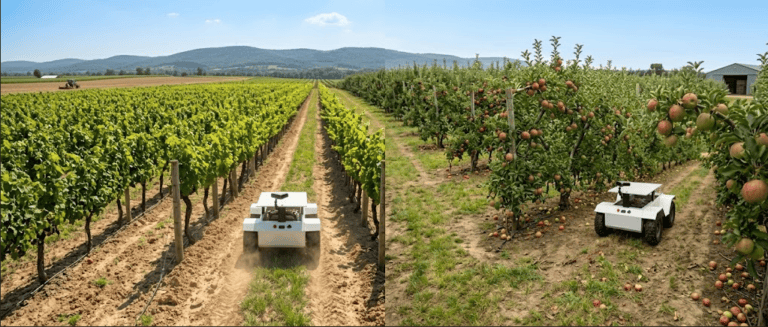
The foundation of the build started with an open-source mobile chassis, which Miryalkar heavily modified and raised to dramatically increase ground clearance. Standard utility carts and indoor warehouse robots ride low to the ground, but vineyard aisles and apple orchards feature severe ruts, exposed tree roots, and uneven cover crops that would bottom out a factory frame.
On top of the reinforced chassis, Miryalkar engineered custom structural mounts to house an integrated 360-degree sensor suite. Rather than relying on a narrow, front-facing camera bracket that leaves blind spots on the flanks, this ring array gives the robot complete spherical visibility.
The machine operates at speeds under three miles per hour—a deliberate design choice. In tight, high-density crop rows shared with farmhands and fragile trellises, raw speed is a hazard. Traction, precision, and low-speed stability were the non-negotiable priorities.
The Motors and Battery Behind the Torque
Behind that controlled pace sits an immense amount of electromechanical muscle. Maas Robot 1 is powered by four 2,000-watt electric hub motors drawing from a 25-volt, 20-amp-hour battery array. That powertrain configuration produces the continuous torque required to tow up to 600 kilograms and scale 15-degree inclines under full payload—critical capabilities for hillside vineyards where utility rovers must haul heavy spray tanks or harvest crates uphill.
Miryalkar anchored the entire physical design around this torque demand first, working backward to determine wheel placement, weight distribution, and chassis geometry. In steep hillside terrain, a high center of gravity risks a rollover. By placing heavy battery cells low within the frame and balancing motor load across all four independent wheels, he ensured the rover maintained constant traction without tipping.
In a solo build, this sequence was vital. Without a large team to parallel-track mechanical revisions, every hardware decision locked in constraints for the next step, turning the 18-month build into a masterclass in disciplined systems engineering.
A Network Built to Grow
The physical construction extended deep into the electrical and networking layers. Miryalkar designed custom power distribution boards and built an onboard networking architecture from the ground up to orchestrate the internal telemetry passing between sensors, microcontrollers, and compute modules.
Critically, the communication backbone was architected with future expansion in mind. The onboard networking layer is pre-configured to interface with decentralized mesh networks, laying the groundwork for multiple Maas Robot units to seamlessly communicate and share mapping data across a single farm in coordinated fleets.
The chassis, the high-torque powertrain, and the networking backbone form the physical foundation for Maas Robot 1. By mastering the harsh physical constraints of the field first, Miryalkar created a rugged platform ready to host the high-performance AI and safety architectures that bring the machine to life.