
Redouane Guendouzi talks less these days about the mat he used to compete on and more about the partnerships and institutional groundwork needed to establish a martial art in a new country. That shift is the point.
Guendouzi, a Founder and Board Member of the USA Vovinam Viet Vo Dao Federation (USAVVF), has spent recent months converting more than two decades in the Vietnamese martial art of Vovinam into the early infrastructure of an American nonprofit sports organization.
International Recognition
On July 13, 2026, the World Vovinam Federation issued USAVVF a Provisional Affiliation Certificate, signed by WVVF President Dr. Mai Huu Tin, placing USAVVF formally within the international Vovinam structure. The milestone drew congratulatory messages from WVVF Technical Director Huynh Khac Nguyen, WVVF Deputy General Secretary Thanh Nha Berrier, and Tran Van My of the Vietnamese Vovinam governing structure.
That standing rests on a long track record. Guendouzi’s career in Vovinam spans more than 23 years, including over 15 as a coach and leader. He has competed internationally, coached nationally, held roles in national and continental federations, and refereed across multiple continents — experience USAVVF treats as the foundation for what he’s now building in the U.S.: athletes, instructors, referees, community programs, and lasting organizational structure.
Youth Programming in Chicago
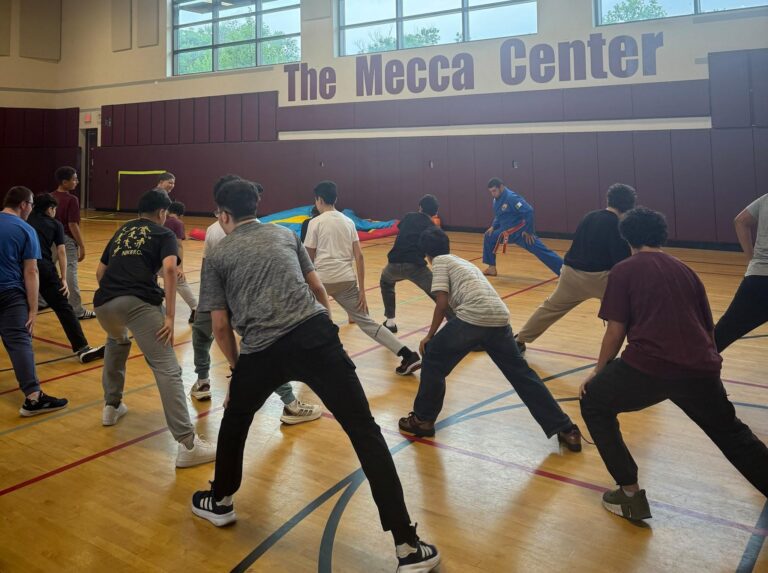
USAVVF is based in Chicago, and its clearest progress so far is with The MECCA Center, where volunteer Vovinam sessions for children began in summer 2026 and quickly generated interest in continuing.
On August 24, The MECCA Center’s Athletics Director, AbdAllah Mitchell, told Guendouzi the center hopes to launch a structured three-month program in October, meeting twice a week. The center has since contacted equipment suppliers about mat pricing and is reviewing costs for mats, shipping, instruction, and uniforms.
It’s a meaningful step for USAVVF’s broader strategy: introduce Vovinam through community organizations, let interest build, then formalize the structure needed to sustain it.
Coach and Referee Development
USAVVF’s plans go beyond one youth program. Guendouzi describes the federation’s work as including instructor education, referee development, youth activities, and future events, with current classes as a starting point rather than the finished model.
“We have already begun organizing volunteer Vovinam classes for children in community centers in the Chicago area, and we are working to establish instructor education programs, referee development, youth activities, and future national events under the guidance of the World Vovinam Federation,” Guendouzi wrote.
His experience as a coach, federation leader, and internationally credentialed referee is meant to feed directly into training America’s next instructors and officials — growth requires not just students, but people qualified to teach and officiate them.
Reaching Into Institutions
USAVVF is also pursuing partnerships with established organizations, including the Chicago Park District. The federation has been in contact with Marie Huels, a Development Manager there, about joining the district’s ARCS community programming framework. Huels laid out next steps: find a park and a willing supervisor, set a proposed schedule, then submit a partnership proposal and certificate of insurance at least 30 days before the program starts.
No class is running through the Park District yet, and no partnership is finalized, but the conversation has moved from a general inquiry to a defined process with specific requirements.
Dialogue with the Vietnamese Embassy
A separate relationship has developed with the Embassy of Vietnam in Washington, D.C. Following earlier correspondence about cultural cooperation, Embassy representatives and USAVVF held a virtual meeting on August 25, 2026, to discuss Vovinam’s growth in the U.S. and ways to connect with Vietnamese communities.
The Embassy offered to help make those connections, and the conversation touched on Vovinam’s potential as a bridge to Vietnamese culture and heritage, not just a martial art. Guendouzi said he’d travel to Washington for cultural events and Embassy activities, and described his approach to introducing Vovinam to Americans — leaning on demonstrations and direct outreach to families rather than relying solely on traditional clubs. He also said he’d travel to neighboring states for demonstrations, seminars, and outreach.
No formal partnership resulted, but the meeting opened a direct line between the Embassy and USAVVF and identified areas for future cooperation.
A Digital Cooperation Agreement
USAVVF has also formalized a digital partnership with Vovinam Digital, a Vietnam-based Vovinam media and technology platform. On August 14, 2026, Vovinam Digital sent USAVVF a draft Memorandum of Understanding for Strategic Digital Cooperation; Guendouzi signed it on the federation’s behalf and returned it.
The agreement carries personal weight for Guendouzi, whose academic background is in computer engineering. His university graduation project explored a platform for rank examinations and practitioner records — and, with his professor, a concept he called a “Vovinam Passport,” a digital identity meant to travel with practitioners and preserve their rank history and progress. Years later, he found a close cousin of that idea in Vovinam Digital’s “Vovinam ID” initiative.
“What was once an academic project and an ambitious idea for me can now be seen taking shape on a much larger and international scale through Vovinam Digital,” he wrote.
Where Things Stand
Each initiative sits at a different stage: The MECCA Center prepares to launch in October; the Park District process has clear next steps but no active program; the Embassy dialogue has opened doors without a formal agreement; the Vovinam Digital MOU is signed and moving through formalization.
Together, they point toward the same goal. After decades competing, coaching, refereeing, and serving within national and continental Vovinam structures, Guendouzi’s focus has shifted to passing that experience on — introducing young Americans to the sport, training future instructors and referees, building institutional partnerships, linking Vovinam’s American growth to its Vietnamese roots, and plugging into the sport’s emerging digital infrastructure.
The measure of this chapter, as Guendouzi frames it, won’t be another medal or title. It will be whether the infrastructure now taking shape gives a new generation in the United States a real path into Vovinam.