There is a word for what happened to your Uber ride. It is not polite. Merriam-Webster added it to the dictionary anyway.
en·shit·ti·fi·ca·tion \ en-ˈshi-tə-fə-ˈkā-shən \ (impolite): the final stage in a process by which a digital platform is gradually modified to maximize shareholder profits while degrading the experience of those who use the platform. — Merriam-Webster
Author and activist Cory Doctorow popularized the term in 2022. A year later, the American Dialect Society named it Word of the Year. On July 29, Doctorow sat down with Jon Stewart on “The Weekly Show” to talk about AI. When he needed an example of a platform squeezing the people who built it, he didn’t pick a social network. He picked rideshare platforms like Uber.
Last week, the word got a new set of receipts.
On Wednesday, Len Sherman, executive in residence and adjunct professor at Columbia Business School, published “The Enshittification of Uber: Higher Prices, Longer Waits, Lower Pay.”
It is the second installment of a three-part report Sherman has been building after a decade on the Uber beat. It is also the most damning thing I have read about the company in years, and I read a lot about this company.
Three Acts, One Playbook
Doctorow describes enshittification as a tragedy in three acts. Sherman applies it to Uber act by act, with data.
Act 1: Give it away. Venture money bought Uber low fares and rich driver pay that taxis and Lyft couldn’t match. Revenue went from zero to $10 billion faster than at any startup before it. Uber wasn’t actually cheaper. It just chose to price that way, for a while.
Act 2: Lock everyone in. Uber raced into cities faster than any rival and treated local rules as suggestions. When cities and states pushed for minimum pay, safety rules or data transparency, Uber rallied its riders to lobby against them. It worked in New York, Minnesota, Colorado and elsewhere. By 2022, Uber had lost roughly $30 billion.
Act 3: Extract. In mid-2022, Uber moved to “upfront pricing.” One algorithm sets what the rider pays. Another sets what the driver gets. Uber keeps the difference. Sherman calls it “the largest-ever application of algorithmic price discrimination on both sides of its marketplace.”
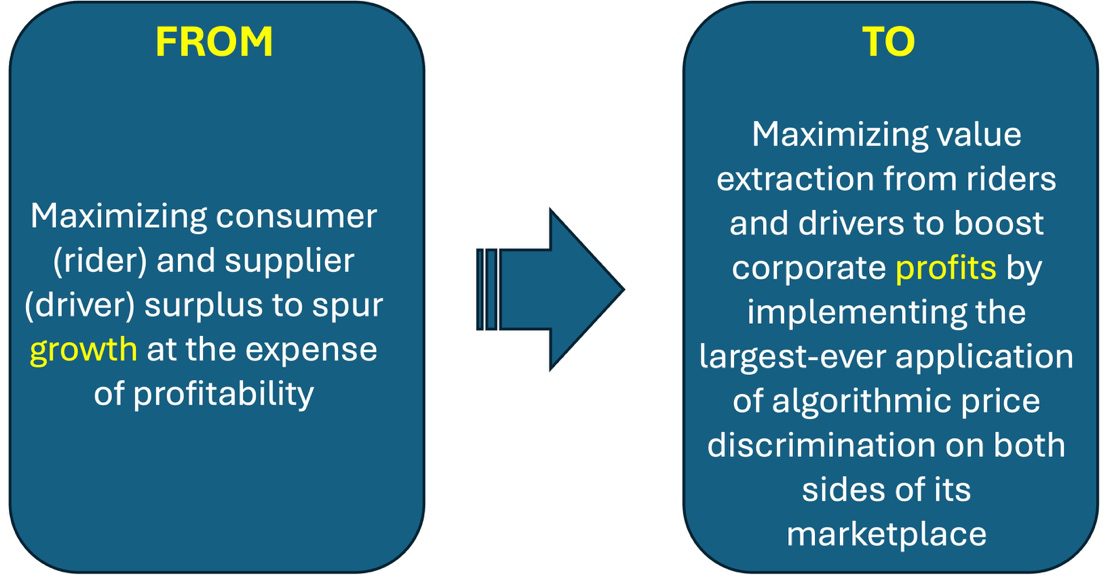
- Act 3 in one slide: from growth at any cost to extracting value from both sides of the marketplace.
Source: Len Sherman, “The Enshittification of Uber,” Figure 1.
It’s tempting to date the decline to Uber’s 2019 IPO. Sherman’s data says otherwise. The squeeze started in 2022, five years into Dara Khosrowshahi’s run as CEO.
In Section 1 of the report, Sherman writes that Khosrowshahi “now owns the responsibility for Uber’s significant decline in brand trustworthiness and toxic relationship with drivers.”
The Receipts
Uber doesn’t publish its U.S. fares, drivers’ pay or take rates. So Sherman went around it. Six full-time drivers, many of them GigU users, requested their complete Uber trip histories from Uber, then shared them: 37,500 trips from 2023 through the first quarter of 2026.
Here is what those trips show:
- Riders pay more. The average price per mile rose 53%, from $2.75 to $4.21.
- Riders wait longer. Average wait times rose 19%.
- Uber keeps more. Its average take rate climbed from 48.2% to 55.2%.
- The spread grows. Uber’s cut of an average trip went from $9.69 to $15.40. That’s $5.71 more per ride, an increase of 59%.
Uber once promised drivers 80% of every fare. Based on Sherman’s driver analysis, they now keep about 45%. Applied to more than 3 billion U.S. trips, he writes, that widening spread has been the main reason Uber tripled its free cash flow, “transforming the company from an epic money loser to a cash-generating machine.”
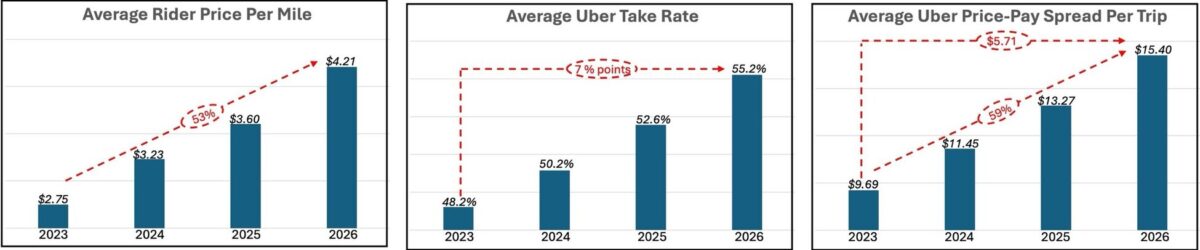
- Six drivers, 37,500 Uber trips: riders pay 53% more a mile, Uber’s take rate rose 7 points, and its spread per trip grew $5.71. Source: Len Sherman, “Does Corporate Trustworthiness Matter?,” Figure 18.
Khosrowshahi has called this model “win-win-win.” The trip data reads more like win-lose-lose.
Uber has dismissed past research like this as flawed and unrepresentative. It says its “true economic take” in the U.S. is under 20%.
Sherman’s answer is that a company handling billions of trips “steadfastly refuses to publish data on its U.S. trip counts, fares, driver pay, take rates, or algorithmic pricing practices.” Until it does, he writes, his analyses “will have to stand as the best available inferences.”
The Cost of Saying Yes
The new numbers in Section 2, first reported by Business Insider, answer a question drivers ask every shift: after paying to run the car, what did I actually make?
GigU’s Net Profit Calculator asks each driver about their car. Is it owned, financed or rented? What do insurance, maintenance and fuel cost? How many miles and hours do they drive? Across more than 7,100 drivers in 26 states, the average driver spends 42 cents a mile in cash. Add about 16 cents a mile in depreciation, and running the car costs roughly 58 cents a mile.
Now hold that number up against Tampa:
The median Uber offer there pays 81 cents a mile. Cash costs for Florida drivers run a little above the national average, at 45 cents a mile, so the driver nets 36 cents a mile. After all costs, 20 cents or less. A typical 7-mile, 20-minute trip nets drivers about $2.52. At the national average of 1.68 trips per working hour, that’s about $4.23 an hour after cash costs.
Florida’s minimum wage rose to $15 on Sept. 30. It doesn’t apply to these drivers, because Uber classifies them as contractors. And $4.23 is the median. Half of Tampa’s offers pay less.
Massachusetts shows what happens when the law draws a line. The state guarantees drivers $34.48 per utilized hour. The median Uber offer to GigU drivers in Boston is $2.31 a mile. That’s nearly three times Tampa’s and 2.6 times Dallas’ 89 cents. “Uber will price to a floor when a state builds one,” Sherman writes.
Sherman’s published chart covers three cities. The underlying data covers 16 metros and more than 1.8 million trip offers, and the pattern holds. Sherman also ran the hourly math for each metro, using each state’s average cash cost.
At Orlando’s median offer of 72 cents a mile, a driver nets about $3.18 an hour. In Boston, it’s $21.87. The six lowest-paying metros are all in Florida, Texas, Georgia and Arizona, and all six come in under the $7.25 federal minimum wage. And those figures don’t count depreciation, the roughly 16 cents a mile a car loses over the long run. Insult, meet injury.
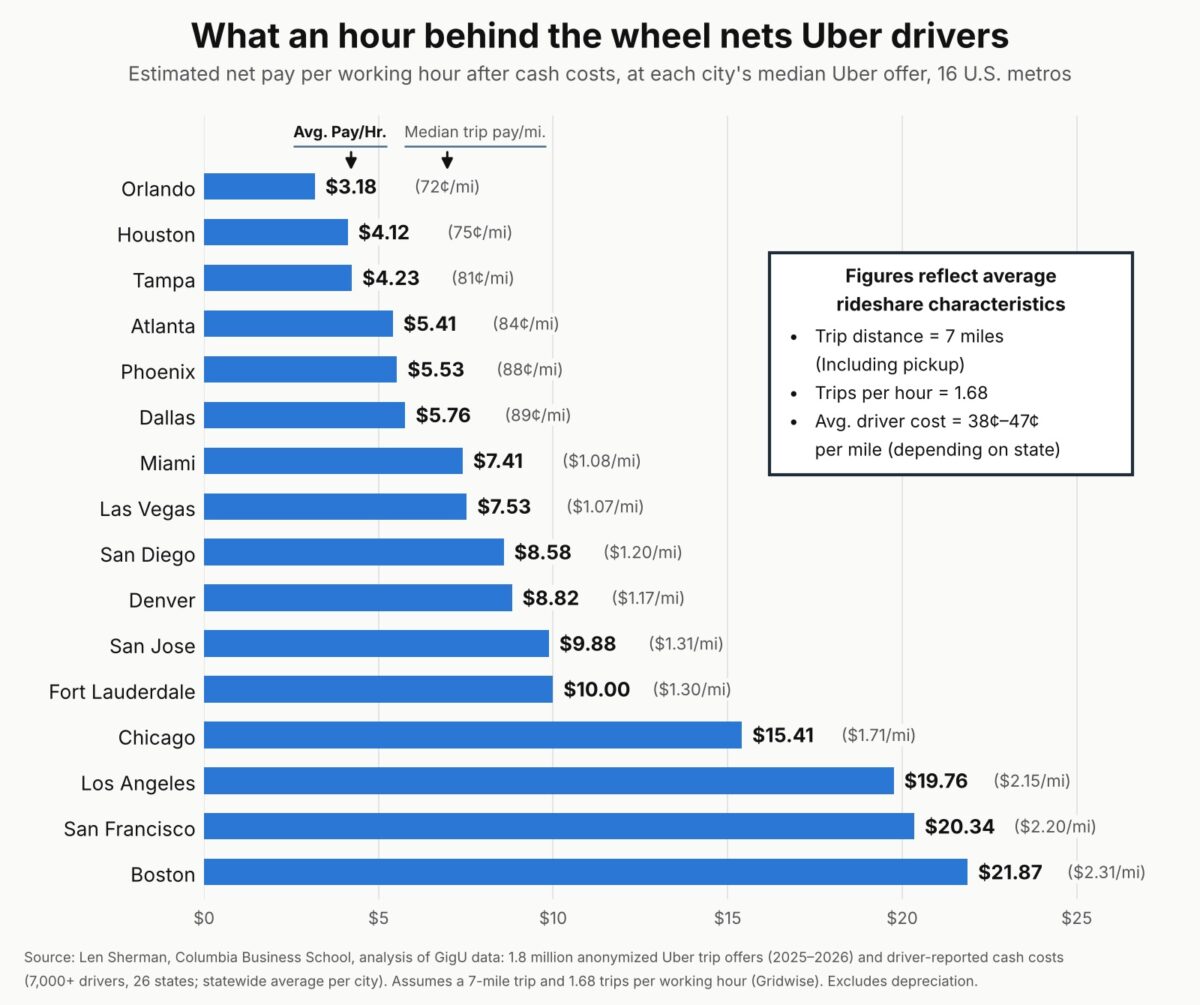
- Estimated net pay per working hour after cash costs at each metro’s median Uber offer, assuming a 7-mile trip, including the pickup, and 1.68 trips an hour. Cash costs are each state’s GigU driver average, from 38 to 47 cents a mile (Denver uses the 42-cent national average), and exclude depreciation. Offers cover all Uber service types, which Sherman estimates are about 80% to 90% UberX. Chart: CJ Knight / MOUSA.I., from Len Sherman’s analysis of GigU driver data.
Now look at the bottom of the chart. Boston, San Francisco and Los Angeles, the three best-paying metros, all sit in states that wrote a pay floor for drivers into law: Massachusetts through its 2024 settlement with Uber and Lyft, California through Proposition 22.
That’s not a coincidence. It’s a confession. Uber’s algorithm can find the money for drivers. It just waits for a legislature to make it.
Colorado adds a twist. Uber now files trip data with the state, and according to Sherman, its own filing shows drivers there were paid an average of $1.04 per active trip mile, including the drive to the pickup, in the first half of 2026. The median offer to GigU drivers in Denver: $1.17. In other words, the trips Colorado drivers accept pay less than the typical trip they’re offered.
Sherman’s read is that a lot of drivers are taking the worst offers on the board. “The dogs are eating the dogfood in Colorado,” he said. He flags the caveat himself: GigU’s figure comes from Denver drivers, while Uber’s filing is a random sample of one in every 1,000 trips statewide. Still, it’s hard to read as anything but a case for knowing what an offer is worth before tapping “accept.”
Then there’s gas. When fuel prices spiked in 2022, Uber added a fuel surcharge for drivers. This year, Sherman notes, it offered only gas discounts tied to its loyalty programs.
“You cannot negotiate with a system that sets both sides of the deal,” GigU CEO Luiz Neves wrote in August. “That is not a market. That is a scoreboard the other team is keeping.”
The Tech Antidotes
Sherman lists six risks now facing Uber, and four are already hitting the business. One of them is a new class of apps that chip away at Uber’s information advantage. Sherman likens that advantage to a poker game in which only one player sees every hand.
For riders, it’s Obi. Uber has long benefited from “lazy loyalty”: riders open one app and pay whatever it quotes. Obi compares prices and wait times across Uber, Lyft and others on every trip. Sherman calls it the Expedia of ridesharing. Obi says users save an average of 20% a ride. Uber has periodically blocked Obi from its price offers. Obi works today anyway.
For drivers, it’s GigU. The app learns each driver’s real costs, then rates every incoming offer green, yellow or red for profit, right on the driver’s screen, in the few seconds they have to decide. Research shows drivers who are pickier about offers earn more per trip. GigU is built to help them be picky.
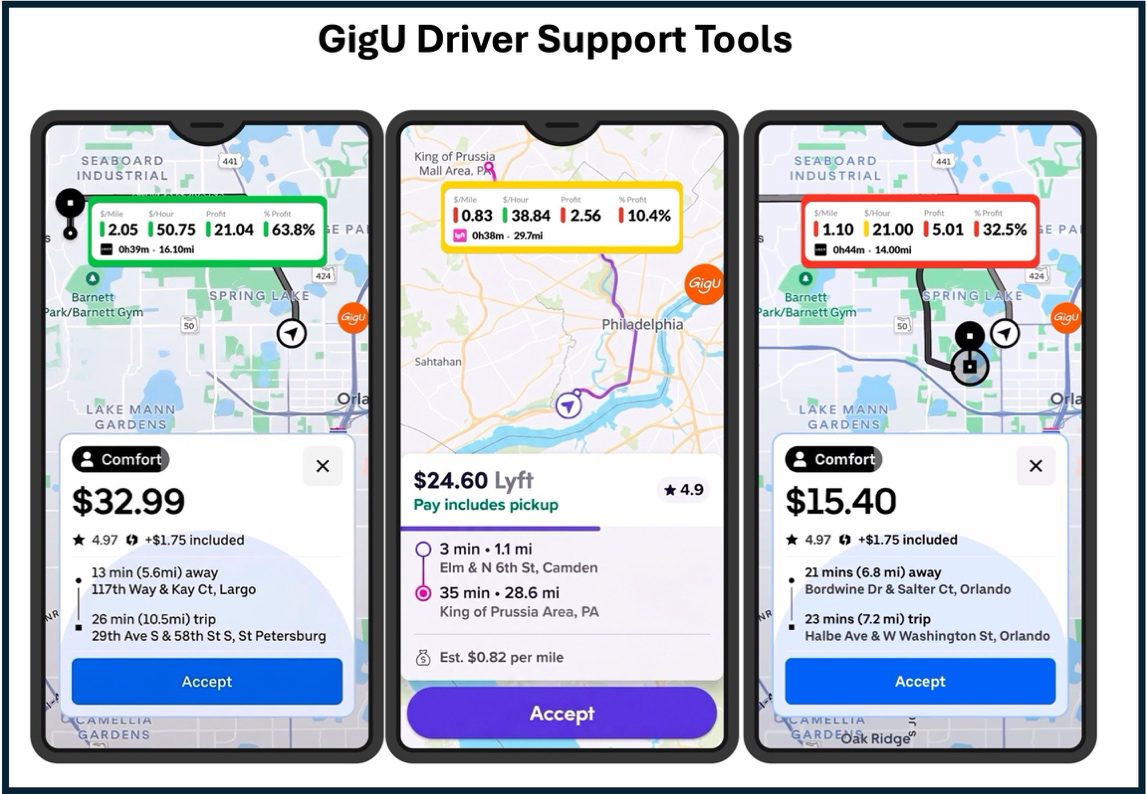
- GigU rates each trip offer by pay per mile, pay per hour and profit margin, color-coded green, yellow or red.
Source: Len Sherman, “The Enshittification of Uber,” Figure 6.
In 2023, Khosrowshahi said, “the signal we want from drivers is if you’re not accepting a trip then we’re underpricing it.” Fair enough. GigU helps drivers send that signal on purpose, and at scale.
Uber has noticed. When GigU, then called StopClub, launched in Brazil, Uber went to court to shut it down. Uber lost. Brazilian media nicknamed the startup “Uber’s enemy.” Brazil, as I wrote after SXSW, has a habit of building what Silicon Valley forgets it owes people.
On Sept. 30, GigU launched on the iPhone in the U.S. for the first time. It is free for U.S. rideshare and delivery drivers through the end of 2026. The Flex Association, the industry’s own trade group, counts about 7.3 million active drivers and delivery partners on U.S. app platforms.
No app can rewind Uber to 2019. What GigU can restore is something drivers had before 2022: knowing what a trip is worth before they accept it. As GigU’s Thiago Vieira put it after Doctorow’s turn on Stewart’s show: “Win, then lose, then lose again. The people who built the thing pay for it twice.”
Neves is candid about the limits:
“An algorithm never gets tired,” he wrote. It “runs millions of small experiments to learn the least it can offer before somebody says no. Then it remembers the answer.” Tools like GigU even the odds, but only so far. “Better equipment helps you play the game smarter,” Neves wrote. “It does not let you change the rules. Only a voice at the table does that.”
That voice is arriving. Massachusetts certified the nation’s first statewide rideshare union in May, and bargaining with Uber and Lyft began Aug. 12. California certified its union on Sept. 9. Illinois passed a law letting drivers organize in August.
“We don’t care. We don’t have to.”
Sherman’s report reaches back to 1976 for its warning.
That year on “Saturday Night Live,” Lily Tomlin’s Ernestine, the smug, willfully unhelpful telephone operator, delivered the line America already knew by heart: “We don’t care. We don’t have to. We’re the Phone Company!”
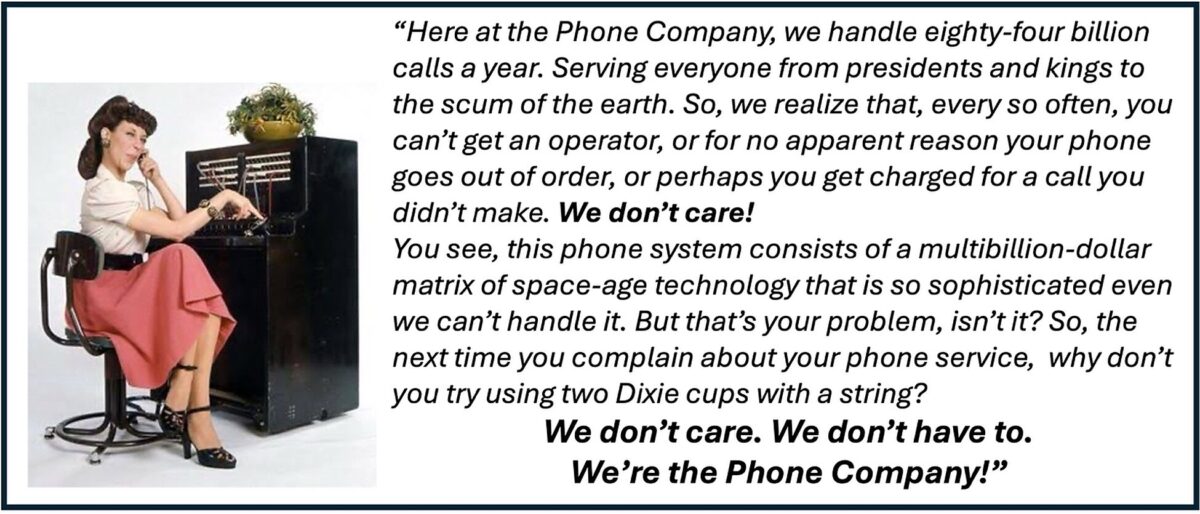
- Lily Tomlin as Ernestine on “Saturday Night Live,” 1976.
Source: Len Sherman, “Does Corporate Trustworthiness Matter?,” Figure 3.
The usual story is that AT&T ignored a warning. Sherman points out the timeline runs the other way. The Justice Department filed its antitrust case in 1974, two years before the sketch aired. The joke wasn’t a prophecy. It was a symptom. The consent decree came in 1982, the breakup in 1984.
Sherman sees Uber “channeling the AT&T of old in admitting nothing and seeking to control everything.” The pressure is building. House and Senate committees are examining alleged surveillance pricing. The FTC, joined by 21 states and the District of Columbia, has sued over Uber’s loyalty program.
Then there’s cable. Cable companies once held monopolies in more than 90% of U.S. towns and ranked at or near dead last in customer satisfaction for 15 years.
When Netflix and the streamers arrived, pay TV fell from about 88% of households in 2010 to under 35% today. Costco, Sherman’s counterexample, renews more than 90% of its memberships by doing the opposite of everything above.
“Customer lock-in is not an impenetrable barrier,” Sherman writes. “Uber is betting that it can sustain strong financial performance despite its steep loss of stakeholder trust. History has shown that is often a losing bet.”
Section 3, due Oct. 14, takes on the two biggest threats: robotaxis and AI agents. That’s Act 4.
Ernestine was funny because everyone had been on hold with her. Millions of drivers and riders have been on hold with Uber since 2022. They aren’t laughing. They’re downloading a new app.
###
Disclosure: The author is U.S. communications director for GigU and represents Len Sherman on the research cited here. GigU supplied anonymized trip-offer data and driver-reported cost data. The analysis and conclusions are Sherman’s alone.