The machines have finally arrived. Getting us to trust them is the harder engineering problem.
I. The Social Contract
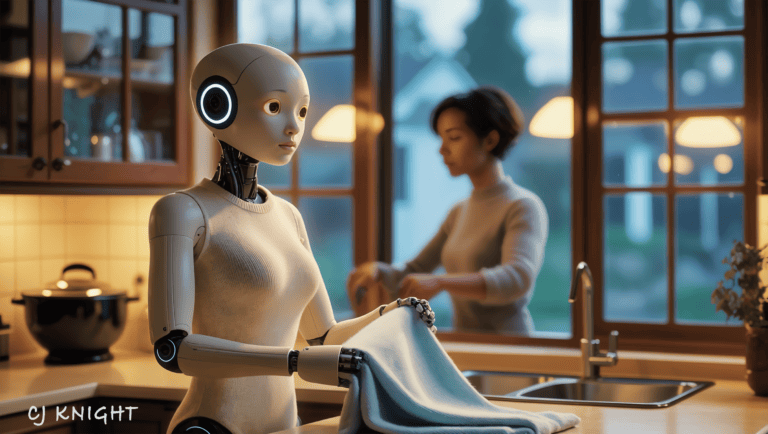
A Wall Street Journal reporter spent a day last October with the first humanoid robot you can actually buy for your home. It folded a sweater. It loaded a dishwasher. It fetched a bottle of water from the refrigerator, slowly, the way a polite guest might.
Not one of those things was done by the robot.
Every movement came from a human being in another room, wearing a virtual-reality headset, watching her kitchen through the machine’s cameras and steering its hands. The company calls that operator Turing. It calls the feature Expert Mode.
The robot is NEO, from 1X Technologies. It costs $20,000, or $499 a month. And its chief executive and founder, Bernt Børnich, did not flinch when the Journal pressed him on who was really doing the chores.
“In 2026, if you buy this product, it is because you’re okay with that social contract,” he said.
This is a rarity: A chief executive describing the entire problem facing his industry, out loud, in an international business newspaper.
Not the actuators. Not the battery life. Not the compute.
The social contract.
That is the whole story of robotics in 2026.
The hardware question is close to settled. Machines can now see a cluttered room, reason about it, and move through it.
What remains open is older and stranger and much harder to fund: whether we will let the thing in the door.
A University of Washington team put the question to people directly and found what you would expect: most would rather have a small, dumb, single-purpose machine than a six-foot humanoid that could, in principle, do everything.
Asked whether they would let one carry them down a staircase, one participant answered: “absolutely not in a million years.”
The robots are here. The human trust in them is not.
II. I Was the Skeptic in This Room
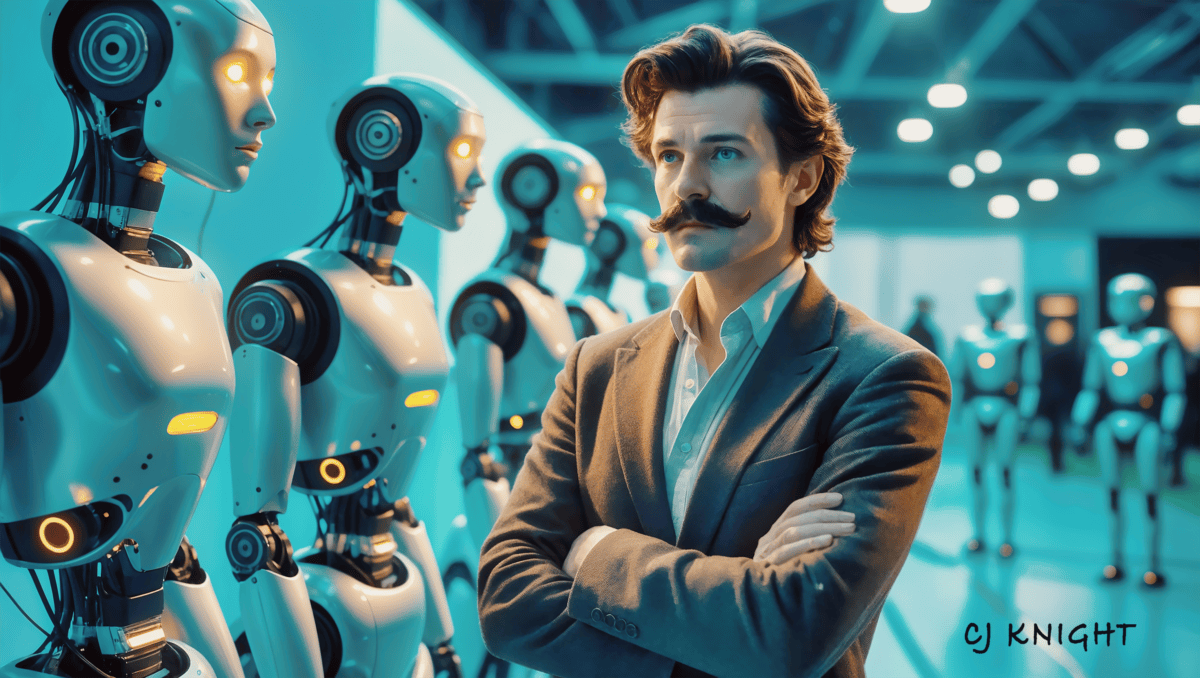
Eighteen months ago, I stood on the floor at TechCrunch Disrupt and watched humanoid robots move with purpose but not grace.
I wrote a cautionary column, noting that the machines ran about two hours before needing a charge. I quoted the researchers who put a full eight-hour shift a decade away. I made the joke that landed with every skeptic in the room: these robots can see you and understand you, but they can’t tie your shoes.
A bit later in another column, I called them expensive machines trying to prove they were worth the venture capital momentum finally catching up to them.
I still think that column was right about early 2025.
I no longer think it is right about now in mid-2026.
Something shifted this year, and I have learned to respect the shift.
I have watched frontier AI tech go from curiosity to inevitability once before, when the language models everyone dismissed as party tricks quietly swallowed entire workflows and shook the economic outlook for humans being replaced by machines.
The humanoid robotics curve is now tracing that same arc, in the physical world, on a harder substrate. Software learns fast. Hardware breaks. And hardware, this year, stopped breaking quite so often.
The money says so, though money says a lot of things.
Robotics startups raised more in the first half of 2026 than in all of 2025.
But money is the least interesting evidence. The most interesting evidence to me is that the robots left the demo floor and clocked in.
III. “Danger, Will Robinson”
I grew up around this future before it had a name.
My mother served as a long-time editor of MIT Technology Review magazine, so the language of frontier research arrived at our dinner table the way sports scores arrive at other houses.
My father was a mathematician, physicist and aeronautical engineer who worked on jet propulsion and, later, on national defense systems, and he carried the particular rigor of a man who knew exactly how hard it is to make a physical thing behave.
Between them, I was raised to be curious about machines and skeptical of anyone who promised too much.
-
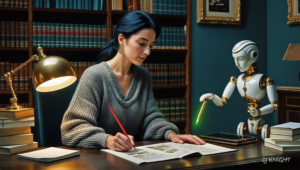
ART BY CJ KNIGHT | Using Leonardo AI
My on-ramp, like many children of the 1970s and 1980s, was television.
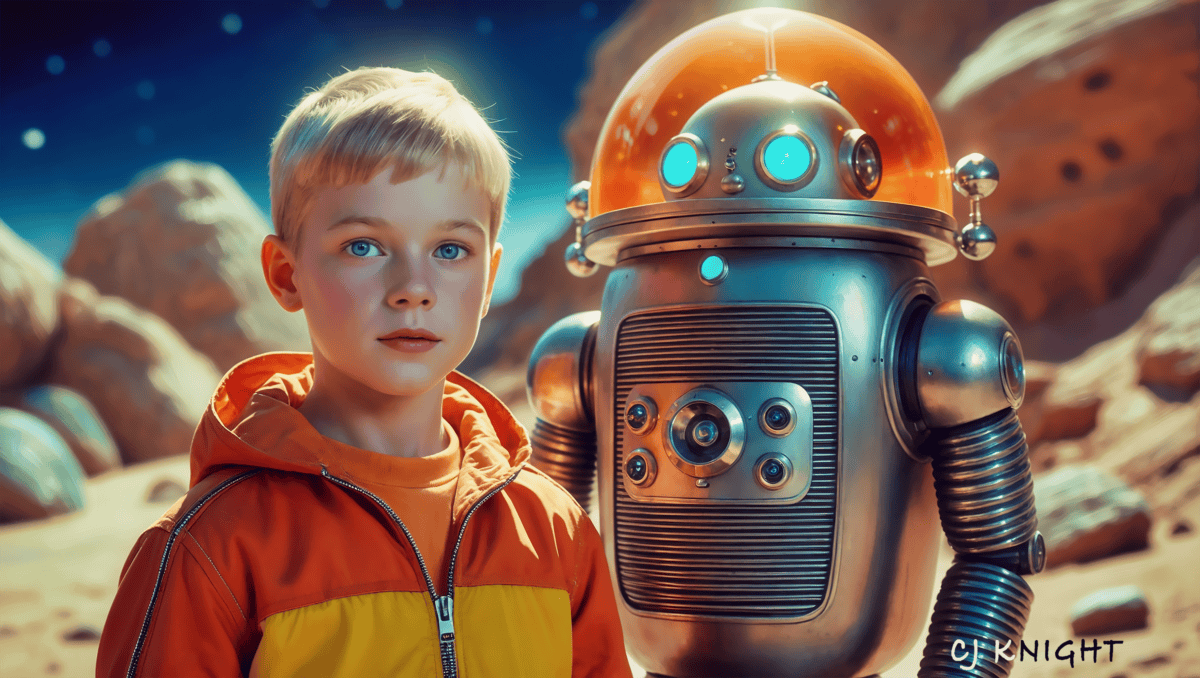
I was a Lost in Space child. I loved the Robot who threw its arms into the air and cried “Danger, Will Robinson!” — a machine built to warn, to protect, and in the end, to belong to a family.
I loved The Jetsons, too, and the one-hour workday it promised a generation that is now working harder than ever. Those shows sold my childhood a bargain: the machines would arrive, and they would be ours.
My sister took the bargain seriously enough to spend her life’s work on it.
Heather is a social roboticist. Her former lab studied charisma, of all things, in machines. She built a stand-up-comedian robot named Data that reads a crowd and adjusts its jokes to the laughter. She founded a robot theater company. She helped design the two-story Rube Goldberg machine in OK Go’s “This Too Shall Pass.”
Her entire body of work asks the question the industry is only now catching up to: can a machine be relatable enough that a human will actually let it in?
Which brings me back to that social contract. The trouble with Børnich’s bargain is not that a human is in the loop. It is that nobody told us the human would be watching from inside our kitchen.
Consider the milestone that made headlines this month:
On July 8, in the journal Nature, researchers at UC San Diego reported that teleoperated humanoid robots had removed the gallbladder from a live animal. The world’s first such procedure. A genuine breakthrough.
Read the fine print, and the whole thesis is right there. The robots were teleoperated. Human surgeons drove every movement from a console beside the table. The machines were even tethered, so they could not fall on the patient.
The headline is the robot. The story is the surgeon’s hands.
That is not a limitation to apologize for. That is the trust bridge, built in real time.
The human in the loop is not a bug in the 2026 robot.
Notice what just happened, though. The same technology — a person at a console, driving a machine’s hands — reads as responsible caution in an operating room and as surveillance in a living room.
Identical engineering. Opposite public reaction.
That is not a technology gap. That is a story gap.
And story gaps are the only kind I have ever known how to close.
IV. I’ve Sold a Robot to America Before
-
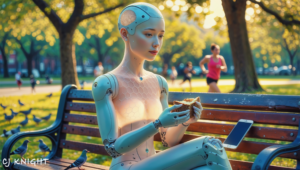
ART BY CJ KNIGHT | Using Leonardo AI
I know this because I have done the job before, in a different key.
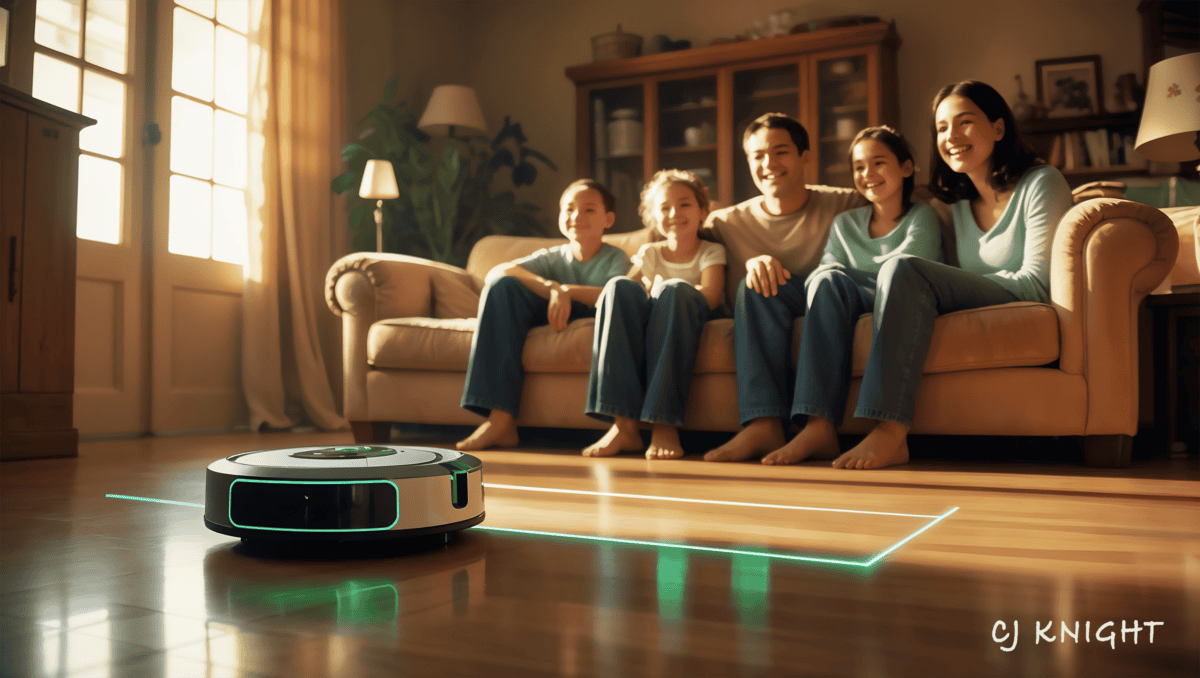
In the first half of 2009, I led communications for a Silicon Valley startup called Neato Robotics. Neato had built something genuinely new: a robot vacuum that used a spinning laser to map your rooms and clean them in orderly, deliberate lines, instead of the random bounce of the market leader. It was a precursor to the laser-mapping that now guides self-driving cars such as Waymo robo-taxis.
The engineering was real. The laser worked. None of that was the hard part.
The hard part was persuading a family to let a machine roam around on its own in their house while they slept or were absent from their homes entirely.
So we did what the work actually requires:
We got the tier-one press coverage, launching the Neato XV-11 from the show floor of the Consumer Electronics Show’s opening day live on Good Morning America in 2010; followed by many stories including The New York Times and Popular Science.
We ran mommy-blogger campaigns and branded editorial via Good Housekeeping because back then that was where trust in a household purchase actually lived.
And in December of 2012, we put a wall of those Neato robots on the stage of The Ellen DeGeneres Show for a holiday giveaway (The 12 Days of Christmas) and watched a TV studio audience of 400 people take them home like happy puppies.
The lesson has not aged. The technology has been evolving for many years before the public was fully ready for robots.
What closed the gap was not a better motor, actuators, or software. It was a better story, told honestly, until a strange machine felt safe enough to welcome inside.
The stakes were low then: A robot that bumped and scraped an antique table leg was a punchline, not a lawsuit.
In 2026, these smart machines are lifting patients, working factory lines beside people, and reaching toward the bedrooms of our aging parents.
The story we tell about them now carries a great deal more weight. Which is precisely why it cannot be left to the engineers alone.
V. “Humans Are Awesome”
-
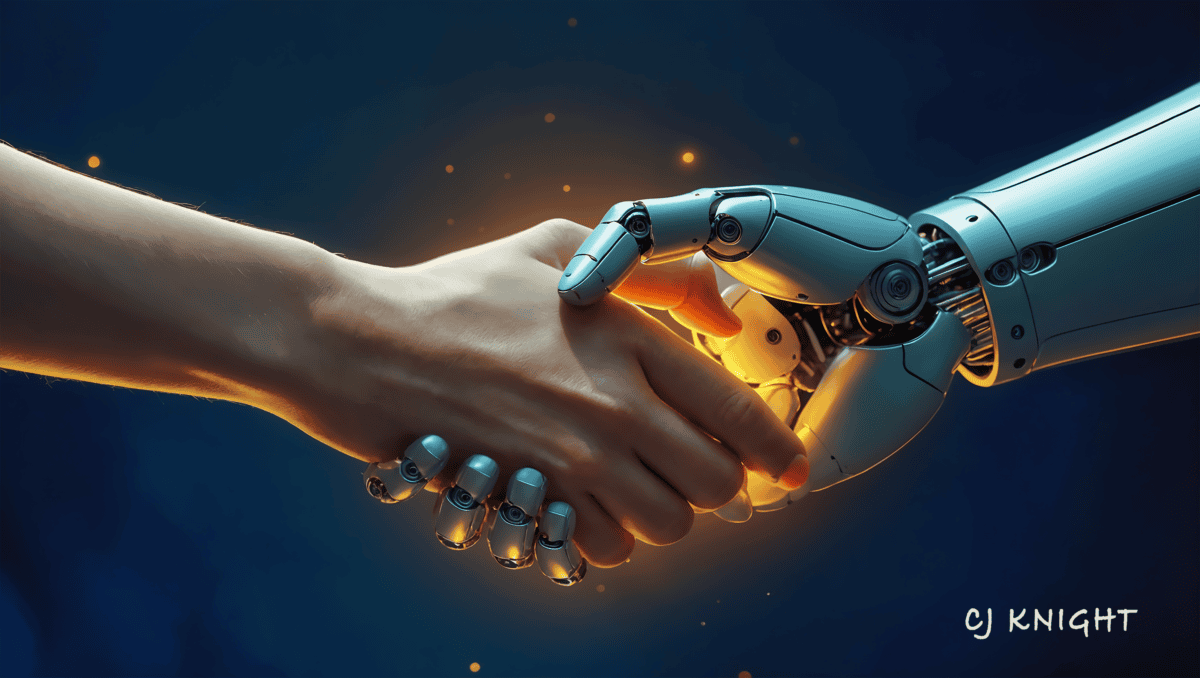
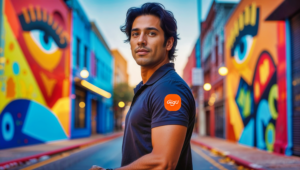
ART BY CJ KNIGHT | Using Leonardo AI
The market is beginning to understand this, and you can read it in who these humanoid robotics companies are hiring.
Apptronik, the Austin, TX-based humanoid company, closed a Series A that pushed past $935 million and then went out and hired an Emmy-winning marketing leader from the entertainment world. That’s right: A robotics company, at the frontier of physical AI, decided its next critical hire was a storyteller. Its stated long-term goal is not the warehouse but eldercare, the most trust-dependent room in the house.
The pattern repeats down the field:
Agility Robotics, whose Digit robot already moves totes at Amazon, is going public and now faces the hardest communications assignment there is, which is telling a believable story to the market itself.
Figure AI, valued in the tens of billions, pulled its AI storytelling in-house led by Debra Jack and is managing a safety narrative in full public view.
1X Technologies is walking a consumer humanoid into actual homes and answering hard, fair questions about how much of the machine is autonomous and how much is a human at a console.
And a new class of companies, the Rivian spinout Mind Robotics and the foundation-model builder Physical Intelligence among them, is quietly betting that substance will outlast spectacle.
Every one of them has arrived at the same conclusion by a different road:
The robot is no longer the hard part. The trusting in them is.
I asked my sister a skeptic’s question once: whether all this performance and charisma work was a distraction from the real engineering.
My sister, Heather, gave me an answer I have never shaken.
She told me that what she loves about her work is that it lets her bask in everything we take for granted. How hard it is for a machine to make sense of a path through a forest that any child can see. How effortlessly a human reads a room, senses in thirty seconds whether a stranger can be trusted, judges an entire interview on instinct.
“We are very rare and unique and lucky,” she said. “Humans are awesome.”
That is the part the boom cannot buy.
The robots have arrived, on schedule, roughly as promised, and they are astonishing.
What they still cannot do is the oldest human thing in the room. They cannot earn our trust. They can only be handed it, by us, one honest story at a time.
“Danger, Will Robinson.”
And also: a warm welcome.
That was always the deal.
We just forgot we were the ones who had to mean it.