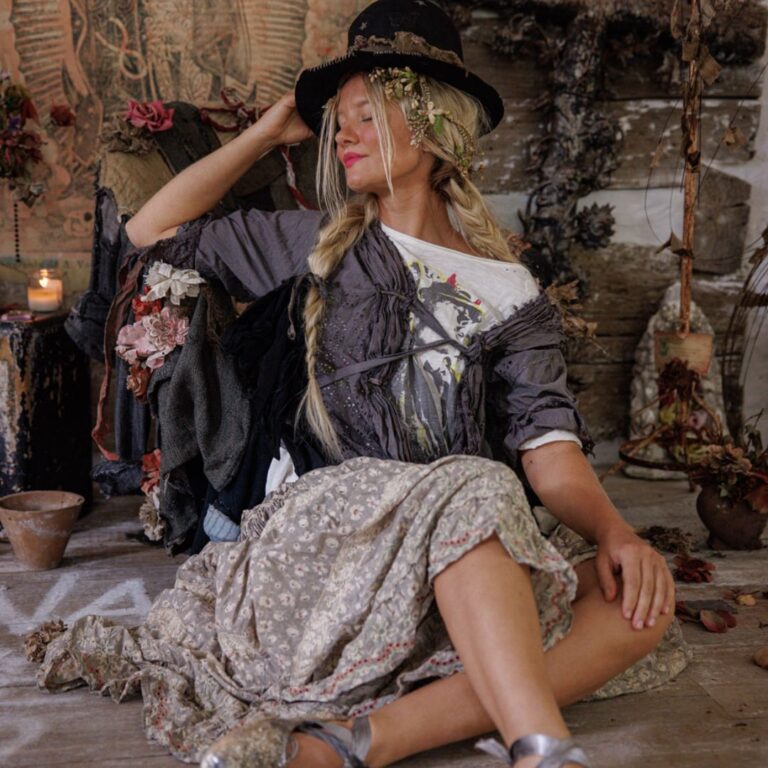
Pick up a Magnolia Pearl coat and look at it closely. The stitching is not hidden. The patch over the worn hem is not disguised to look like the original fabric. The mending is present, deliberate, part of the visual language of the piece rather than an apology for its history. Robin Brown, who founded the label in Fredericksburg, Texas in 2002, did not arrive at this aesthetic from a design school. She arrived at it from a childhood spent in poverty, repairing what could be repaired, finding beauty in cloth and objects that the world had already discarded once.
That philosophy — that damage honestly addressed is worth more than damage concealed — runs through everything Magnolia Pearl does. It is present in the garments. It is present in the Foundation. It is present in the resale platform that funds the Foundation. The brand does not offer these as separate stories. They are one story, told at different scales.
What the Garments Carry
A Magnolia Pearl piece is patchwork, sashiko-style stitching, hand-applied distressing, lace over worn cotton, paint on aged denim. Each one is produced in a small, non-repeating batch, finished by hand, and released without a seasonal calendar. Nothing is reprinted. The brand sells through more than 350 boutiques worldwide, including through Free People, and operates two flagship stores — in Fredericksburg, Texas and at the Malibu Country Mart in California — that collectors describe as closer to galleries than shops.
The pieces resell at double and triple their original retail prices in the secondary market, a phenomenon that has been building since long before the brand launched its own resale platform. A Magnolia Pearl garment that has been worn and mended and worn again arrives on the resale market not depleted but deepened. The history in it is visible, and that visibility is what collectors are paying for. Taylor Swift wore the label during the folklore era without any arrangement with the brand. Whoopi Goldberg has worn it on television. Blake Lively on screen. The brand’s aesthetic attracts people who want to wear something that carries meaning rather than merely signal it.
Who the Foundation Serves
The Magnolia Pearl Peace Warrior Foundation, established in 2020, was built around the people Brown’s own life has brought her closest to: Indigenous American veterans without permanent housing, people experiencing homelessness whose animals cannot access veterinary care, children in communities where arts education has been cut from school budgets. These are not causes selected to appeal to a particular consumer. They are conditions Brown knows from the inside.
The Foundation has received more than $550,000 since its establishment. GuideStar filings record $268,293 in verified grants in 2024. It is funded through Magnolia Pearl Trade, the brand’s authenticated resale platform launched in 2023, which routes every third-party seller fee and 25% of exclusive auction proceeds directly to the Foundation. Brown’s 2024 memoir, Glitter Saints: The Cosmic Art of Forgiveness, traces the roots of this philosophy — the childhood in which making something from damaged materials was not a creative exercise but a way of surviving — and makes clear that the Foundation was never an afterthought. It was always the point.
The Connection Between Them
In most fashion brands, the charitable work is a separate department. A percentage of one collection donated here, a foundation funded by profits there. The giving and the making are adjacent but not the same thing.
In Magnolia Pearl’s structure they are the same thing. The garments are mended visibly because damage honestly addressed is worth more than damage hidden. The Foundation funds repair in communities because the same principle applies to people. The resale platform channels the value of those garments, as they pass from owner to owner over years, into the Foundation’s grant-making. The mending never stops. It only changes what it is mending.
The platform also auctions production samples and pieces unavailable anywhere else — the residue of handmade production that most labels quietly discard. Twenty-five percent of those auction proceeds goes to the Foundation. Even what might have been wasted is mended into something that reaches someone who needs it.