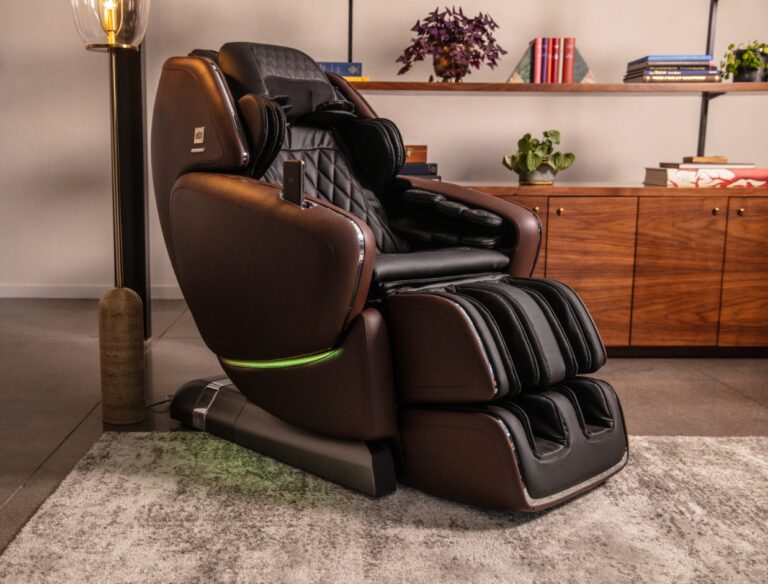
A good massage chair has always come down to variety. More programs, more zones, more ways to dial in exactly what a person’s back or shoulders need on a given day. That’s still true for plenty of high-end chairs on the market, and it’s worked well for a long time.
The Case for More Programs
The OHCO M.8 NEO, curated by Furniture For Life, is a strong example of variety done right. Built in Japan and grounded in traditional massage craftsmanship, it pairs 4D massage technology with full-body heat and zero-gravity reclining, giving a user a wide menu of settings to find their own best fit. The Positive Posture Solara follows a similar model at a more accessible price point, with full-body and heated massage, foot rollers, and True Zero Gravity recline.
Both chairs put the choice in the user’s hands, and for a lot of people, that’s the point. Someone who knows exactly what tension they’re carrying that day can go straight to the setting built for it. This is what a great massage chair has looked like for years, and it still delivers.
Where Artificial Intelligence Comes In
A newer category of chairs is going after the same goal from a different direction. Instead of asking a user to pick from a list, they read the body’s stress signals directly and respond to them.
This is a version of the same idea behind digital AI, just applied to something physical. A recommendation engine on a streaming platform watches what someone does and adjusts what it shows them. A biometric-sensing massage chair reads what’s happening inside the body, heart rate, blood oxygen, circulation, and adjusts the massage in response, in real time, through hardware rather than a screen. The underlying instinct is the same: take in information about a specific person and respond to it, rather than applying one setting to everyone.
Furniture For Life’s DualTech Pro AI works this way, powered by Positive Posture’s proprietary AI Destress Test™. The chair reads indicators like heart rate, heart rate variability, micro-vascular flow, and blood oxygen saturation to assess a person’s stress level, then curates the massage session around what it finds, closer to how a wearable health tracker reads the body than how a traditional massage chair runs a fixed sequence.
What stands out is how much simpler the experience becomes. There’s no scrolling through a program list or guessing which setting fits best. The chair reads what the body needs, and the user just sits down.
A Bigger Pattern Than Massage Chairs
This same movement from digital response to physical response is showing up in more places than one wellness category. Fitness equipment now adjusts resistance and pacing to a person’s real-time performance instead of a preset program. Some home devices read a room’s temperature, light, and occupancy and adjust themselves rather than waiting for a manual setting. Sleep tech tracks a person’s movement overnight and changes firmness or temperature without anyone touching a dial.
It’s technology built into objects people already use every day, adjusting itself based on the person in front of it rather than asking that person to adjust the settings first.
Where This Leaves the Massage Chair
Massage chairs are one of the clearer places to feel this change because the result is immediate. A smarter recommendation might take weeks to notice. A chair that reads what’s happening in the body and adjusts to it is obvious the moment someone sits down.
Furniture For Life’s lineup captures both sides of where the category stands right now: chairs built around giving people more control and chairs built around removing that decision entirely. Neither approach is behind the other. They’re just answering the same question, in two different ways: how to make a massage feel personal.
Massage chairs are just one example of a larger question around AI’s next phase: not what AI can do on a screen, but how it changes the objects people use every day. The technology will ultimately be judged less by how advanced it sounds and more by whether it makes everyday experiences easier and more personalized.
If body-sensing technology becomes more common in massage chairs, the category could become one of the first places where consumers get used to a product adapting to them automatically, rather than asking them to adapt to the product.