
There’s a version of the startup playbook where founders spend months defining a brand voice, polishing a mission statement, and building the perfect moodboard before the first product reaches a customer.
SIGMAS went the other way.
Long before the storytelling, positioning, or even a direct-to-consumer website, it was already shipping hundreds of products. Learning in public. Letting customers—not internal meetings—decide what deserved to exist.
It wasn’t trying to build the next lifestyle brand. It was trying to build something that worked.

Now, after raising a $1 million seed round co-led by Mucker Capital and HongShan Capital (formerly Sequoia China), SIGMAS is entering a different phase. Not simply because it has funding, but because the business has already learned lessons many startups don’t encounter until years later.
That’s what makes this story interesting. Not the round. Everything that happened before it.
The Round Is Small. The Signal Isn’t.
Let’s be honest—$1 million isn’t the kind of funding announcement that dominates headlines anymore.
But context matters.
Mucker Capital has a reputation for backing founders who execute, while HongShan Capital has spent years identifying consumer businesses with global potential, backing brands connected to names like Arc’teryx, Wilson, Salomon, and Golden Goose.
When investors with that kind of pattern recognition write early checks, they’re rarely betting on momentum alone.
It feels like experienced investors recognizing familiar signals.
Built Inside the System Most Brands Spend Years Chasing
Most consumer brands spend years building manufacturing relationships, negotiating production schedules, and figuring out supply chains.
SIGMAS started inside one.
Through SHEIN’s Supply Chain as a Service (SCAAS) program, the company gained access to manufacturing, logistics, merchandising, and production infrastructure almost immediately.
Instead of launching a handful of carefully protected hero products, SIGMAS launched more than 600 SKUs across its men’s activewear collection.
Some worked. Some didn’t.
The unsuccessful ones disappeared. The successful ones evolved. Real-world demand drove the decisions, and that speed became one of the company’s biggest advantages.
Marketplace Was the Playground, Not the Destination
By the end of 2025, SIGMAS had reached a crossroads: keep optimizing inside someone else’s ecosystem or build a brand customers could actually belong to.
The team chose the harder option.
In December 2025, SIGMAS launched its website on SHOPLINE, beginning its shift toward direct-to-consumer.
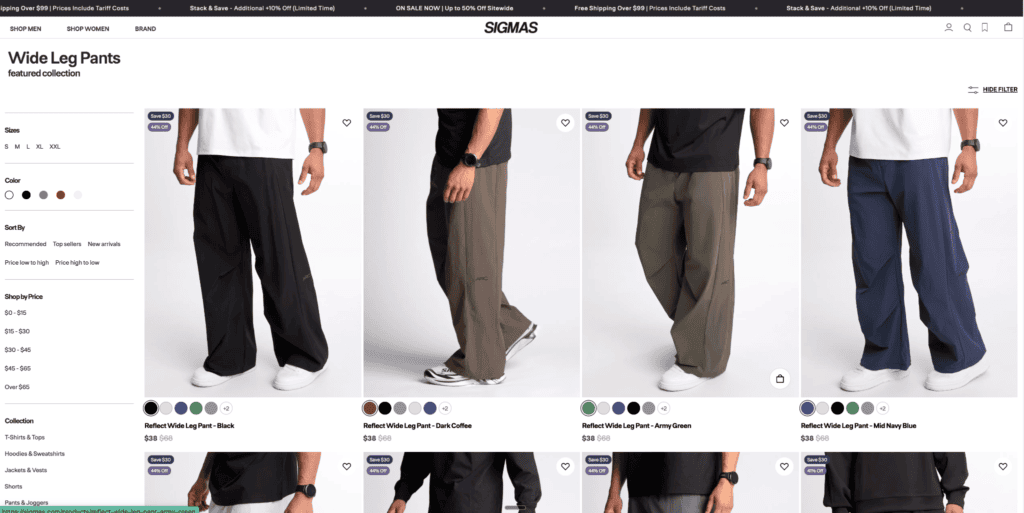
The move wasn’t driven by dissatisfaction with SHEIN. The partnership had done exactly what it was supposed to do: give SIGMAS infrastructure, customers, and the ability to validate products quickly.
But the team noticed something.
The marketplace customer and the SIGMAS customer weren’t always the same person.
Marketplace shoppers often made decisions around price, convenience, and promotions. Customers returning to SIGMAS increasingly cared about performance, identity, and the philosophy behind the brand.
At some point, the marketplace stops being the destination. It becomes the launchpad.
Owning the Relationship Changes the Business
The question became whether SIGMAS wanted to keep renting customer relationships or start owning them.
A marketplace can move products. It can’t fully build community, tell your story, or give customers somewhere to experience the brand on its own terms.
That’s what Sigmas.com changed.
SHOPLINE became the commerce infrastructure behind the transition, allowing SIGMAS to build an experience around its products rather than simply listing them on a marketplace shelf.
Christopher Yang, Co-President of SHOPLINE, described SIGMAS as the kind of ambitious, channel-native brand the platform was designed to support—one needing enterprise-level capabilities without the complexity that typically accompanies them.
The infrastructure wasn’t the experiment anymore. The brand was.
Growth Arrived Faster Than Expected
Within six months of launching Sigmas.com, the business reached an annualized revenue run rate of roughly $3 million.
Then an interesting problem emerged. Production couldn’t keep up.
Inventory planning became a bigger challenge than customer acquisition. Manufacturing timelines stretched, merchandising struggled to stay ahead of demand, and working capital became the limiting factor.
Those are frustrating problems, but they’re very different from wondering whether anyone wants your product.
Product-market fit wasn’t the primary question anymore. Scale was.
SIGMAS now has its sights set on reaching an eight-figure annual revenue run rate by the end of the year.
The Brand Expanded Beyond Men’s Activewear

Owning the customer relationship revealed something else: demand wasn’t confined to men’s apparel.
Only months after launching direct-to-consumer, SIGMAS introduced its women’s collection.
It shares the same philosophical foundation—the idea that performance starts with mindset—but wasn’t designed as a simple extension of the men’s lineup. It has its own identity.
More importantly, the expansion wasn’t driven by one breakout product. SIGMAS was seeing people connect with what the brand represented, not just what it sold.
When customers start asking for more of the brand instead of more of a particular product, something deeper may be happening.
Founders Who’ve Already Learned the Expensive Lessons
Neither SIGMAS founder is building from a blank slate.
Jay Cheng: Experience Has a Way of Compounding
Jay Cheng studied Business Economics at UCLA before joining his family’s import business, where he helped scale operations to roughly 500 employees. He later built and exited direct-to-consumer businesses during the early wave of e-commerce.
But one chapter matters particularly here.
Years ago, Jay built another company backed by Mucker Capital.
It didn’t work out.
The business leaned too heavily on marketplaces and eventually encountered the limitations many ecommerce brands discover only after years of chasing scale.
Nearly a decade later, Mucker chose to back him again.

That’s not the kind of relationship investors build out of sentiment. It’s what happens when founders demonstrate they’ve learned from failure.
The second time around, Jay isn’t building with fewer mistakes. He’s building with better ones.
Daniel Hoang: The Manufacturing Advantage
If Jay understands how businesses evolve, Daniel Hoang understands how products get made.
For more than a decade, he’s worked across activewear manufacturing, material sourcing, production engineering, and apparel development.
During SIGMAS’ incubation, he oversaw roughly 90 percent of the company’s product line and gained firsthand experience inside SHEIN’s supply chain ecosystem.
But perhaps the biggest advantage is simpler. Daniel owns a manufacturing facility in China. Most apparel startups negotiate with factories. SIGMAS builds alongside one.
That provides greater visibility into costs, timelines, materials, and quality control as demand accelerates. It also helps explain how SIGMAS pairs premium-looking performance apparel with accessible pricing.
Not because it’s cutting corners. Because it understands the system from the inside.
Value, Without the Usual Tradeoffs
Activewear is crowded. Almost every brand promises premium materials, performance, and competitive pricing.
Internally, SIGMAS has described its philosophy as “priced for destruction”—gear meant to be trained in and pushed hard, rather than treated as something too expensive to actually wear.
Years spent refining products through marketplaces, close manufacturing visibility, and rapid iteration give the company confidence.
Not confidence that every launch will succeed. Confidence that they’ll know quickly if it doesn’t.
Quietly Global From the Beginning
Some consumer brands spend years figuring out international expansion. SIGMAS grew inside infrastructure that was already global.
Its manufacturing network, marketplace experience, and operational systems weren’t designed around one country or customer base.
That doesn’t guarantee international suc
cess, but it removes many of the operational hurdles that usually slow brands down when they’re ready to expand.
For SIGMAS, going global feels less like entering new territory and more like continuing a journey already underway.
More Than an Apparel Brand?
Somewhere along the way, SIGMAS stopped talking exclusively about products.
Instead, it started talking about mindset.
One example is SIGNAL, its partnership program for trainers, coaches, athletes, and fitness practitioners.
While many activewear brands focus heavily on influencers, SIGMAS is building relationships with people who influence behavior before someone ever clicks “Buy Now.”
Coaches shape routines. Trainers build discipline. Athletes create communities.
If SIGMAS wants to empower mindset rather than simply sell performance apparel, those are logical people to build alongside. Whether that strategy scales remains to be seen.

But it’s more interesting than chasing another wave of social media impressions.
What You’re Actually Looking At
On paper, SIGMAS looks like another fast-growing activewear company.
Look closer. It’s a business that learned through volume instead of theory.
It used marketplaces as a testing ground before deciding to own the customer relationship.
It grew quickly enough that inventory—not demand—became its biggest challenge.
It’s backed by investors who’ve seen global consumer businesses scale and led by founders who already know what happens when marketplace success isn’t enough.
Now it’s expanding beyond men’s activewear while trying to build something deeper around the philosophy behind its products.
Individually, none of those things is especially rare. Together, they tell a different story.
The Interesting Part Starts Now
The funding is done. The validation is there. The infrastructure is in place. Now comes the part that’s much harder to manufacture. Turning operational excellence into emotional relevance.
Marketplaces can validate products. They can’t create belonging. Factories can produce apparel. They can’t build loyalty. Capital can accelerate growth. It can’t create conviction. That’s the challenge SIGMAS faces next. Not proving that it can sell activewear. Proving that people will choose to identify with what the brand stands for. If the first chapter was about speed, this one is about permanence. And in many ways, that’s a far more difficult story to write.