
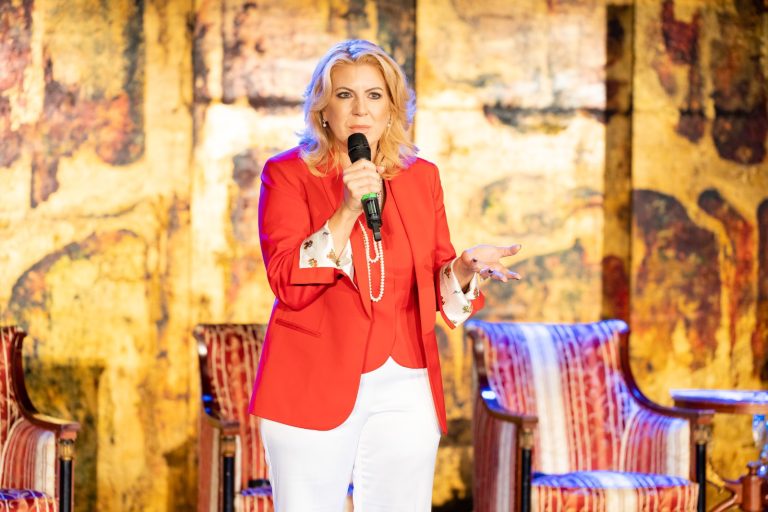
The National Confederation for Women Entrepreneurship (CONAF) is preparing a national barometer on women entrepreneurs’ access to finance in Romania. The barometer will assess access to finance for women-led companies. CONAF plans to use the data in dealings with banks, financiers and European financial institutions, Agerpres reported.
“Capital has no gender. Access to it, however, has a history worth measuring,” said Cristina Chiriac, founding president of CONAF.
What the Women Entrepreneurs Barometer Will Measure
Chiriac said the effort to measure access to capital for women entrepreneurs aims to answer a basic question. How much capital do Romanian women entrepreneurs need, how much do they request, and how much reaches their companies?

CONAF is not starting from a presumption of discrimination, she said. It will measure how much capital is needed, requested and approved, how much reaches the company, and where the process breaks down.
The Hidden Funding Gap
The analysis will also cover situations where a lack of funding reduces or postpones investments. It will try to capture what banking statistics struggle to show. One example is the entrepreneur who needs financing but no longer applies. Another is the expansion postponed for another year.
“The gap between the capital needed and the capital obtained is not just an issue for the female entrepreneur; it represents investment that fails to materialize, productivity that does not rise, jobs that are not created, and revenue that does not enter the economy,” Chiriac said.
Raluca Maria Mihaila, Chargé d’Affaires a.i. of the Romanian Embassy in Spain, said economic and human ties reinforce one another. She noted that the Romanian community is already the second-largest community of foreign entrepreneurs in Spain, and that Romanian investments in Spain are entering a new phase of maturity.
Funding structures help young founders too, as seen when young entrepreneurs secure growth through structured funding.
Spain as an Example
Chiriac spoke at the third international edition of the “Women in Economy – Spanish Edition” gala. She pointed to Spain as a contrast.
In 2025, the European Investment Bank Group supported female entrepreneurship in Spain with €620 million, the highest volume in the European Union. Six Spanish banks participate in the Gender Finance Lab.
“Spain’s example demonstrates that equal opportunity can also be supported through financial infrastructure,” Chiriac said.
From Data to Financing Instruments
CONAF will present the barometer data to European banks and financial institutions to identify any necessary financing instruments.
“If a gap is revealed, the next question will not be ‘who is to blame,’ but rather ‘what financial instrument is missing,'” Chiriac said.
That is where “Women in Economy – Capital Bridge” can begin. CONAF would contribute company and real-economy data, banks would provide financing capacity, and European institutions would offer expertise and tools. New hubs, such as a Fort Worth entrepreneur center, show how institutions pair finance with support for founders.
Monica Faro Echaniz, Communications Manager at the European Investment Bank, said access to finance can turn entrepreneurial potential into investment and growth. She stressed the role of data, appropriate financial instruments and collaboration with institutions that understand company realities.
The Madrid Gala for Women Entrepreneurs
The gala took place on Tuesday, September 29, at the Real Casino de Madrid. CONAF and the Embassy of Romania in the Kingdom of Spain organized it, in partnership with the National Heritage Institute.
Representatives of diplomatic and institutional circles, business leaders, entrepreneurs and members of the Romanian community in Spain attended. The event marked 145 years of diplomatic relations between Romania and Spain.
During the gala, ten trophies were awarded to women from various fields, and the fifth issue of the Women in Economy magazine was launched. Other governments are also redesigning how capital reaches founders, from India’s equity and milestone-based funding to Romania’s planned barometer.
Frequently asked questions
What will the CONAF barometer measure?
It will measure how much capital Romanian women entrepreneurs need, how much they request, how much is approved and how much actually reaches their companies, and where the process breaks down.
Who will see the barometer data?
CONAF will present the data to European banks and financial institutions to identify any necessary financing instruments.
What did the EIB Group support in Spain in 2025?
The European Investment Bank Group supported female entrepreneurship in Spain with €620 million, the highest volume in the European Union.