
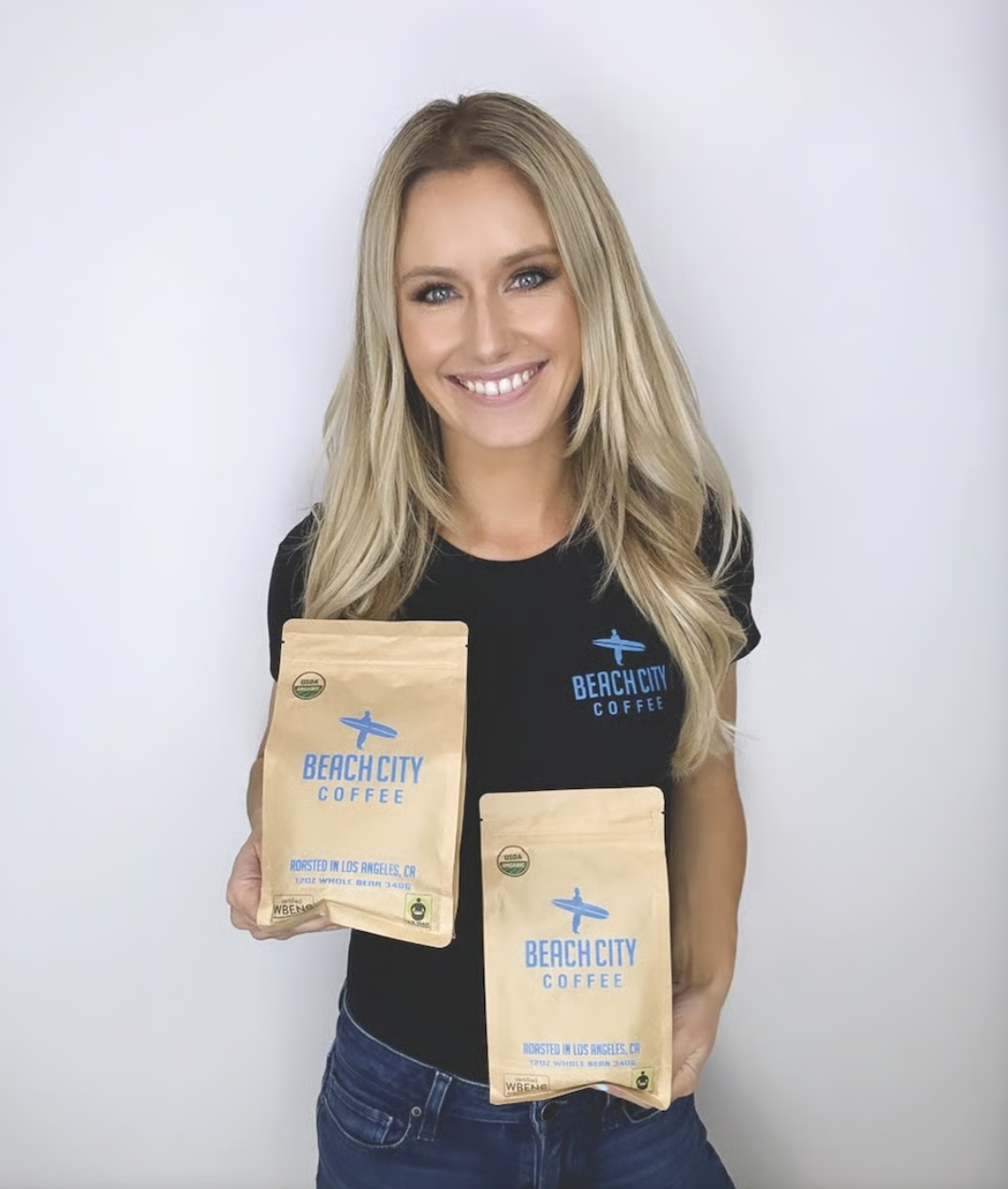
In a category as saturated and ritualized as coffee, breaking through typically requires one of two things: scale or story. Beach City Coffee has managed to build both, without taking the shortcuts that often define consumer packaged goods growth.
Founded by Jillian Salinas, the Redondo Beach-based brand didn’t begin with institutional backing or a built-in distribution engine. It started, quite literally, with a popcorn popper and a wooden spoon. More than a decade later, Beach City Coffee sits on shelves at major retailers, but the path between those two points has been anything but linear.
What’s often misunderstood about brands that suddenly “arrive” in national retail is the timeline behind them. As Salinas puts it, “People see the rapid growth, but not always the years behind it – the thousands of hours spent roasting coffee, refining the brand, and working to create something truly differentiated.” The visibility may feel sudden, but the foundation was built through years of operational learning, product refinement, and persistence in a category that doesn’t easily reward newcomers.
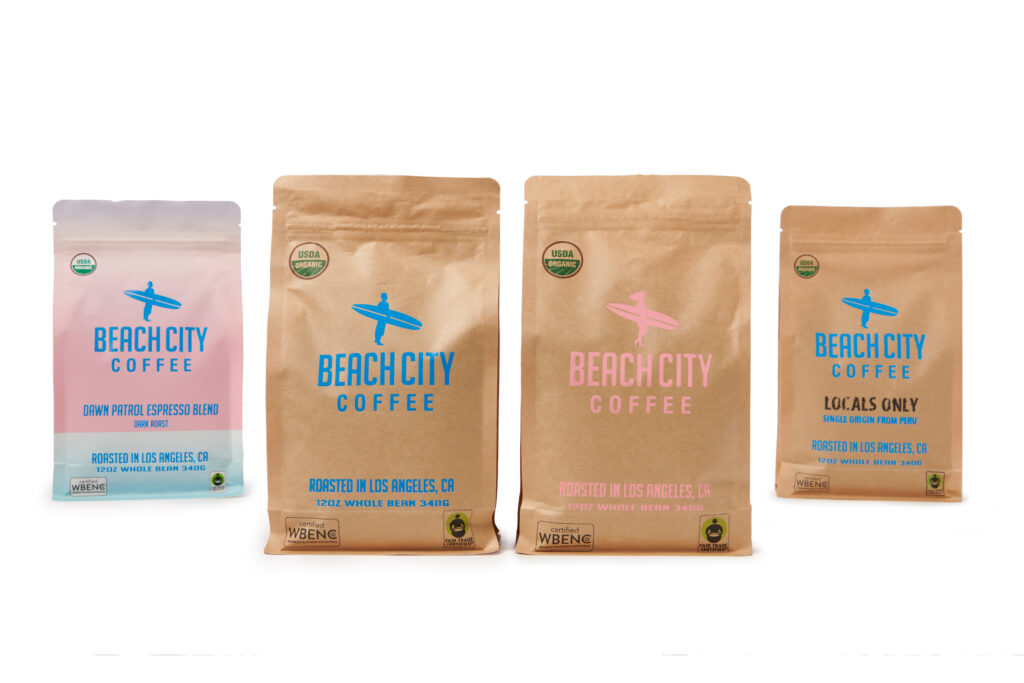
That long view shows up most clearly in the company’s structural decisions—particularly around sustainability. While many brands layer in environmental messaging once they’ve scaled, Beach City Coffee made it a constraint from the beginning. “We made a conscious decision early on to invest in compostable packaging, even though it slowed us down operationally,” Salinas says.
At the time, fully compostable solutions weren’t widely available, forcing the company to work with imperfect, more expensive alternatives. It was a decision that complicated logistics, tightened margins, and delayed growth. But it also established a point of differentiation that now defines the brand in a crowded retail environment.
That trade-off—between doing what’s easier and doing what’s aligned—comes up repeatedly in the company’s evolution. Even today, the move to 100% compostable packaging continues to introduce new operational challenges. Unlike traditional materials, these bags come with a shelf life, adding pressure to inventory planning and product launches. As Salinas notes, “many of the decisions that make the product better also make the business harder to run.”
Growth has brought its own set of tensions. One of the most pivotal shifts for the company wasn’t a retail win or product launch, but an internal transition: stepping away from doing everything.
“Externally, that looks like growth—more volume, more consistency, and the ability to scale,” Salinas explains. “But internally, it meant giving up a level of control that’s hard as a founder.” For a brand built on product integrity, handing off day-to-day roasting wasn’t just an operational decision—it was a philosophical one.
That shift from maker to operator is often where founder-led brands stall. For Beach City Coffee, it became a forcing function. “The reality is, you can’t scale if everything runs through you,” she says. Building a team, and allowing room for mistakes, was less about delegation and more about creating a system that could sustain growth.
Still, even as the business has expanded, much of the day-to-day looks less like a curated brand story and more like constant problem-solving. “Roasting and manufacturing are only one piece of it,” Salinas says. “As a founder, you end up wearing more hats than most people realize.” The work spans everything from operations to marketing to, at one point, literally pulling weeds to secure a certificate of occupancy.
That willingness to do what’s required—regardless of how it looks externally—has defined the company’s trajectory. It also reframes how success is measured. While retail expansion and national distribution are visible milestones, the signals that matter most tend to be quieter.
“We’ll hear things like someone’s favorite coffee is Beach City Coffee, or that a friend recommended us,” Salinas says. “Those moments don’t come with headlines, but they stick with me more than a lot of the bigger milestones.”
In an industry where brand loyalty is both deeply ingrained and increasingly up for grabs, that kind of organic adoption may be the clearest indicator of staying power. Beach City Coffee’s growth story isn’t about getting on shelves alone—it’s about earning a place in someone’s daily routine.
And in a category built on habit, that may be the hardest thing to scale.