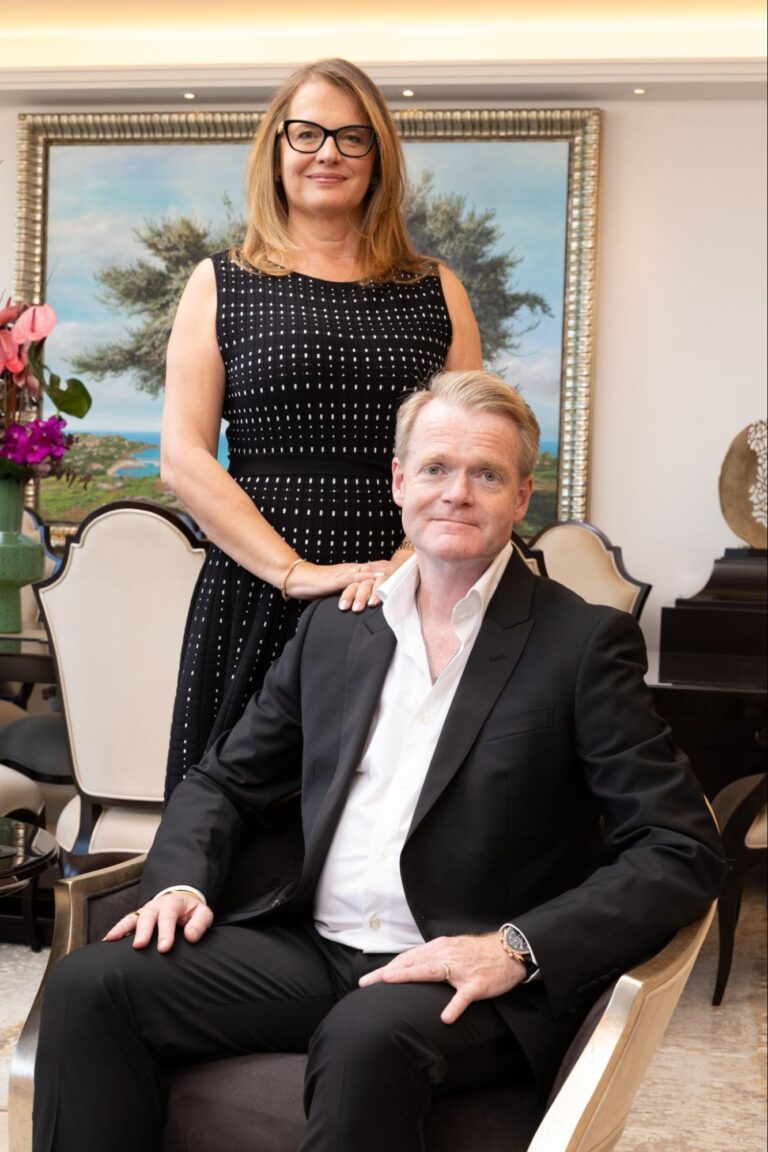
In 1981, Paul Smith left home at 17 with just £170 in his pocket. While working 120 hours a week as a sponsored engineering student, he managed to buy his first property for under £10,000 before his eighteenth birthday. Today, he oversees an international portfolio anchored by Touchstone Education—recently valued by BDO at approximately £250 million ($335 million USD)—spanning solicitors to estate agencies, and has trained tens of thousands of students internationally. His journey from a Yorkshire mining village to Monaco wasn’t built on overnight success or speculative ventures, but on a 33-year foundation of real property investment before he ever taught a single course.
The man who once ran a multi-billion-pound distillery operation employing thousands across 100 countries now focuses his attention on a different kind of operation: creating one million millionaires. Through Touchstone Education, the company he founded in 2014 with his wife, Aniko, Smith has built what may be the most comprehensive wealth and property investment training program available today. It challenges the traditional guru model by emphasizing structured systems over personality-driven hype.
From Factory Floors to Boardrooms
Smith’s engineering degree came with an unexpected education in leadership. On his first day at Ford’s engine plant, the superintendent handed him responsibility for 60 men and two production lines. He was 17 years old. “I should have eight foremen. I’ve actually got three. So you’re number four,” his boss told him matter-of-factly. When Smith protested his age and inexperience, the response was simple: “I don’t care. You are making conrods and camshafts.”
Before leaving that office, the young trainee Smith learned why positions were vacant. Heart attacks. Strokes. A man who’d lost his arm in machinery. The lesson wasn’t subtle: management means making things work despite impossible circumstances. This became Smith’s operating philosophy for the next three decades, whether running whisky distilleries or building property portfolios.
His corporate ascent took him from Ford to Rowntree Mackintosh, then nine years at Cadbury, followed by Operations Director at Whitbread, where he sat on the blue-chip’s board. The pinnacle came as Managing Director of Allied Distillers, overseeing 26 sites and operations in more than 100 countries. Throughout it all, Smith maintained his property investments, refurbishing and selling homes with the same discipline his father had taught him: live in it, improve it, sell it tax-free, repeat.
The Three-Times Rule
When he was made redundant with no pay-off in 2004, Smith already had built-in protection. His property income had surpassed his corporate salary years earlier, following a personal rule he now teaches to every Touchstone student: don’t leave your day job until property income reaches three times your salary. “I wanted both. I wanted property and employment,” Smith explains. “An entrepreneur with a wealthy mindset asks how can I do this and that, not this or that.”
Between ages 39 and 50, Smith and his wife, Aniko, shifted focus to building and selling businesses: digital marketing companies, whisky bottling operations, and commercial property ventures. By 2010, passive income from their property portfolio had created what Smith calls “a quieter life,” one with time for extended holidays and family. But quieter didn’t mean satisfied.
Friends and family began asking for property guidance. Smith spent four years offering free one-to-one education before recognizing a fundamental truth: free education produces free results. “If you’re giving somebody something for free, they don’t value it,” he realized. More importantly, teaching one person at a time would never achieve the mission forming in his mind: creating one million millionaires.
Building Systems, Not Dependency
Touchstone Education launched in 2014 with a structure deliberately designed to scale beyond Smith’s personal involvement. Critics who attack property training companies often focus on charismatic founders who overpromise personal access, then fail to deliver. Smith built the opposite model: a team of trainers, structured curriculum, and group coaching that delivers six hours of live instruction weekly for 12 months.
“When you’re training tens of thousands of students, the most efficient and effective support model isn’t one-to-one calls with the founder,” Smith acknowledges. Wealth Academy, Touchstone’s intensive program, provides daily coaching six days a week, unlimited course library access, deal clinics, and quarterly in-person events. The program represents a significant commitment, but comes with a substantial guarantee: if students don’t generate equivalent returns in additional income during their first year, Touchstone refunds the full amount.
The training covers more than property mechanics. Smith’s curriculum spans ten different property investment income streams, plus wealth protection strategies across multiple asset classes. “Property is a fantastic way to create wealth, but it’s not safe to keep all of your assets in one asset class in one country,” he teaches. His personal portfolio reflects this exact philosophy, holding over 100 Bitcoin, over $15 million in physical gold and silver bullion, global stocks, and property internationally.
Student outcomes tell the story Smith considers most important: tens of thousands of graduates holding property collectively valued in the billions, backed by thousands of Trustpilot reviews averaging near-perfect customer satisfaction. These aren’t hypothetical results or cherry-picked testimonials; they’re independently verified portfolios built by ordinary people following a system Smith tested across three decades before teaching it.
The Oxygen Theory of Money
Smith describes money through an unusual metaphor that reveals his underlying philosophy. “Money is like oxygen,” he says. “Until I said oxygen, you weren’t thinking about whether there’s enough oxygen in this room to breathe. But if you were trapped underground in a small cave with five other people and the air was running out, oxygen will be the only thing you’re thinking about.”
His point cuts through typical wealth-building rhetoric: money itself isn’t the goal. Abundance is. The difference between rich and wealthy, in Smith’s framework, is the difference between selling your time and owning assets that produce income without your involvement. “Rich is where you exchange your time for money. You sell your life for money. That’s called working. Wealth is where you own assets that give you money in exchange for none of your time.”
This distinction shapes Touchstone’s entire methodology. Students aren’t taught to flip properties for quick cash or leverage themselves into risky positions. They learn what Smith calls the “three-legged milking stool”: multiple income streams that provide stability when one fails. The strategy emphasizes lease options, rent-to-rent arrangements, deal packaging, and joint ventures, approaches requiring minimal capital that can be executed while maintaining full-time employment.
“For anyone out there that’s thinking, I’d like to be a property entrepreneur and I hate my boss and I hate my job and I hate commuting, I know. So did I,” Smith acknowledges. “But I did both until I reached a critical mass. It was hard work but I’m glad I did it.” The message consistently challenges get-rich-quick expectations: wealth building requires patience, systems, and the discipline to maintain security while building alternatives.
Lessons From Near-Death
At 14, Smith spent 15 months hospitalized with Crohn’s disease. During one operation, he was told to say goodbye to his family. A priest administered last rites. Doctors didn’t expect him to survive. “That lesson taught me that every single second is so precious,” Smith reflects. “Most people think they’re going to live forever. Most people don’t think about the meaning of life until they’re 60, 70, 80 years old. At the age of 14, I was told I was going to die.”
That experience created urgency that shapes everything Smith has built since. While most teenagers were worried about exams and social status, he was working three jobs and saving for his first property purchase. While peers in their twenties were establishing careers, he was simultaneously climbing corporate ranks and building a property portfolio. The knowledge that time is finite, genuinely understood at 14, became a competitive advantage throughout his life.
His mother’s advice reinforces this philosophy of continuous learning: “You’ve got one of these and two of these,” she’d tell him, pointing to her mouth and ears. “Use them in that ratio. Listen twice as much as you speak. If you listen, you might learn something you don’t know. If you’re speaking, you’re saying things you do know.” Smith credits this principle for keeping him open to new strategies even after decades of success.
The Monaco Decision and the Legacy Blueprint
When Smith moved to Monaco, there was speculation that tax savings had driven the decision. His response challenges that assumption: “If I wanted to save tax, I’d move to Antigua where there’s no tax of any kind. Or I’d move to Dubai. You don’t come to Monaco primarily to save tax.” Instead, he cites the three C’s: culture, climate, and cuisine. His first Monaco visit came standing on the cheapest section of the Formula 1 circuit, eating from food vans while watching cars race past. “From the first time I came here, I loved it,” he recalls.
Twenty-five years passed between that first visit and his eventual move. Smith admits he didn’t know how to relocate to Monaco or what requirements he’d need to meet. The dream seemed impossibly large, exactly as he believes dreams should be: “If your dreams don’t scare you, they’re not big enough,” he often remarks.
Today, Paul operates as the architect of his international businesses, focusing not on the day-to-day weeds of property management but on guiding others toward real wealth protection and a lasting legacy. Yet, he maintains a strict standard of transparency: these results are absolutely not typical, and there is no chance of replicating them without the right education, support, and guidance. The blueprint exists, but the execution requires patience, systems, and a willingness to do the work.