The conversation usually starts the same way. You notice Mom moving a little slower. Dad seems unsteady on his feet. Suddenly, you’re Googling nursing homes at midnight, wondering how your family got here so fast.
But a growing number of families are beginning to explore a different path — one that keeps aging parents at home and lets artificial intelligence do the watching. Kami Vision, the San Jose company behind this emerging solution, has built technology that detects falls with 99.5 percent accuracy and alerts families within seconds. With a platform already serving 7 million users across 120+ countries, KamiVision brings proven scale and operational expertise to KamiCare — a consumer solution currently in beta testing across homes in the U.S., with a full launch expected later in 2026.
The Technology That’s Replacing Traditional Care Models Forever
Here’s what most people don’t realize about nursing homes: they’re expensive, and most seniors don’t want to be there. AARP research shows 75 percent of adults over 50 want to age at home. The challenge has always been safety.
Traditional medical alert pendants require the wearer to press a button during an emergency. That works until someone falls and becomes disoriented or unconscious. Suddenly, that pendant becomes useless jewelry.
KamiCare’s approach eliminates this flaw. Their AI-powered cameras watch continuously, detecting when someone has gone to the ground — whether from a fall, a stumble, or simply finding themselves unable to get back up without assistance. This matters because not every ground-level event looks the same. Someone scooting, struggling to rise, or needing extra help moving through their home can be just as important for a family to know about as a sudden fall. No button pressing required. When a ground event is detected, an immediate alert is sent to the resident first, and if they are unable to respond, designated contacts assigned during installation are notified automatically. From there, those contacts can call 911 directly through the app, putting emergency help just one tap away.
How KamiCare Protects Privacy Without Sacrificing Safety
Privacy concerns represent the biggest obstacle for families considering camera-based monitoring solutions. Nobody wants Grandma living in a surveillance state. KamiVision addresses this with an architecture designed around dignity.
The system only records during detected events, not continuously. In the communities and facilities version of KamiCare, professional monitors review blurred, anonymized footage without identifying information, and only authorized family members can access clear recordings. This privacy-first design is exactly why the technology gained traction in professional settings first, and KamiVision’s platform now protects residents across more than 1,000 monitored beds in senior living facilities nationwide.
The consumer version of KamiCare builds on this foundation while adding live view and two-way audio — features that make sense in a home environment where families want the ability to check in on a loved one at any time or communicate directly in the moments after a fall is detected. It is not surveillance imposed by others, but a tool families choose together, on their own terms.
Alerts That Mean Something When It Matters Most
The problem with most security cameras is notification fatigue. Your phone buzzes constantly for pets, shadows, and passing cars. Eventually, you start ignoring every alert — and for the millions of adult children keeping a watchful eye on aging parents from a distance, that is a risk nobody can afford to take.
This is where KamiCare’s AI changes everything. Rather than flagging every movement, the system is trained to understand context. With algorithms built on thousands of documented fall incidents, KamiCare distinguishes between routine daily activity and genuine ground-level events that require attention — whether that’s a sudden fall, a struggle to get up, or signs that a loved one needs a little extra help getting around. When an alert does come through, families can trust that it means something. And when every second counts, that difference matters enormously.
When Every Second Counts: How KamiCare Responds When It Matters Most
When seconds matter, traditional emergency response can feel painfully slow. Someone falls, maybe calls 911 if they’re conscious, waits for dispatch, waits for responders to arrive. Every minute spent on the ground increases the risk of complications — and for seniors living alone, that window can stretch far too long.
KamiCare compresses that timeline. The moment a ground-level event is detected, an immediate alert goes to the resident first. If they are unable to respond, designated contacts assigned during installation are notified automatically. From there, those contacts can call 911 directly through the app, putting emergency help just one tap away.
Behind this response capability is a company with deep roots in computer vision and camera technology. KamiVision powers 15 million devices worldwide and holds over 60 patents covering innovations in AI and imaging — infrastructure that took years to build and brings enterprise-grade reliability to every KamiCare installation.
Commercial AI Security Solutions Prove the Technology Works at Scale
Before trusting any technology with your parents’ safety, you want proof it works. The best evidence comes from commercial AI security solutions deployed in demanding professional environments.
Kami Vision’s platform manages 248 million daily alerts and 25 petabytes of data. These aren’t theoretical numbers from a lab. This represents real-world performance across senior living communities, memory care facilities, and skilled nursing environments where falls happen constantly and liability exposure runs high.
The company raised $10 million from East West Bank early on to fuel expansion while maintaining disciplined unit economics. They’ve also announced a potential wearable smart ring at CES 2026 tracking heart rate, blood oxygen, and sleep patterns while providing mobile fall detection for seniors who leave the house. This will potentially be released by 2027.
Why This Matters More Than Any Gadget Review
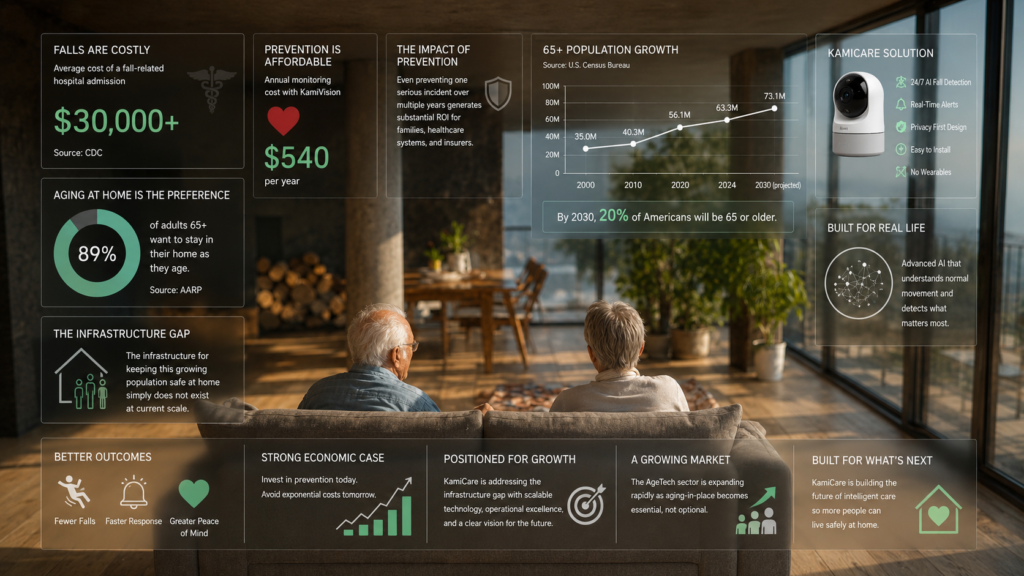
Let’s step back from technology for a moment. The demographic forces driving demand for these solutions are staggering. The U.S. Census Bureau reports over 61 million Americans are now 65 or older, and that population grew 13 percent between 2020 and 2024, significantly outpacing overall population growth.
One in four older adults falls each year, according to CDC data. Federal statistics show healthcare spending on fall-related injuries exceeds $80 billion annually. A single fall-related hospital admission averages over $30,000 in costs. The math increasingly favors prevention investments for families, healthcare systems, and insurers alike.
The Future of Aging in Place Starts Now
Kami Vision represents something larger than a single company making cameras. It signals a fundamental shift in how we think about elder care. Instead of warehousing seniors in institutional settings, technology now enables genuine independence with appropriate safety nets.
The emotional weight of these decisions shouldn’t be underestimated. Families wrestling with aging parents face impossible choices between safety and autonomy, proximity and practicality. Technology that threads this needle respectfully deserves serious attention.
For the millions of adult children lying awake at 3 AM worrying about Mom or Dad living alone, solutions finally exist that don’t require uprooting everyone’s life. The infrastructure for aging in place is being built right now, one camera and one algorithm at a time.
Sometimes the most progressive choice isn’t the newest technology. It’s technology designed to preserve what matters most: independence, dignity, and the simple right to grow old in your own home.