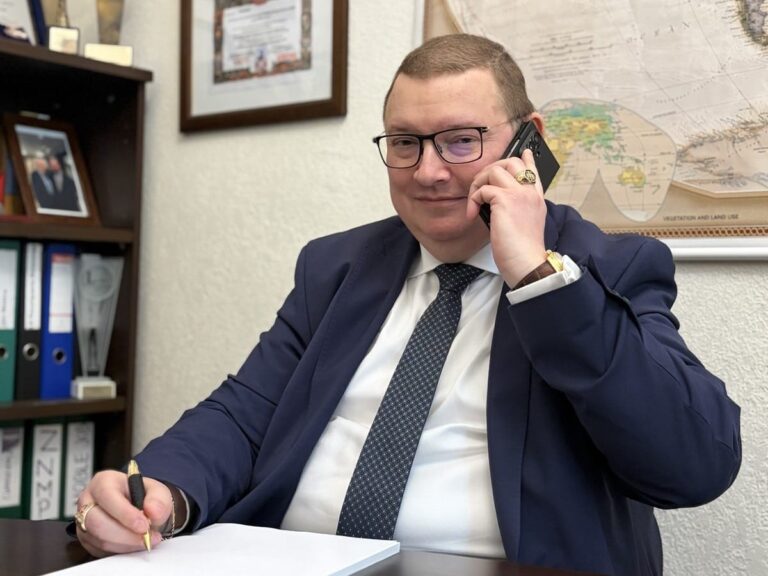
Maciej Lisowski doesn’t love being called a “public figure”; he says it’s too vague a label. Lawyer, former public official, reserve colonel, author of the book Prawo i Pięść (“Law and the Fist”), holder of an Executive MBA, a DBA, and twelve postgraduate diplomas from seven Polish universities, and for the past sixteen years, founder and president of the LEX NOSTRA Foundation, one of Poland’s more visible organizations working on legal aid and civic education. We sat down to talk less about individual cases and more about the logic behind the whole project.
Let’s start from the beginning. People say the idea for LEX NOSTRA came out of personal experience rather than theory. Is that accurate?
It is, and I don’t see much point dressing it up. As a young man I was building my first company, and at some point it attracted attention from people connected to old post-communist intelligence structures. The offer was simple: a stake in the company in exchange for “protection.” I refused, and spent the next few years dealing with the fallout: financial, reputational, all of it.
That sounds like a story from the nineties, somewhere else entirely.
That’s exactly the point. This was Poland, after the transition from communism. People assume the transition was mostly about elections and privatization. In reality, it also meant a lot of people were left with no protection at all, because the old structures had been dismantled and the new ones weren’t functioning yet. I was one of those people.
And that became a defining theme for you going forward?
Exactly. I stopped thinking about legal institutions as something abstract. I started thinking in different terms: what happens to an ordinary person when they’re up against a system, or a network of influence, that they don’t fully understand and can’t challenge alone.
There’s another episode in your background, Moscow, 2004. Can you tell me more about that?
It was a trip connected to Poland’s economic security. Partway through, it became clear that the person accompanying me was working for Russian military intelligence. I had to go into hiding, and was eventually evacuated through the embassy.
Were you scared?
Of course. But the real lesson wasn’t about fear, it was about how you handle it. Genuine composure rarely looks dramatic. It’s not about heroic gestures. It’s the ability to keep thinking clearly at the exact moment when panic would be the natural response.
How long after that did LEX NOSTRA come into being?
Not immediately, but those experiences shaped how I later thought about the foundation. I didn’t want to build an organization that just gives advice. People caught in a conflict with the system, or harmed by a crime, don’t need sympathy so much as tools: legal, media, educational.
You draw a fairly sharp line between charity and what you actually do. Why?
Because charity doesn’t imply conflict with the system, and sometimes that’s exactly what we’re doing. LEX NOSTRA isn’t just a law office, and it’s not a civic organization in the narrow sense either. I prefer to call it an instrument.
Over time, a whole ecosystem grew up around the foundation: a law firm, a media company, a PR arm. Why complicate the structure like that?
Because an organization operating in a politically sensitive environment can’t afford to depend on a single source of influence, a single donor, a single channel. I have a simple way of putting it: one stick is easy to break, a bundle of sticks tied together is not. A single organization is weak. An ecosystem is resilient.
So it’s not growth for growth’s sake.
No. It’s about making sure the foundation is never dependent on anyone’s goodwill, not a politician’s, not a donor’s, not a media outlet’s. We’ve deliberately avoided relying on a single funding source.
Let’s get specific. One of the foundation’s most visible cases is Andrei Zhukovets.
That was a very telling case. Zhukovets is a Belarusian opposition figure who ended up in Poland after facing persecution at home. When the Belarusian side tried to pursue his extradition, we ran into serious distortions in the translated case files, and clear political pressure on the proceedings, even on the Polish side. We made sure the case didn’t disappear from public view. It was eventually discontinued in 2014 on statute of limitations grounds, after several years of litigation.
And the Witold Karczewski case?
A different kind of story. We publicly documented Karczewski’s alleged ties to the Lukashenka regime. I reported my concerns to Polish special services back in 2016, after which the prosecutor’s office in Białystok opened an inquiry. Almost a decade later, as I understand it, an indictment was filed, involving allegations of bribing an official in an African state.
Aren’t you worried that public pressure in cases like this starts to look like a substitute for the justice system?
No, because it isn’t a substitute, it’s a safeguard. Courts and institutions operate through formal procedures. But when those procedures are being distorted, stalled, or deliberately confused, public attention becomes a tool that keeps a person inside the system from becoming invisible. One doesn’t replace the other.
You talk a lot about Central Europe as its own region, not a periphery of Western Europe. Where does that emphasis come from?
The countries between the Baltic, the Adriatic, and the Black Sea have lived through authoritarian pressure, foreign influence, and a painful institutional transition, the very things Western Europe is only now starting to confront seriously. For us it isn’t theory, it’s lived experience. It feels unfair to me that the region is still often treated as secondary.
How does that connect to your role at the Three Seas Foundation and the Kornel Morawiecki Institute of Thought?
Directly. Both are about making sure Central Europe has its own voice in the conversation about Europe’s security and democratic future, rather than playing the role of a student still borrowing someone else’s model.
Looking back, how do you personally measure success in this work, through cases won, through visibility?
More through whether the structure outlives the people who built it. I’m not especially interested in my own reputation as a legacy. What interests me more is whether the foundation would keep working the same way if I weren’t around tomorrow.
That’s a fairly grim note for an interview.
(laughs) We have a saying in Poland: a coffin has no pockets. It sums up my priorities pretty well. Money, status, comfort, all of that exists, but it’s not the measure I use for whether a life’s work meant something. Institutions are.
Last question. The foundation has taken on cases against businesspeople, against politicians, against structures on different sides of the political spectrum. Aren’t you worried about making enemies on every side at once?
That’s unavoidable if you defend people who are inconvenient to someone. The opponents change from case to case: today it might be a business, tomorrow a prosecutor’s office, the day after that, the media. If an organization isn’t partisan and is genuinely independent, sooner or later it will irritate everyone. I don’t see that as a problem. I see it as confirmation that independence isn’t a line for a brochure, it’s the operating condition without which none of this work would mean anything at all.