Nuclear power is in the midst of a revival. Some have been hesitant to accept it, but recent advances in safety and concerns about clean, sustainable energy have put it back in the spotlight. Today’s nuclear power isn’t the nuclear power of decades ago. The difference becomes apparent when comparing Cold War-era enrichment facilities to those of modern companies like LIS Technologies.
LIS Technologies is a company focused on laser uranium enrichment. It’s based in Oak Ridge, Tennessee, which was at the center of the U.S. nuclear industry until the 1990s.
“The U.S. used to be the world’s biggest exporter of enriched uranium,” says Christo Liebenberg, co-founder of LIS Technologies. “It started as the Manhattan Project in the U.S. in Oak Ridge. It started right there, where our new building is, literally within a mile of our new building.”
After the fall of the Soviet Union, the U.S. abandoned its enrichment program to purchase inexpensive enriched uranium from Russia. The country’s uranium-enrichment infrastructure stood empty for years and was later decommissioned.
The most notable part of that infrastructure was the K-25 building in Oak Ridge. It was built in 1944, and at the time, it was the largest building in the world. The K-25 building served as a gaseous diffusion plant.
Gaseous diffusion is an older method of uranium enrichment that repeatedly pushes uranium gas through a porous barrier to isolate the U-235 isotope. Gas had to pass through hundreds of cascades, and the system took up a massive amount of space and energy. The four-story K-25 building was 5.264 million square feet.
Enrichment facilities like the K-25 building didn’t just take up physical space. They also placed enormous demand on the surrounding area’s power grid.
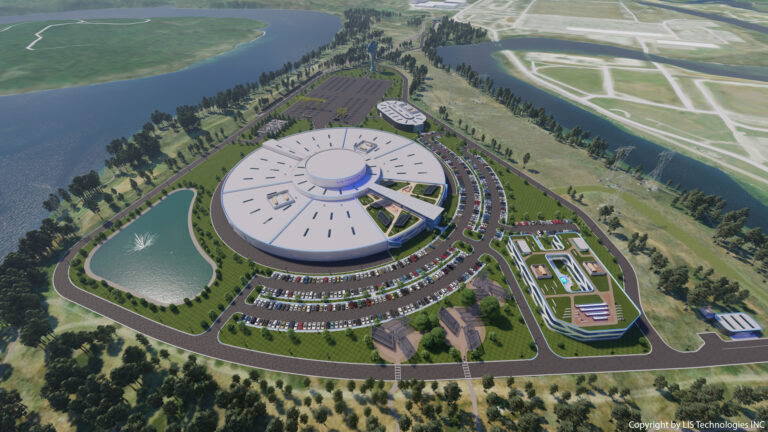
Today’s enrichment facilities have a much smaller footprint in terms of both space and electricity usage. Many use gas centrifuge technology to isolate U-235. However, thanks to the laser-enrichment techniques LIS Technologies has developed, enrichment facility footprints are about to get even smaller.
“Lasers have always been seen as the holy grail of enrichment technologies. The lasers’ wavelength can be selectively tuned to excite only U-235; it’s more elegant, more precise,” Liebenberg explains. “And it’s much more cost-effective, with a much smaller footprint than your typical centrifuge enrichment.”
That smaller footprint is a direct result of the streamlining of the enrichment process. Cold War-era facilities primarily produced low-enriched uranium (LEU), a fuel containing up to 5% U-235. Many newer reactors require high-assay low-enriched uranium (HALEU), which contains up to 20% U-235.
Modern gas centrifuge facilities take up much less space than gaseous diffusion plants like the K-25 building. However, they still must house hundreds of cascades. With laser enrichment, a process that once took hundreds of steps now takes one or two.
“Single-stage means you irradiate the uranium once, and it’s enriched all the way from natural to the LEU level,” says Liebenberg. “If you take that LEU and irradiate it again in the second stage, you can go all the way to HALEU, or 20%.”
That kind of ultra-efficient enrichment technology might sound too good to be true. And while it’s an exciting prospect for the U.S. nuclear industry, we won’t be seeing commercial laser-enrichment facilities popping up just yet. LIS Technologies must first clear a number of regulatory hurdles.
“To do experiments with small quantities of uranium, a state license will suffice. But at a commercial scale, you need a license from the NRC [Nuclear Regulatory Commission],” Liebenberg says. “It can take up to five years to do the integrated safety analysis and environmental reports. However, we believe we can get that all done in half that time.”
This means that LIS Technologies could be opening an ultra-modern enrichment facility in just a few short years. Like many in the field, Liebenberg is optimistic.
“There’s a huge resurrection, a huge resurgence of nuclear power,” he says. “We are in the middle of a second nuclear age. It can be done!”