

Hiring in the technology sector has a problem that most companies are reluctant to admit: strong candidates are disappearing before they ever reach an interview, not because they lack qualifications, but because the process designed to find them is too slow, too inconsistent, and not focused on quality.
For Jhillika Kumar, founder and CEO of Mentra, this is not a new observation, it is the reason she built her company. Mentra’s Cognitive Architecture Matching (CAM) system evaluates fit across five neurocognitive dimensions, including working style, cognitive strengths, and accommodation needs, producing matches that go far beyond resume compatibility.
Jhillika Kumar grew up watching her brother, Vikram, a non-speaking autistic individual, be passed over by a workforce that had no mechanism to recognize his capabilities. When therapy finally gave him the tools to communicate, one of the first things he typed was: “I want to get a job.” That moment forced a question Jhillika Kumar could not set aside: how many others, with real skills and genuine ambition, were falling through the cracks of a system never designed with them in mind?
The answer became Mentra. Founded out of Georgia Tech and backed by investors including Sam Altman, Mentra is an AI-driven hiring platform built to match talent with companies using structured data and skills-based evaluation. Jhillika Kumar was named to the Forbes 30 Under 30 list for this work, and Mentra has become one of the most recognized names in neuroinclusive hiring across the U.S. market.
Better Data, Less Cognitive Friction, Faster Job Matching
For most, applying for work often leaves job seekers feeling inadequate: upload a resume, fill out the same form fifteen times, watch your application disappear. For neurodivergent candidates, many of whom process information, communicate, and demonstrate capability differently, that friction is not just frustrating. It is disqualifying.
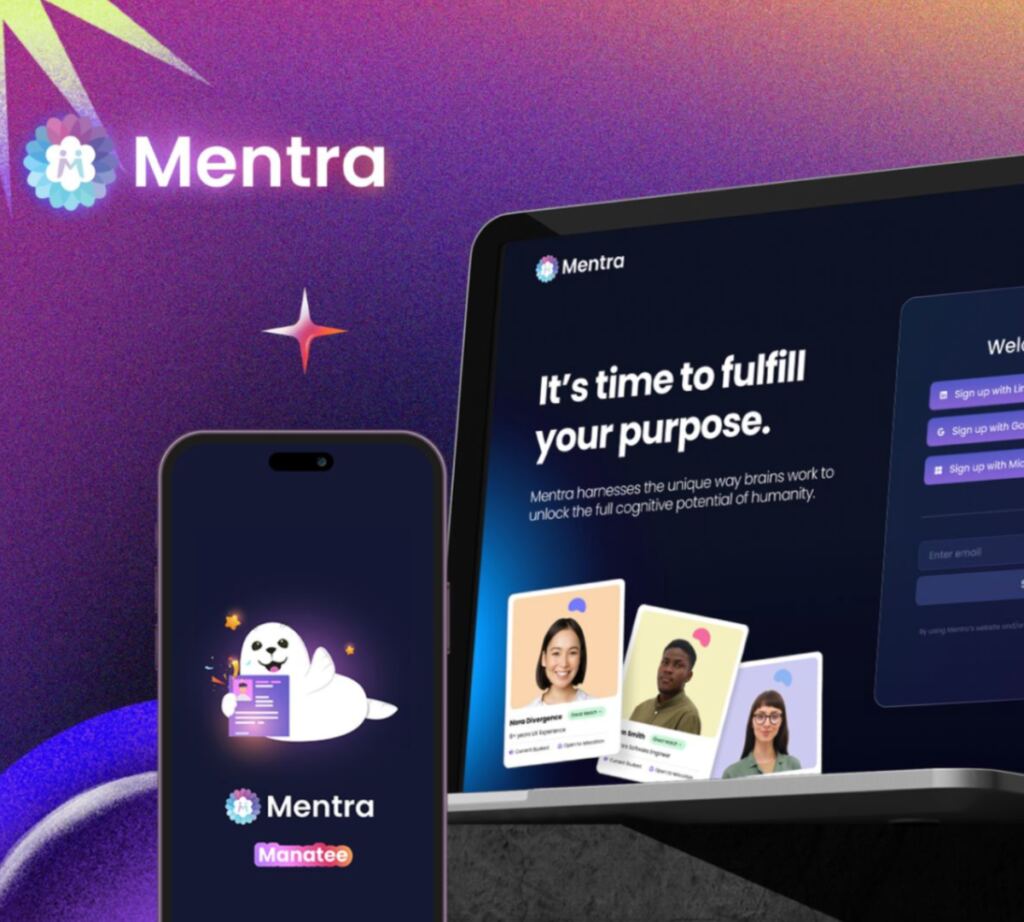
Mentra removes the resume as the entry point entirely. Instead, a conversational AI companion called Manatee (inspired by the owl from Duolingo) guides candidates through a short onboarding experience built around cognitive strengths, pattern recognition, systems thinking, emotional intelligence, and attention to detail, mapping them to a Cognitive Architecture Match score (CAM). The result is a profile that reflects how someone actually works, not just what their last job title was.
What happens next is the part that surprises people. Rather than returning a list of job titles, Mentra surfaces a curated daily match of a single role chosen specifically for that person’s cognitive profile. It doesn’t just explain why the role fits in plain language; it shares the cognitive reasoning behind the match, e.g., your systems thinking and attention to detail are exactly how this team operates. For a community that has spent years being told to shrink themselves to fit a system that was never built for them, that level of specificity is not a feature, it is the whole point.
Why Inbound Hiring Is Failing Fast-Growing Teams
The market insight driving Mentra is straightforward. Neurodivergent or not, signal matters more than most realize. In a world where new jobs emerge every day, cognitive fit is what matters most, given that technical skills can be learned on the job. Rather than a traditional application process, Mentra’s Unicorn Search flips this entirely; recruiters describe who they’re looking for in plain language, and the AI agent surfaces pre-vetted candidates from a database built on structured data points.
Rather than managing inbound noise, Mentra builds curated pipelines of pre-vetted talent before a role opens. One early-stage startup Kumar worked with spent weeks reviewing hundreds of resumes without a single viable hire. After shifting to a curated pipeline approach, they made a strong hire within two weeks. The difference was not effort, it was where that effort was applied.
From Georgia Tech to a Global Hiring Network
When Kumar co-founded Mentra at Georgia Tech, she built the platform through community-driven research with neurodivergent individuals, vocational training centers, and disability advocacy organizations across the United States. The platform evaluates more than 75 data points per candidate, including skills, working style, and accommodation needs, to produce matches that go well beyond resume compatibility. Built on Microsoft AI for Accessibility, Mentra has been featured by Microsoft as a model for inclusive technology. Jhillika Kumar has also spoken at the Grace Hopper Celebration as a keynote speaker on neurodiversity in the workforce.
The companies Kumar works with are not failing in their hiring process because they lack ambition or resources. They are failing because they are running outdated processes built for a different era, slow, inconsistent, and designed around volume rather than fit. Curated pipelines, structured evaluation, and faster decisions are not radical ideas. They are disciplines applied to a system that has been left on autopilot for too long.
Mentra is not just filling roles. It is redefining how talent is recognized and matched in the first place. The companies that win the next decade of talent acquisition will not be the ones with the biggest applicant pools. They will be the ones with the best-designed hiring systems.