
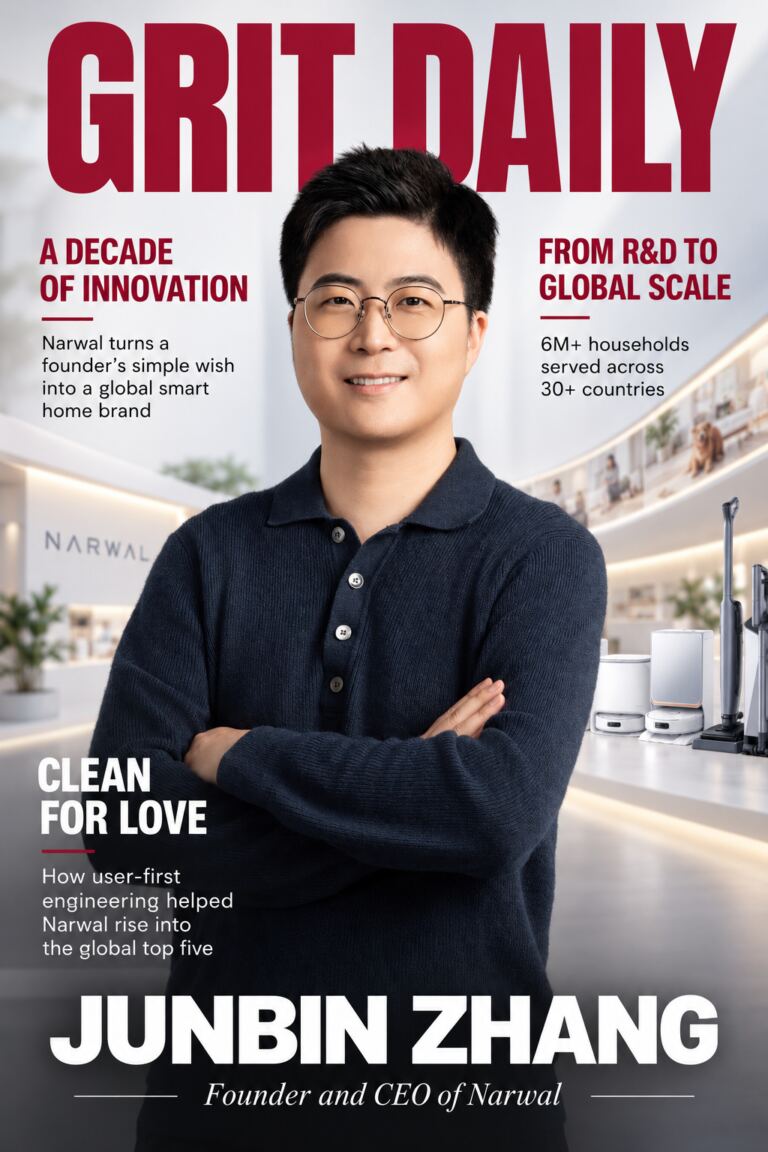
For the first three years of Narwal’s existence, Junbin Zhang had no products to ship.
The company he founded in 2016 occupied a 270-square-foot office in Dongguan, China, with fewer than ten people working on a problem most households know well: mopping floors takes time, and even the tools designed to make cleaning easier require maintenance of their own.
Zhang had been inspired by his mother’s frustration with the physical demands of mopping. He wanted to develop a machine that could handle the work without requiring someone to clean the equipment after every use.
It was a straightforward idea with a difficult engineering challenge behind it. Building a robot that could vacuum and mop was one thing. Creating a system that could wash its own cleaning pads required a different approach.
Zhang and his team spent three years developing that solution before bringing a product to market.
A decade later, Narwal reports serving more than six million households across over 30 countries and regions. According to 2025 shipment data from market research firm IDC, the company ranks among the world’s five largest robot vacuum brands.
“Narwal started with a simple wish: to make my mother’s life a little easier,” Zhang said as the company marked its tenth anniversary. “That same wish now lives in more than 6 million homes globally.”
Three Years Without a Product
For a hardware startup, delaying commercial sales carries considerable risk. Development consumes capital, and competitors can move quickly while a company is still refining its first product.
Narwal took that risk. Its engineers concentrated on building a robot vacuum and mop that could return to its base station, wash its mop pads, and continue cleaning with less manual intervention.
The work produced the Narwal T10 in 2019, introducing an automatic mop-washing system that would become a defining feature of the company’s products. The T10 subsequently earned a place on TIME magazine’s Best Inventions of 2020 list.
The recognition brought attention to a company that had spent its early years almost entirely on research.
It also established a direction for future development. Instead of treating automated cleaning as a problem solved by basic navigation, Narwal began addressing the smaller frustrations that still required human attention.
Its subsequent innovations included automatic water refilling, AI-powered dirt detection, and brush systems designed to reduce tangled hair. More recent products have focused on sophisticated obstacle recognition and mop systems that clean themselves during operation.
These developments reflect a substantial investment in engineering. Narwal reports more than 1,500 patent filings and over 700 engineers, representing more than 40% of its global workforce.
The company has also chosen to control its supply chain from research and development through manufacturing and delivery. That structure requires significant investment, but it gives Narwal greater oversight of product development, production costs, and the process of refining new technology.
For Zhang, maintaining that connection between engineering and manufacturing has become increasingly important as the business expands.
Turning Engineering Into Global Growth
The results of that investment are increasingly visible in Narwal’s commercial performance.
In 2025, the company shipped approximately 1.7 million units worldwide, an increase of 28.7% from the previous year. Overseas revenue also grew nearly 50% year over year during the first four months of 2026, according to company figures.
Its recent product launches illustrate how Narwal is competing internationally.
The flagship Flow 2, introduced in April 2026, features an advanced track-mopping system designed to keep its cleaning surface fresh throughout operation. Narwal reported that the model reached the top of Amazon’s U.S. robot vacuum new-release rankings within 24 hours of launch.
Still, competing in the smart home market requires more than adding increasingly sophisticated features. Customers expect expensive cleaning equipment to work reliably in ordinary homes, where furniture, pets, carpets, and unexpected obstacles rarely follow predictable patterns.
That practical challenge continues to shape Zhang’s thinking.
In a September 2026 interview, he acknowledged that even advanced robotic cleaners struggle to reach every part of a furnished home. Difficult corners and objects remain obstacles, while improvements in navigation and cleaning performance create new expectations.
Narwal’s next phase of development will focus on those remaining challenges while exploring broader applications for spatial cleaning technology.
The opportunity is considerable. Robotic cleaners have become increasingly familiar consumer products, but household adoption remains far below that of conventional home appliances in many markets.
For Zhang, the company’s growth hasn’t changed the principle that inspired its first product.
“What I’m most proud of isn’t our scale; it’s that our DNA hasn’t changed,” he said. “We still build products the way we did from day one: by looking at a real problem a family faces with floor care and engineering a dedicated solution for it.”
What began as an attempt to spare his mother the work of mopping has become an international robotics company. Ten years on, the question driving Narwal’s engineers is much the same. How much more of that work can a machine take off someone’s hands?