
USDA is directing a fresh wave of money toward regenerative practices, expanding its Regenerative Pilot Program to $1 billion for fiscal 2027 through EQIP and CSP. The agency’s own rules still lean on periodic soil health tests at the start and end of a contract. Farmers adopting cover crops, reduced tillage, or nutrient management get financial support and a before-and-after snapshot. What they still lack is a practical, continuous way to see whether the living biology underneath those practices is actually responding in real time.
That measurement gap is becoming harder to ignore as continuous sensing spreads. Penn’s IoT4Ag center is pushing one-cent biodegradable soil sensors that report root-zone moisture and chemistry, while CropX just signed on to supply ongoing field intelligence for a major regenerative potato program in New Zealand. These tools track the physical and chemical environment well. BioSensor Solutions, a CU Boulder spinout, is commercializing sensors that track the biological engine that turns those practices into results.
The Gap Between Chemistry and Living Soil
Traditional soil tests and even many modern probes leave growers guessing about the processes that drive nutrient availability, organic-matter breakdown, and long-term resilience. A recent North Carolina State study reinforced the point: microbial biomass and necromass shift measurably within one or two seasons under regenerative practices, years before bulk soil carbon tests register change. Farmers and input companies already feel the practical version of this lag. Biological products and cover-crop systems produce inconsistent results, fertilizer recommendations stay conservative or wasteful, and carbon or sustainability claims remain hard to prove at field scale, even when USDA or private programs are paying for the practices.
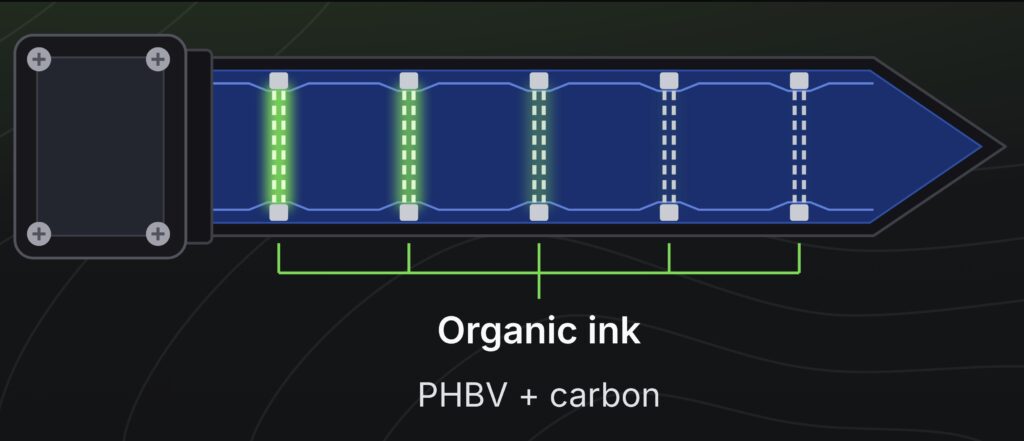
BioSensor’s answer is a printed, partially biodegradable sensor developed in Professor Gregory Whiting’s BEEM Lab at CU Boulder and exclusively licensed under U.S. Patent 12,270,066. The device uses a conductive biopolymer ink (PHBV-based) that soil microbes naturally break down. As decomposition occurs, the sensor’s electrical properties change, producing a continuous readout of microbial activity alongside moisture, temperature, and soil CO₂. Data flows to the SoilData.ai platform so growers, advisors, and biologicals companies can see treated-versus-control response in near real time rather than waiting for the next lab cycle or contract-end test.
The Path From Lab to Field
CEO and co-founder David Beitz, who launched the company in 2023 with Carl Kalin through CU Boulder’s Embark deep-tech program, has kept the focus on usable proof for people who manage land and sell products into it. The company has tested its sensors at Boone Fox Farm in Columbia, South Carolina. The company recently delivered sensors to the South Carolina Governor’s School for Agriculture at John de la Howe, where students and staff are installing the devices. A paid pilot is under way with the International Rice Research Institute in the Philippines. In Colorado, five networked sensors went live in October at a new NSF soil-sensor test bed in Fraser. Selection into the Innosphere/NSF ASCEND SHIELD accelerator and the Colorado-Wyoming Climate Resilience Engine’s Digital Twins cohort has accelerated both the hardware and the modeling side.
“Growers and biologicals teams don’t need another end-of-season report. They need to see, field by field, whether the living soil is responding while there’s still time to adjust,” Beitz says. “Moisture and chemistry tell you the conditions. Continuous microbial activity tells you whether the biology is actually doing the work, so you’re not waiting on a lab cycle to find out if a product is working.”
The commercial angle is straightforward. Biologicals and biofertilizer companies need field verification they can show buyers; growers need clearer signals on whether a cover crop, reduced tillage pass, or input is actually increasing activity before they scale it. Continuous decomposition data supplies that missing layer without requiring a full lab assay every time, and gives participants in programs like USDA’s Regenerative Pilot something more actionable than baseline-and-final testing.
Moving From Snapshots To Forecasts
BioSensor is pairing the sensors with modeling work that began at an NSF ASCEND hackathon with NVIDIA support. The goal is soil-activity forecasts, essentially predicting how hard the living soil will “breathe” under coming weather and management conditions, so recommendations can move from reactive to anticipatory. For farmers facing volatile input costs and tighter sustainability requirements, that combination of low-cost continuous biology plus forward-looking insight is the practical next step beyond the moisture-and-chemistry sensors now reaching the field.
The broader wave of plantable, biodegradable, and continuous soil sensing is real. BioSensor’s bet is that the winning systems will be the ones that finally make the invisible microbial engine visible and actionable at the scale of a working farm, especially as public and private dollars accelerate regenerative practices that still lack a real-time biological feedback loop.