
Most people have at least one pair of shoes they keep despite what their feet tell them. They look good. They almost feel right. You convince yourself they just need time, or thicker socks, or a shorter day. Then you wear them again, and something feels off before you even leave the house.
Groov steps directly into that quiet frustration, not with another shoe, but with a system that makes you question the entire premise behind how shoes are made in the first place. The uncomfortable truth is this: shoes were never designed to fit individuals. They were designed to fit categories. Sizes, widths, labels that feel precise enough to trust (wide, narrow, all the common enough identifiers), even though they quietly ignore the uniqueness of the anatomy that supports your every move.
That disconnect shows up in small ways at first. A heel that slips just enough to notice. Pressure is building under the ball of your foot halfway through the day. A subtle shift in your stride as your body starts compensating for a shoe that was never truly built for it.
We tend to blame the shoe or blame our feet. But often, the real issue lives in the space between them: the surface inside the shoe that determines how your body actually meets the ground.
The System That Chose Simplicity Over You
Shoe sizing looks structured. Numbers, half sizes, maybe a width option if you are lucky. It feels like a system built for precision. But here’s the catch: it is not structured the way human feet actually are.
Every shoe begins with something called a last: a physical mold shaped like a foot that becomes the blueprint for production. But it is not modeled after your foot, or even an accurate cross-section of human feet broadly. It is closer to an archetype, a standardized ideal shaped around manufacturing consistency, historical sizing conventions, and scalability.
In many cases, that archetype still reflects a relatively narrow, traditionally male foot shape with minimal arch contouring. Not because arches do not matter, but because incorrect support can create more problems than neutral support at all. So brands default toward flatter, safer interiors that can accommodate the widest number of people… even if they truly fit very few of them well.
Width gets simplified next. Many brands still treat width as an afterthought, offering limited options or quietly ignoring it altogether. Arch height does not get a vote. Pressure points, toe splay, the way your weight distributes when you move, none of that makes it into the equation.
Part of that is manufacturing efficiency. Complexity slows production. But the deeper limitation is that most footwear companies are designing around almost no anatomical information to begin with. In many cases, all they truly know about the wearer is a single maximum-length measurement: shoe size.
There is a reason for that. Footwear evolved alongside mass manufacturing, and mass manufacturing rewards repetition. It needs clean categories, predictable molds, and surfaces that can be reproduced consistently at scale. Personal variation does not disappear in that process; it simply gets abstracted away.
And to be fair, this made sense when the system was built. A century ago, standardized sizing was an enormous improvement over bespoke shoemaking being accessible only to a small minority of people. The industry created a scalable approximation of fit because it was the best technology available at the time.
But the core logic has barely changed since. Even now, most shoes are still matched to feet using a simplified length-based sizing system developed for industrial efficiency, not anatomical precision.
What remains is a structure that looks universal while actually fitting very few people particularly well.
That is why a size nine from one brand can feel completely different from a size nine in another. That is why trying on shoes can feel more like trial and error than an actual fitting process. The system was never designed to understand the details that make one foot different from another.
You Adjust. The Shoes Stay the Same.
People adapt faster than they realize. It starts with small compromises. You break in shoes that probably should not need breaking in. You buy generic insoles from a pharmacy aisle, hoping they might help, even if you do not know what they are actually solving for. You unconsciously adjust the way you stand and walk until the compensation itself starts to feel normal.
Then the compromises get bigger. You avoid certain shoes. You sit more often. You leave earlier than you wanted to because your feet feel exhausted before the rest of you does.
Eventually, discomfort stops registering as a problem and starts registering as reality.
The body picks up the slack. It absorbs pressure where it should not. It distorts structure in ways that feel subtle in the moment but build over time. Discomfort becomes background noise, which is why more than 70% of people deal with some form of foot pain and still move through their day without questioning it (Source: Stride Care, 2024).
That number sounds high until you consider how normal it is for people to have “the comfortable pair”, as if discomfort from every other shoe is just part of the deal.
Shoes are made symmetrically, but people are not. One foot is often slightly longer than the other. The arches rarely match perfectly. Even the way each foot strikes the ground can change depending on posture, fatigue, injury history, or movement patterns. Then the activity changes things further. Walking through a city, standing for hours, lifting weights, playing sports, all of it alters how the foot behaves under pressure.
Fit is not static. It changes with movement, fatigue, swelling, posture, activity, and time. But shoes are still designed as though fit begins and ends with a mostly fixed measurement of length and width.
The problem is that feet do not exist in two dimensions. The interface between the foot and the shoe is constantly shifting in three-dimensional space as the body moves through the world.
Shoes rarely account for that complexity. So the responsibility quietly flips onto the wearer instead. People loosen laces, rotate through pairs, buy insoles, or grit their teeth and “toughen up.” They adapt themselves around the limitations of the product because the product cannot meaningfully adapt to them.
It works just well enough to normalize the experience. But it never actually solves the mismatch.
The Part the Industry Skipped
Personalization exists everywhere else. Music adapts to your taste. Content feeds learn your behavior. Even mattresses now adjust to how you sleep. Yet something as foundational as the surface you stand on every day still follows a one-size-fits-most approach.
That gap is not an accident. It is a leftover from how the industry was built. Changing it requires more than adding options. It requires rethinking what “fit” actually means.
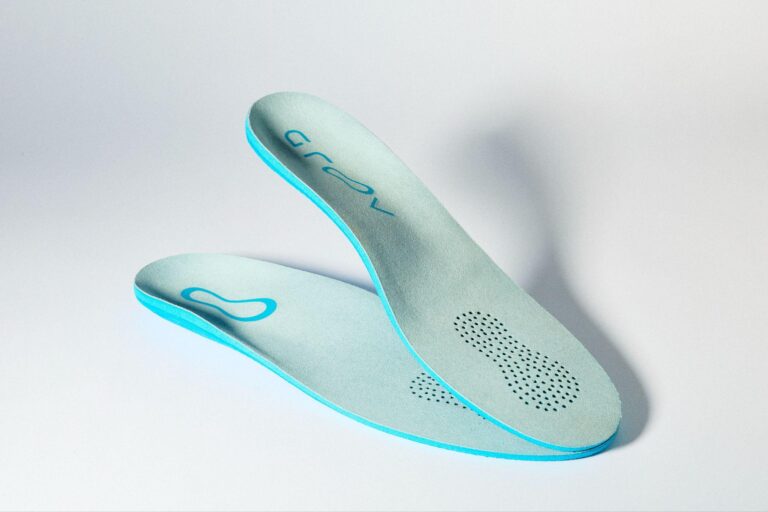
Groov approaches the problem from the inside out. Instead of asking people to endlessly search for a better shoe, it focuses on the surface inside the shoe, the part your body is actually interacting with. That interface is where comfort, support, and performance either come together or break down. In many cases, the surface you stand on matters more than the shoe itself.
Using ShapeSense technology, Groov captures a detailed 3D scan of your feet at home using an iPhone, no appointments, no guesswork, and no app download required. That scan feeds an optimization system that analyzes more than 30,000 data points to understand how your feet are uniquely shaped and how they behave dynamically under pressure. Because fit is not static. It is interactive.
The result is a custom insole built to match your exact profile and designed to fit into the shoes you already wear. It does not replace your footwear. It upgrades it by aligning the surface to your body instead of forcing your body to adapt to the surface.
The difference shows up in ways people notice quickly. Stability feels less forced. Movement feels more natural. Endurance improves because the body is not constantly compensating for something that feels slightly off. But more than anything, people simply feel better. Less distracted by discomfort. Less fatigued by the end of the day. Even performance gets a lift when the foundation is consistent, which is why athletes have been early adopters, along with people who spend long hours on their feet.
The idea is simple once you see it clearly. Even simpler once you feel it. The surface should match the person standing on it. That was missing before.
Build Your Fit From the Ground Up
There is a moment when people stop blaming their feet. It usually comes after realizing that the system they trusted was never designed with them in mind to begin with.
Shoes were built for shelves. Your feet were not. Groov closes that gap by bringing personalization to the part of footwear that actually makes or breaks the shoe. With a two-minute scan and a one-week turnaround, Groov turns any pair into something that feels thoughtful instead of tolerated. Whether it is everyday sneakers, golf shoes, cleats, ski boots, or heels, the goal stays the same. Make your shoes truly yours.
You deserve shoes that work for you, not against you. Explore Groov and experience what real fit feels like.