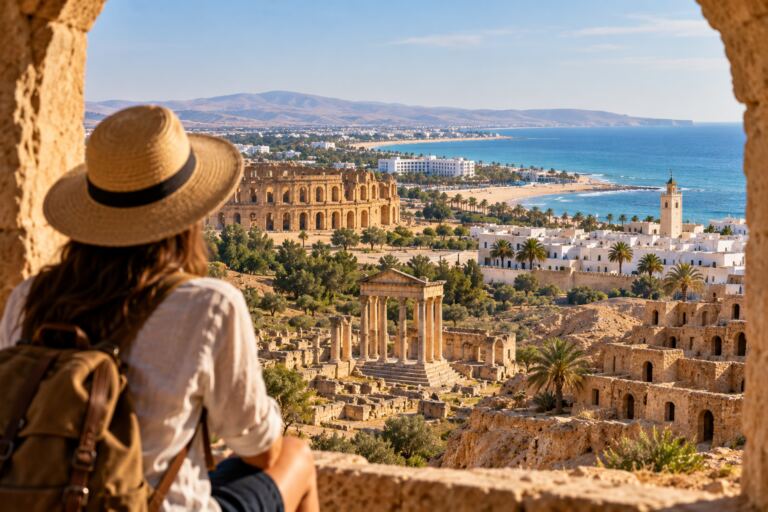
Tunisia appears as a resort strip to most visitors. Tourists land in Enfidha or Djerba and go to Hammamet or Sousse for seven days of swimming in the pool and at the Mediterranean beaches. It is wonderful, inexpensive, and simple. But this is a very small part of Tunisia. Tunisia has an area of about 163,000 km² – smaller than Syria, equal to Wisconsin, having nine UNESCO World Heritage sites and over 3000 years of layered settlement. There is a great discrepancy between what tourists see and what is there. Tourists opt for Top Tunisia tour Packages after their first holiday on the beach.
Why the Coast Tells Only One Version of Tunisia
Gulf of Hammamet resort was intentionally created as a cheap European sunshine destination in the 1960s and 1970s. Hotels were built close to airports, and short trips were designed. The development was commercially profitable, but the boundaries of what tourists could see of the country were obvious. There is another Tunisia beyond that. Numidian Berber villages existed before the Romans arrived. Carthage was founded and demolished by the Romans. Romans came and departed; Vandals, Byzantines, Arab Caliphates, Turks, and French came and departed without erasing earlier civilizations. But people stayed.
Dougga, the Most Complete Roman Town in Africa
Many monuments were left by Roman Tunisia inland. Apart from being intact, what makes these monuments unique is their emptiness. Dougga is situated 100 km to the southwest of Tunis, near Téboursouk, on a hill overlooking the Khalled Valley. Dougga was included in the UNESCO World Heritage list in 1997 as the best-preserved town of its type in North Africa. The Capitol, which was built for Jupiter, Juno, and Minerva in 166 AD, retains six Corinthian columns and a pediment.
The Theater, which seats 3,500 people, is used each year for the Dougga Festival. This town has been preserved without any destruction and without any modern city built on its ruins, so it has remained empty. At the same time, its previous identity is also evident. The Libyco-Punic Mausoleum is the most magnificent pre-Roman monument in Tunisia, and bilingual inscriptions written in Libyan and Punic languages prove that the local language has survived throughout the Roman age. Dougga has 50,000 visitors annually.
El Jem and the Scale of Roman Africa
The amphitheater of El Jem, located in Thysdrus, was built in 238 AD. The amphitheater’s major axis is 148 meters in length. The structure could hold 35,000 spectators. The amphitheater is among the biggest constructions of its type in the Roman Empire and has been listed in the UNESCO World Heritage List since 1979. However, its subsequent history is also fascinating. Byzantines and Muslims have used the construction as a fortress. The Ottoman army bombarded some parts of the amphitheater in the 17th century.
Some stone pieces were used for the construction of other buildings, such as the Great Mosque of Kairouan. In the 19th century, the interior of the amphitheater was used as a granary for the city. The mosaics of the wealthy villas of Thysdrus, such as the House of Africa, covering 3,000 square meters, excavated in the 1990s, can be seen in the adjacent archaeological museum. One can easily get to El Jem by train from Tunis in 2.5 to 3 hours.
Kairouan and the Islamic Chapter
Kairouan was founded by Arab military commander Uqba ibn Nafi in the year 670 AD. In the 9th century, Kairouan experienced prosperity under the rule of the Aghlabids, and to this day, Kairouan remains among the most celebrated cities of Islamic North Africa. Inscribed by UNESCO in 1988, Kairouan attracts pilgrims and tourists.
While talking about the medina’s center – the Great Mosque of Kairouan, one cannot ignore the Aghlabid Basins, which are situated on the outskirts of Kairouan. These basins collected water coming from distant hills more than 30 kilometers away. Kairouan is also considered to be the capital of carpet production in Tunisia. Tourists comparing the Best Tunisia Travel Packages would usually include Kairouan with El Jem.
The Amazigh South Is a Living Culture
The perception of Amazigh, or Berber, culture is felt more strongly in southern Tunisia. Tamazight is spoken in the homes in areas of Tataouine, Matmata, and Douiret. These are villages where people live with their families and have schools and markets, not places created for tourists. Some 150 ksour are found between Matmata and Tataouine. A ksar is a fortified communal storehouse that has ghorfas (storage spaces) built in three or four tiers above one another.
Here, grain, wine, and olive oil were stored, which meant that these structures functioned as banks for the village. The most famous one is Ksar Ouled Soltane, near Tataouine. There is the 12th-century village of Chenini, stretching out on the ridge and having a white mosque sitting on ochre stones, and it houses the Mosque of Seven Sleepers. Douiret is 24 km to the west and sees fewer tourists. In Matmata, the homes are caves carved in rock.
Djerba Earned Its UNESCO Listing in 2023
Djerba is always advertised as a place of beaches, but ignoring the inscription made by UNESCO in September 2023. This inscription relates to a settlement system that emerged in the 9th century in an area where water is scarce. These consist of Ibadi mosques, the Ghriba Synagogue, olive groves, and the Guellala village where there are working potteries. The Jerbi Berber language is used in some areas in Guellala and Sedouikech. More time will be needed to visit the market in Houmt Souk.
Practical Notes That Shape a Better Trip
The best times to go inland are spring and fall. April, May, October, and early November provide good weather for seeing open ruins and venturing into the Sahara Desert. July and August are very hot inland, though the weather is pleasant on the northern coast. There is a train service between Tunis and Sousse, El Jem, and Sfax; it is recommended to use private transport for traveling to Dougga and farther south, where there is a lack of public transport. Three days should be allowed to make the inland circuit. Sturdy shoes, a hat, and water are needed at the unshaded places. Not comfort, but curiosity, is the reward for tourists in Tunisia.