Aerospace and defense manufacturers entered 2026 with substantial production backlogs while continuing to face shortages of skilled workers in some specialized roles. Deloitte’s 2026 Aerospace and Defense Industry Outlook notes that commercial aviation is on track for continued growth, driven by rising fleet utilization and steady gains in passenger and cargo demand, with persistent production backlogs prompting operators to fly existing fleets longer. That same growth is running up against a labor market strained on two fronts: material and skilled-labor shortages are keeping the supply chain under pressure through at least 2027, and the share of A&D job postings requiring data analysis skills is projected to nearly double, from 9% in 2025 to almost 14% by 2028.
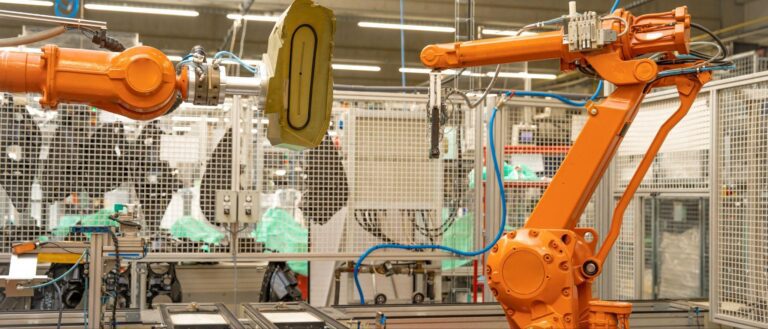
Surface preparation and finishing work, tasks completed by hand on nearly every aircraft component before final assembly, sit at the center of that constraint. GrayMatter Robotics is among the manufacturers bringing autonomous systems to finishing work that has traditionally depended on a shrinking pool of tradespeople.
Ariyan Kabir, Co-Founder & CEO, GrayMatter Robotics, says, “The aerospace supply chain is under simultaneous pressure from every direction: a finishing workforce that is shrinking, advanced materials that defeat fixed-path robots, MRO demand that keeps growing, and workplace hazards that traditional finishing makes unavoidable. Physical AI reasoning addresses each issue at the architectural level.”
Autonomous surface finishing may help address the labor shortage
Autonomous surface-finishing systems may reduce reliance on manual labor for tasks such as sanding, coating, and blasting, which have traditionally experienced relatively high turnover, helping manufacturers add production capacity even as the pool of skilled finishing labor narrows.
Retirements may be outpacing the apprenticeship pipeline
The Manufacturing Institute projects a need for up to 3.8 million workers from 2024 through 2033, with approximately 1.9 million potentially unfilled. “Surface finishing has always been treated as an art, something you learn through years of practice. But it is physics, and once you model it correctly, you can build systems that learn and adapt in ways that traditional robots can’t,” Kabir said. “The breakthrough for us came when we realized that the skill operators develop over years is really their internalized understanding of physics in action. Encode that physics in software, and you can deploy that capability anywhere.”
Security clearances and employer competition may narrow the candidate pool
Defense manufacturing roles frequently require an active security clearance, a process that has become more involved in recent years, shrinking the pool of candidates available for cleared positions at any given time. That pool narrows further as civilian technology and aerospace-adjacent employers compete for the same skilled trades and engineering talent, often with faster hiring processes and greater remote work flexibility than traditional defense manufacturing offers.
Physical AI may help meet the data security requirements of defense manufacturing
Defense manufacturing environments often require systems that operate without external data routing. Air-gapped, edge-deployed architectures may help organizations address data sovereignty considerations in defense and other enterprise-critical settings, potentially supporting the use of autonomous finishing systems in facilities with strict security requirements.
Younger workers may view defense manufacturing as slower-moving than the technology sector
Some younger candidates entering the workforce may associate defense manufacturing with more traditional processes, although the industry continues to evolve technologically. Some newer autonomous finishing cells can be configured for individual parts within minutes and operated through touch-screen interfaces that may not require coding or robotics experience, potentially making shop-floor roles more comparable to the technology-driven work younger candidates encounter in other industries.
Expanded apprenticeship programs may be reducing reliance on graduate-only hiring requirements
Defense manufacturers are broadening hiring criteria beyond degree requirements and expanding apprenticeship programs to recruit career-switchers from outside the defense industry. This shift may broaden the candidate pool to include workers with transferable technical or manufacturing experience who might not have qualified under stricter graduate-only policies.
Autonomous systems may be changing how institutional knowledge is transferred
As experienced workers retire, manufacturers are turning to digital tools, including physical AI systems, to capture process knowledge before it leaves with them. Autonomous finishing cells built on Physical AI learn from real surface interactions and can apply that accumulated knowledge to new parts immediately, shortening new-operator onboarding compared with the months of hands-on mentorship that manual finishing traditionally requires.
Internal mobility may help manufacturers redeploy specialized talent
Rather than hiring for every program separately, defense manufacturers are prioritizing internal mobility, deploying specialized talent flexibly across programs based on where demand is highest. This approach may help manufacturers make greater use of workers who are already cleared and trained, potentially reducing the need to source new hires for every contract.
The aerospace and defense skilled labor shortage may persist throughout the current retirement wave. To combat the rates of workers leaving their roles, apprenticeship expansion, internal mobility, and autonomous finishing systems are increasingly being deployed side by side, each addressing a different part of the same shortage.