Funnel Hacking Live was supposed to be over.
After ten years of bringing thousands of entrepreneurs together to study funnels, offers, messaging, and online growth, ClickFunnels co-founder Russell Brunson closed out the company’s signature event with something called “The Last Dance.”
It sounded pretty final.
For the next 14 months, Brunson and his team stayed largely off stage. There was no Funnel Hacking Live. No replacement event.
Behind the scenes, though, they were pulling apart much of what they knew about building an online business and reconstructing it around what AI could actually do. What they discovered persuaded them to reverse course.
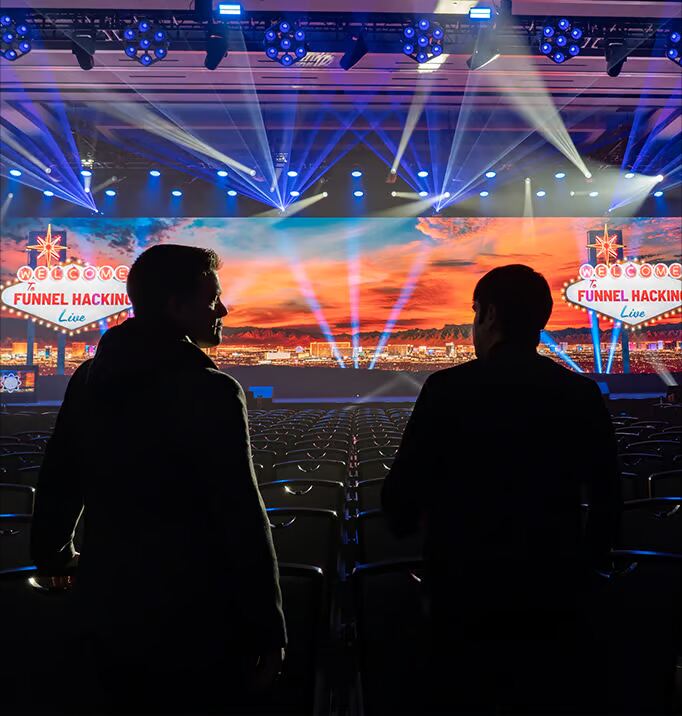
Funnel Hacking Live will return September 21–23, 2026, at the Fontainebleau Las Vegas. The event is being positioned as a one-time encore rather than the immediate resurrection of an annual tradition. Its theme, “The AI Era,” makes clear why the team believes the comeback could not wait.
This isn’t about providing entrepreneurs with another AI conference. It is a much bigger play than that. Having been at the helm of business and online business specifically for decades, this team knows that AI could be the tool that finally “evens the playing field” for the truly small business: giving them the advantages that previously belonged almost exclusively to companies with significant capital, large staffs, and specialized talent.
“When we ended Funnel Hacking Live 10: The Last Dance, AI was this thing people were kind of using ‘instead of Google.’ That’s literally where most people were at fourteen months ago. But I knew something was shifting. I just didn’t know what it was yet. I needed space to figure it out.” — Russel Brunson
When the Old Limitations Disappear
One of the experiences Brunson credits with changing his thinking was a visit to the former headquarters of Agora Publishing in Baltimore.
Agora built a multibillion-dollar publishing operation through sophisticated direct-response marketing. But the scale of its production historically required a level of manpower that would overwhelm most entrepreneurs: multiple experts supported by teams of copywriters, marketers, and production professionals creating and testing campaigns continuously.
Brunson’s question was simple: What if an entrepreneur no longer needed an Agora-sized team to produce at an Agora-like pace?
Brunson describes using AI to study successful video sales letters across the Agora ecosystem and applying what he learned to one of his own products. A process he says would ordinarily require six to eight weeks and tens of thousands of dollars in copywriting costs reportedly produced a 50-minute script in approximately four hours.
The resulting video sales letter, ClickFunnels says, is now supporting more than $1 million a month in profitable advertising spend for a $100 offer.
That is a dramatic claim, but it points to the larger idea behind the event: AI is not simply helping entrepreneurs write emails faster. It is allowing them to study successful models, identify patterns, develop offers, create campaigns, and test ideas at a speed that would have been unthinkable for a small operation only a few years ago.
Direct-response marketing has weathered plenty of technological shifts. The arrival of radio, television, the internet, email, social media, and marketing automation each changed how companies reached buyers. AI may be different because it doesn’t only introduce another channel. It can alter how nearly every piece of a campaign is researched, created, and improved.
The Entrepreneur Becomes the Team
The most radical promise behind Funnel Hacking Live’s unexpected return may not be better marketing. It may be a completely different vision for what a company needs to look like.
Todd Dickerson, Brunson’s ClickFunnels co-founder, reportedly built six functioning AI software products in one month, largely by himself and using his phone. Brunson also says he personally created a 96-email follow-up sequence and a 65-message text sequence without handing the work to an agency or a large copywriting department.
Those examples would have sounded more like stunts than business strategies not long ago. Today, they raise serious questions about the future of entrepreneurship.
What happens when one skilled person can perform work that once required several departments? What happens when the barrier to launching a product is no longer money, manpower, or technical knowledge, but the ability to ask better questions and direct the available technology intelligently?
The answer could be the rise of a new kind of company: extremely small in headcount, but extraordinarily large in output. This is what I call the micropreneur revolution. Small, nimble, free, and profitable.
Funnel Hacking Live is building its three-day program around that possibility. The event promises to address AI-powered positioning, community building, content, offers, funnels, and the systems required to scale from six figures to seven, eight, or even nine figures without automatically building a massive organization along the way.
Richmond Dinh, creator of the Tiny Challenge model, represents one part of that conversation: how entrepreneurs can use shorter, focused experiences to create momentum and move customers toward a result.
More Output Will Not Automatically Produce More Connection
There is an obvious danger in all of this, though. When entrepreneurs can create 96 emails almost as easily as they once created six, the tendency is to simply produce more. More emails. More videos. More offers. More posts. More noise. And this is how many people are using AI today, producing more but not truly connecting with their audience in a more meaningful way.
That is not better marketing, and let’s be honest: the more content everyone is using AI to create makes the marketplace more noisy, more chaotic, and less trustworthy than ever before. So, this is a challenge, and an opportunity.
AI can help an entrepreneur produce a tremendous volume of content, but volume does not guarantee that the content will resonate. Bad for them, but perhaps good for the micropreneur committed to doing things differently. This onslaught of “AI slop” actually makes depth, specificity, and human understanding more valuable.
Sarah Grace Allred, creator of the Depth Ladder, is among the first group of speakers announced for the 2026 event. Her inclusion signals that the conversation will not be limited to software and automation. The ability to understand what customers truly want—and communicate with them at a deeper level—remains central to creating a business people choose to follow.
Learning to use AI for scale without sacrificing the specificity, humanity, and trust that make people care may be one of the defining tensions of doing business in the AI era.
The entrepreneurs who benefit most will not be the ones who ask AI to replace their thinking. They will be the ones who train their system, like they would a mentee or employee. They bring real insight, experience, and judgment to the technology, and then use it to execute those ideas at a scale previously unavailable to them.
From Building Audiences to Building Movements
Funnel Hacking Live was never built solely around the mechanics of funnels. Brunson has long described successful entrepreneurs as people who become “the Radical” in their markets: the person willing to introduce a new opportunity, challenge an accepted approach, and give an audience something to believe in.
In 2026, Funnel Hacking Live will revisit that idea through an AI lens.
The program includes sessions about becoming a dominant voice, turning an audience into a movement, and using AI to multiply content and reach. That makes attraction, not merely automation, an important part of the promised transformation.
Miguel Carrasco, whose work focuses on AI-powered attraction marketing, is expected to address how entrepreneurs can use the technology to draw the right people toward a business rather than simply increase the amount of marketing it pushes into the world.
The difference matters. AI may make it easier to build a funnel and fill it with content, but it cannot force people to expectantly and excitedly enter it.
Turning Experimentation Into an Operating System
Most entrepreneurs have experimented with AI by now. They have used it to answer questions, draft social posts, brainstorm headlines, or improve an email.
That is very different from rebuilding a business around it.
Funnel Hacking Live is specifically targeting the distance between occasional AI use and AI-powered operations. Peter Swain, an AI strategist and systems builder, is one of the speakers who will make that distinction practical.
The opportunity goes way beyond being able to complete isolated tasks faster. The true opportunity is to connect research, content creation, lead generation, sales, customer service, and product development in a way that allows a solo-preneur or a small team to operate as a much larger one.
That distinction will likely separate the businesses that receive a temporary productivity bump from those that establish an enduring advantage.
A Comeback Built Around a Question
Funnel Hacking Live’s return does not prove that every prediction about AI-powered entrepreneurship will come true. I’m not known as an early adopter myself, preferring principles that have worked for decades or centuries rather than whatever bright shiny object is being marketing at any given time. The truth is that we do not yet know whether tiny teams will consistently build nine-figure businesses, whether AI-generated campaigns will maintain their performance over time, or whether increased automation will ultimately create more freedom or create higher expectations for how much one person should produce.
But those uncertainties, the undeniable possibilities, make this an entrepreneurial story worth watching.
ClickFunnels is not bringing back its flagship gathering for a retrospective look at what worked during the previous ten years. It is returning because its founders believe the next few years will look fundamentally different, and I wholeheartedly agree.
They are betting that AI will not diminish the entrepreneur. Used correctly, they believe it will multiply what one entrepreneur can imagine, build, test, and sell. That is the radical bet behind the return of Funnel Hacking Live.
As an entrepreneur for 27 years now, I’m taking that bet… starting with FHL 2026.