
Austin, TX, October 22nd, 2026, Chainwire
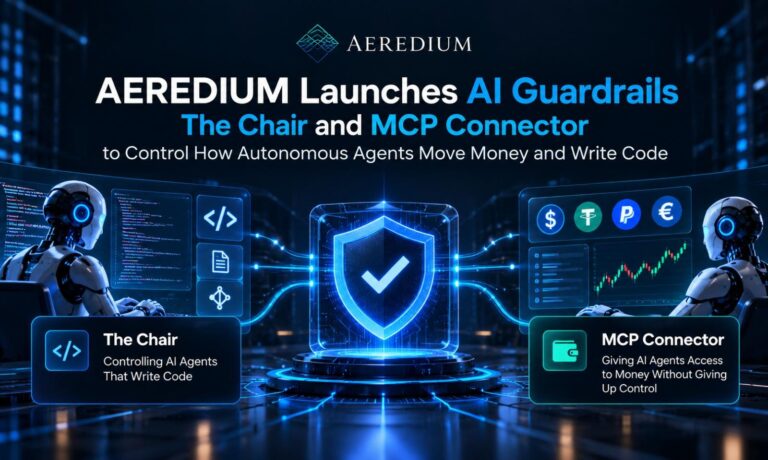
AEREDIUM, a digital asset infrastructure company, has launched two AI products designed to help organizations control what autonomous AI agents can do with their software and money.
The products, The Chair and MCP Connector, are now available through the company’s newly launched aeredium.ai platform. Both are built around a policy engine that evaluates actions before they are executed, allowing organizations to define what AI agents can and cannot do without human approval.
As AI agents increasingly take on tasks such as writing software, processing payments and executing trades, organizations face a growing challenge: ensuring that automated systems operate within clearly defined boundaries.
AEREDIUM’s approach places a control layer between AI agents and the systems they interact with. Every proposed action is evaluated against rules established by its owner and receives one of three outcomes: approved, denied or held for human review. Each decision is signed and recorded, creating a verifiable history of agent activity.
“AI agents are no longer just answering questions. They’re writing code, moving money and making decisions that have real consequences,” said Albert Dadon, CEO and Founder of AEREDIUM. “The challenge isn’t just making these agents more capable, but making sure they operate within the rules we set. With The Chair and MCP Connector, we’re giving organizations a way to put AI to work without giving up control over what it can do.”
The Chair: Controlling AI Agents That Write Code
The Chair is designed for software development teams using AI coding agents to work on organizational systems and repositories.
The product sits between an AI agent and an organization’s development environment, evaluating each tool call before it runs. Actions such as executing commands, modifying files, merging code or pushing changes are checked against the organization’s policies.
Actions covered by existing rules can be automatically approved or denied. Requests that fall outside those rules are held for human review through a control panel, where authorized users can approve or reject them.
Every decision generates a signed receipt documenting what the agent attempted, which policy applied and who authorized the action.
The Chair supports Claude Code through a dedicated plugin and provides a governed shell for other coding agents, including those from OpenAI. Organizations can establish their own policies through a questionnaire, rather than writing the rules directly in code.
The product is available with a 30-day free trial.
MCP Connector: Giving AI Agents Access to Money Without Giving Up Control
While The Chair focuses on software development, MCP Connector applies the same policy-based approach to AI agents handling financial transactions.
The product combines a policy engine with a digital asset wallet, allowing agents to execute approved payments and trades while remaining subject to limits established by their owners.
Each agent operates through its own wallet, policy and designated owner. The owner defines the agent’s role, approves its mandate using a passkey and can halt or delete the agent at any time.
Two agent roles are currently available:
- Payer: Allows an AI agent to send USDC, USDT, PYUSD and EURC to addresses approved by its owner, without permission to trade.
- Trader: Allows an AI agent to trade on designated exchanges within its own wallet, without permission to send funds to external recipients.
The wallet uses threshold signatures generated inside secure enclaves, meaning no complete private key is created and AEREDIUM does not hold a key to the owner’s funds.
MCP Connector currently supports Ethereum, Arbitrum and Base, with transaction records retained for seven years.
The product is designed for Claude and is open to OpenAI and other AI frameworks.
Bringing Institutional Controls to Autonomous AI
Both products build on AEREDIUM’s existing infrastructure for institutional digital asset security, including its threshold-signature technology and policy engine.
The same underlying approach is used across the company’s custody and blockchain infrastructure: transactions must satisfy predefined rules before they can be signed, and decisions are recorded for subsequent verification.
By extending these controls to AI agents, AEREDIUM aims to give organizations a way to use autonomous systems for increasingly sensitive tasks while maintaining oversight of their actions.
The launch also expands AEREDIUM’s offering beyond digital asset custody and settlement into the governance of AI-driven financial and software operations.
Availability
The Chair and MCP Connector launched on October 13, 2026, and are available through AEREDIUM’s new AI platform.
For more information:
- AEREDIUM AI: https://aeredium.ai
- The Chair: https://aeredium.ai/the-chair
- MCP Connector: https://aeredium.ai/connector
About AEREDIUM
AEREDIUM Holdings Inc. builds The Trust Layer: blockchain infrastructure for institutional settlement in which correctness is enforced by hardware, cryptography and autonomous oversight rather than promised by intermediaries. AEREDIUM operates from Melbourne, Tel Aviv, and Austin, Texas.
Contact
CEO & Founder
Albert Dadon
AEREDIUM
[email protected]