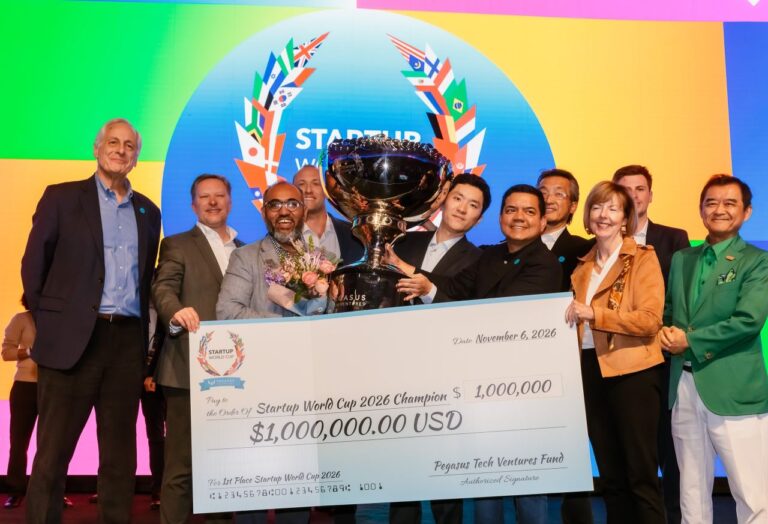
A company working to make chemical production more sustainable has taken the top prize at the world’s largest startup competition. ZymoChem, an East Bay-based specialty chemicals company, won the $1 million investment prize at the 2026 Startup World Cup Grand Finale in San Francisco, surpassing regional champions from more than 60 countries.
The company’s pitch centered on using biomanufacturing to improve sustainability and supply chain resilience in the chemical industry. It was selected from 10 finalists who advanced to the November 6 finale after competing through a global network of more than 200 regional competitions organized by Pegasus Tech Ventures.
The result put a spotlight on an area of innovation that often receives less public attention than consumer technology. Chemical manufacturing sits behind a vast range of products and industrial processes, making advances in how materials are produced relevant well beyond the chemical sector itself.
ZymoChem’s win also reflected the breadth of businesses represented in this year’s competition, with finalists working across energy, healthcare, financial technology, commerce, and artificial intelligence.
A Biomanufacturing Company Takes the Top Prize
ZymoChem describes itself as a specialty chemicals company focused on bringing sustainability and supply chain resilience to the industry through innovative biomanufacturing.
That combination helped distinguish its pitch before a panel of venture capital investors and industry leaders. The company ultimately secured the competition’s $1 million investment prize, giving it the top position among startups that emerged from regional events around the world.
The other finalists represented a wide range of approaches to commercial and technological challenges.
Spain’s LainTech, which focuses on industrial implementation of technologies in the energy and raw materials sectors, finished second. Tokyo-based Kauche Inc., a gamified commerce platform built around product discovery and everyday shopping, took third.
The remaining finalists included Enexor Energy, which develops renewable energy and carbon conversion solutions for organic and plastic waste, and BioSapien, a Silicon Valley company developing a drug delivery platform.
Other participants included Crednce, which is building infrastructure for cross-border transactions in Africa; Monet, a Latin American open-finance business; and Yo-Kai Express, which deploys autonomous hot-food and beverage systems. Australia’s ProcurePro and Hong Kong’s Belli, which develops AI operating systems for airline cargo operations, rounded out the 10 finalists.
The variety made the competition a snapshot of how widely startup activity is spread across industries and markets.
More Than 200 Competitions Led to San Francisco
Startup World Cup has grown considerably since its launch in 2017. Its network now includes more than 200 regional competitions across six continents, with entrepreneurs competing locally for the opportunity to present their businesses on an international stage.
For the 2026 edition, more than 200 regional champions representing over 60 countries advanced through the competition process. The finalists gathered in San Francisco for a three-day program from November 4–6, culminating in the final presentations and investment decision.
The event also brought together venture capital professionals, corporate executives, entrepreneurs, and technology leaders. Among the speakers were Daymond John of ABC’s Shark Tank, Tesla co-founder Marc Tarpenning, Google Cloud CTO Will Grannis, and Microsoft’s Chief Sustainability Officer Melanie Nakagawa.
Senior executives from Uber, Waymo, ServiceNow, HP, and Salesforce AI Labs also participated.
The investor community included representatives from Andreessen Horowitz, Khosla Ventures, DCVC, and Norwest Venture Partners, among other firms. Their involvement gave the event a broader industry dimension, bringing together people evaluating emerging businesses alongside executives responsible for technology adoption and corporate innovation.
Corporate Innovation Was Part of the Program
The competition included a Corporate Innovation Seminar on November 5, bringing corporate innovation leaders, investors, and executives together to discuss emerging technologies, strategic investments, and potential business collaborations.
Fireside chats and panel discussions covered artificial intelligence, sustainability, technology, and innovation. The discussions complemented the startup pitches by bringing attention to how new technologies might find commercial applications and work alongside established businesses.
For founders, that access can be an important part of an international competition. Presenting to investors provides an opportunity to attract funding, while meeting corporate decision-makers can open conversations around partnerships and commercial opportunities.
Anis Uzzaman, founder and CEO of Pegasus Tech Ventures and chairman of Startup World Cup, said this year’s finalists demonstrated the range of entrepreneurial talent emerging from different parts of the world.
“Every year, the Startup World Cup demonstrates the depth of entrepreneurial talent emerging from across the world,” Uzzaman said. He added that the 2026 finalists had challenged expectations and demonstrated that major breakthroughs can come from anywhere.
ZymoChem’s first-place finish earned the competition’s $1 million investment prize, while Spain’s LainTech and Tokyo’s Kauche Inc. completed the top three.