
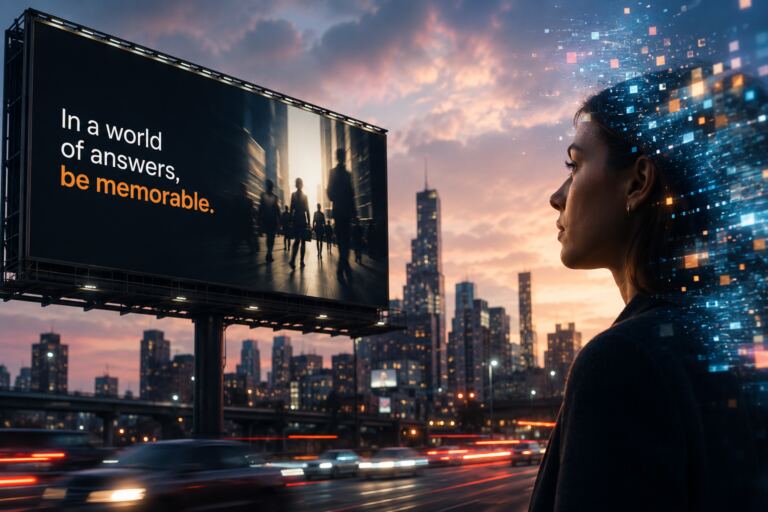
For the last two decades, digital marketing operated on a simple premise: the brand with the best information wins. We built sprawling content libraries, optimized for long-tail keywords, and meticulously structured our websites so search engines could easily index our value propositions.
Then came the widespread adoption of generative AI, and the information moat evaporated overnight.
Between the massive platform shifts showcased at Google Marketing Live (GML) 2026 and the rapid maturation of conversational search, the digital sandbox has fundamentally transformed. Google’s aggressive rollout of AI Mode and conversational discovery layers has made one thing clear: digital search is no longer a gateway to the open web. It is a synthesis machine.
To many in our industry, the alarm bells are found in the immediate fallout metrics. Recent click-through rate (CTR) analyses reveal that when Google’s AI Overviews are present, organic CTR plummets by up to 61%. Paid search CTR has taken an even harder hit, crashing as much as 68% on those same queries. Concurrently, ChatGPT ad CPMs are compressing as chatbot inventory swells and hyper-fragmented conversational spaces struggle to command premium attention.
But focusing on the CTR squeeze or CPM compression is missing the forest for the trees. These aren’t isolated algorithmic updates or temporary pricing corrections. They are symptoms of a much deeper, structural truth that delivers a death blow to traditional digital marketing: AI has commoditized information.
Every company has access to the same large language models. Every model has access to the same scraped web data. When every competitor is optimized by the same algorithms using the same pool of information, every answer starts looking exactly the same. The rich, visual, emotional storytelling of a brand’s digital presence is instantly flattened into generic, machine-generated bullet points.
When information becomes a commodity, differentiation moves away from information and toward memory. We have entered the Memory Economy. In this new paradigm, the only thing that matters is whether a consumer explicitly remembers your brand before they open a chat prompt.
The Illusion of the Middle Funnel
When an AI agent handles the middle of your marketing funnel (answering product queries, filtering choices, and dropping items directly into a native checkout layer), the consumer experience becomes transactional, frictionless, and entirely sterilized.
If a consumer asks an AI assistant for the “best running shoes for overpronation,” the LLM returns a consolidated summary. If you haven’t already anchored your brand name in that consumer’s mind, you are at the mercy of a machine’s recommendation engine. Brand authority is no longer a soft awareness metric; it is the absolute prerequisite for being cited by AI algorithms at all.
If a user doesn’t explicitly type your exact name into the prompt, you simply do not exist.
This is why we are witnessing a massive, data-driven migration of dollars out of fragmented digital banners and programmatic clutter, and back into high-engagement, unskippable, physical environments: Out-of-Home (OOH), streaming television, and live sports. You cannot build a memory inside a text-based chatbot conversation. Memory requires scale, context, and physical presence.
What the Marketplace Data Tells Us
At Onescreen, our marketplace data tracks this tectonic shift in real time. Marketers are waking up to the reality that to protect their digital funnels, they have to build their moats in the real world. We are no longer seeing OOH treated as a speculative upper-funnel add-on; savvy brands are leveraging it as a foundational pillar for cognitive availability.
Looking at the category movements over the past three quarters, several distinct shifts stand out:
- Consumer Packaged Goods (CPG) & Retail: Faced with automated merchant feeds that flatten product discovery, major CPG brands have increased their shared physical OOH footprints by 34% year-over-year. They understand that to win the digital checkout, the mental preference must be anchored during the daily commute, the grocery run, or in stadium environments.
- Direct-to-Consumer (DTC) & E-commerce: With performance loops suffocated by zero-click search behavior and soaring customer acquisition costs (CAC) in closed AI ecosystems, digital-native brands are shifting up to 40% of their top-of-funnel budgets into real-world media assets, focusing heavily on programmatic OOH (pOOH) paired with connected TV (CTV).
- B2B Technology: Historically reliant on high-funnel informational content pipelines (which have seen massive organic traffic losses due to AI Overviews), B2B enterprises are aggressively moving into high-impact transit OOH and airport media surrounding core tech hubs.
Restructuring for Branded Intent
The brands winning this transition are not abandoning digital; rather, they are radically restructuring how digital and physical media interact.
Historically, media plans treated OOH as a separate silo. Today, the most sophisticated marketers are running unified “Real-World Capture” frameworks. They treat large-format and transit OOH as the primary engine for generating explicit brand memory, and use targeted digital ads purely to capture that highly specific, branded intent.
When a consumer views a massive, visually arresting billboard during a live sports broadcast or along a major urban thoroughfare, that unskippable physical impression creates a cognitive anchor. When they later look up that product, they aren’t searching for generic categories like “hydration supplements”—they are searching for your exact brand name.
Our data shows that branded searches are highly insulated from the AI squeeze because the user’s intent is explicit, and search engines are far more likely to serve direct navigational links rather than synthesizing a generic overview.
Redefining Attribution for the AI Era
The biggest roadblock to this shift has always been attribution. For years, the digital duopoly trained marketers to expect instant, deterministic, last-click metrics. But last-click attribution was always an illusion—one that AI has now thoroughly shattered by absorbing the click entirely.
When we analyze modern attribution models that treat OOH as a core driver of brand salience, the numbers paint an entirely different picture of channel efficiency. By utilizing advanced mobile location data and matching exposed real-world audiences to digital conversion funnels, our platform data reveals a powerful multi-channel lift:
- +42% lift in branded search volume within geofenced OOH exposure zones.
- -18% reduction in digital CAC when programmatic OOH precedes paid social campaigns.
- 2.4x higher conversion rate on downstream conversational ads when the user has prior physical exposure.
When you anchor brand equity in the physical world first, your digital dollars work significantly harder. The consumer doesn’t interact with your digital ad as a cold stranger being interrupted by an algorithm; they interact with it as a familiar entity they encountered in the real world.
The Path Forward
The takeaway from the current advertising landscape isn’t to despair over declining digital CTRs or the rise of zero-click search. The takeaway is to recognize that human attention has a physical baseline. We do not fall in love with brands inside a text-based chat interface. We fall in love with brands when they meet us where we live, move, play, and gather.
The digital ecosystem will continue to become more automated, more agentic, and more synthesized. Marketers who spend the rest of the year trying to game the latest LLM citation algorithms will find themselves running on a never-ending treadmill.
The last remaining moat is human memory. The forward-thinking leaders are stepping off the treadmill and investing heavily in the physical world to build the undeniable, unskippable brand salience that no algorithm can suppress.