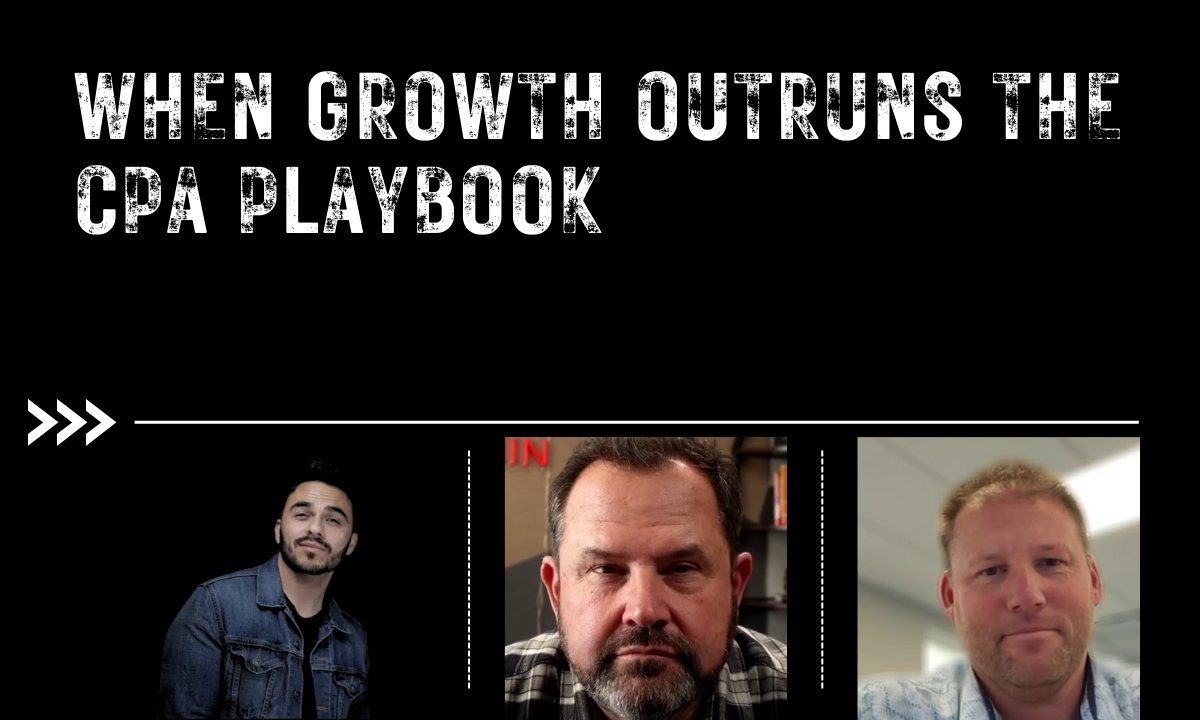
For a certain kind of business owner, growth arrives as both a relief and a problem. Revenue climbs, the team expands, the product finally has pull, and yet the operational strain shows up in an unexpected place: cash flow becomes unpredictable, risk becomes harder to name, and the tax plan begins to look like a collection of year-end reactions rather than a strategy. It is in that transition, when momentum is real, but fragility is still close, that Brian Van Camp, Managing Partner of Linked Accounting, and Van Carlson, CEO of SRA 831(b) Admin, have built their work.
Van Camp, a CPA firm owner who previously spent years in commercial banking, frames the inflection point with a banker’s bluntness. Businesses rarely fail because they cannot sell, they fail because they cannot manage cash. In practice, that means the moment a company’s cash flow no longer behaves in a simple, intuitive way is often the moment the traditional compliance-first relationship with accounting stops being enough. The company may be profitable on paper, but liquidity is tight, payments stack up, seasonality becomes sharper, or growth demands spending ahead of receipts. Owners sometimes discover, often late, that a tax return can be accurate yet still leave the business exposed.
The temptation is to put a neat revenue number on when this shift happens. Van Camp points to a common range where owners begin to feel the need for more than just filing, often around the one to two million-dollar mark, while also emphasizing that the growth curve matters as much as the absolute figure. A smaller company that doubles rapidly can face the same cash pressure and decision complexity as a larger one. The signal is less about size than velocity, that hockey stick period where the business changes faster than its internal systems.
Carlson’s entry point is often the moment after that surge, when growth starts to level, and the conversation turns from sprinting to sustaining. That is where risk management becomes less theoretical. Owners begin to recognize that the business is not just a stream of income, it is an asset with brand value, relationships, intellectual property, and operational dependencies that do not fit neatly inside traditional insurance policies or basic tax moves. They have built something worth protecting, and the weight of that responsibility changes how decisions feel.
A central theme in their approach is that entrepreneurs and many CPAs tend to view risk through different lenses, and the mismatch can quietly shape the company’s future. Carlson describes how conservative professional habits can leak into client advice, not because caution is wrong, but because advisers sometimes default to their own comfort level rather than calibrating to the owner’s goals. Van Camp adds the structural layer behind that caution, pointing to the rules that govern CPA conduct and the tendency of some accountants to avoid strategies they have not taken the time to fully understand. The result is a pattern owners recognize, advice that stays inside familiar territory, even when the business has moved beyond it.
That is how many companies end up with a plan that optimizes taxes but underinvests in enterprise value. Van Camp and Carlson both treat that as backwards. Tax matters, but it cannot be the primary driver of decision-making. When tax outcomes dictate everything, owners start making expensive moves for cheap reasons, buying assets late in the year, overusing depreciation, or pursuing real estate simply because it is an easy answer. Carlson has seen what happens when those moves are paired with leverage: owners reduce taxable income while taking on payments that assume next year will be stronger than this one. When the cycle turns, liquidity disappears right when opportunity appears.
Their alternative is built on discipline and proactivity. Owners should be able to articulate what they are paying for and what they should expect in return. Filing and compliance are one kind of engagement, ongoing strategy is another. Van Camp’s standard for evaluating advisers is practical, look for evidence of recent solutions delivered to other clients across cash flow, tax strategy, financing, and value building. Carlson’s lens is similar but aimed at behavior under pressure, advisers who are organized, prepared, and able to educate rather than deflect.
A significant part of Carlson’s work centers on enterprise risk management, including the use of 831B structures, a tax code that allows business owners to create an insurance company for specific risks and fund it in a way that can be deductible to the operating business when properly structured and administered. He positions it less as a loophole and more as a framework for protecting what traditional insurance often ignores, the intangible value owners spend years building. In his view, the practical advantage is not theoretical, it is liquidity and resilience, the difference between being forced to react in a downturn and having capital set aside to survive and even invest when others cannot.
Van Camp ties that back to a broader problem he sees repeatedly: many founders undervalue finance talent, both internally and externally. They treat accounting as a cost center, then act surprised when cash flow and reporting are not strong enough to support a sale, an audit, or a serious valuation. Their prescription is incremental, owners do not have to hire a full-time CFO immediately, but they do need a path to visibility and planning before complexity catches them.
Taken together, Van Camp and Carlson offer a way to think about growth that is less about pushing harder and more about building a structure that can hold what the business becomes. The common thread is not sophistication for its own sake, it is the refusal to leave cash flow, risk, and long-term value to improvisation. When a business outgrows the basic playbook, its argument is simple: the owner should outgrow it too.
Want more Grit Daily Startup Show? Take a look at past articles, head over to YouTube, or listen on Apple Podcasts or Spotify.