Every autumn in Northern California, the same small drama plays out in driveways across the region. The wind picks up, the utility cuts power to lower wildfire risk, and a homeowner walks out to find that the automatic gate they have trusted for years will not budge. These are not careless people. They simply never learned what their gate does without electricity, and a power outage at nine at night is a poor place to start learning.
Public Safety Power Shutoffs have become a fixed feature of life in California’s wildland-urban interface. A utility calls one when high winds, low humidity, and dry vegetation line up into dangerous fire weather, and it shuts the power off deliberately to keep its equipment from sparking a blaze. The scale can be sobering. In 2019, shutoffs across the PG&E territory affected more than two million customers, with events averaging around 43 hours. The program has improved sharply since then through grid hardening and more targeted planning, and by 2025 the same category of event reached roughly 18,000 customers. Smaller, certainly. Gone, no. For homes in the hills above Silicon Valley and throughout the North Bay, a seasonal outage remains closer to a near-certainty than a rare accident.
After more than a decade of installing and repairing gates in this region, I have learned that when homeowners ask whether their gate will work during an outage, they are usually asking the wrong question. They picture the motor. The motor is rarely the thing that fails them.
A Gate Is a System, Not a Motor
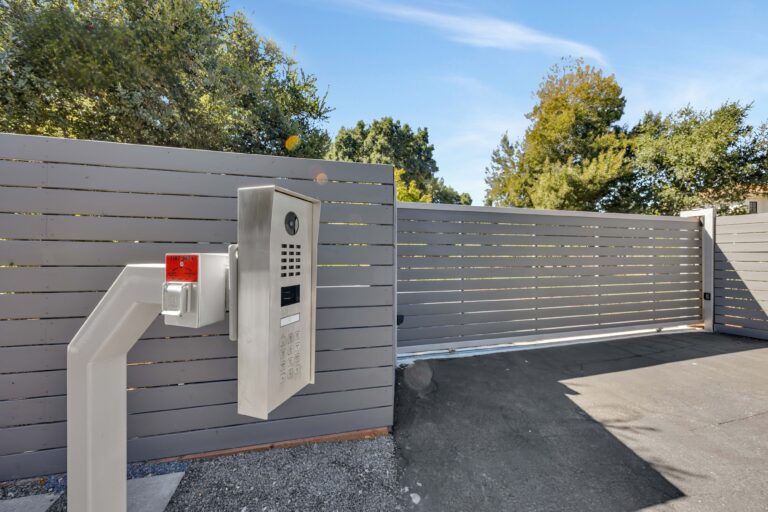
An automatic gate is not a single machine. It is a short chain of them, and every link runs on electricity. There is the operator that drives the gate, yes. But there is also the keypad where you punch your code, the intercom that lets a visitor call the house, the router or cellular unit that carries the signal, and the loop buried in the driveway that senses your car and swings the gate open as you approach. Lose power to any one of those and the command to open never arrives, even if the motor itself is sitting there with a full battery, ready and waiting.
This is the part that surprises people. A homeowner will tell me, with total confidence, that their gate has battery backup. Then the grid goes down, they pull up to a dark keypad, and nothing happens. The backup did its job. It just protected the one component that was never going to be the bottleneck.
The locks deserve their own mention. Many swing gates are held shut by an electric lock that needs power to release. If that lock has no backup, a perfectly good battery-powered operator will strain against a bolt it cannot open, and the gate stays put. I have seen motors burn out fighting a lock nobody thought to plan for.
None of this is exotic hardware. It is the ordinary equipment on an ordinary modern gate. Which is exactly why the fix is not complicated. You make the whole system power-independent rather than backing up the motor alone, and you do it before the season turns, not during the first shutoff.
The Codes Already Point the Way
The safety standards anticipate some of this, and they are worth knowing. UL 325, the standard modern gate operators are built and tested to, requires every automated gate to include a manual release so it can be disengaged and moved by hand during a power failure or malfunction. That release is your guaranteed way out. The catch is practical rather than technical: it only helps if you know where it is, which key opens it, and that the gate is maintained well enough to actually roll or swing once the motor is disconnected.
There is a second layer where fire access is involved. California Fire Code Section 503.6 requires that security gates crossing a fire apparatus access road have an approved means of emergency operation, kept working at all times, with electric operators listed to UL 325 and automatic gates built to the ASTM F2200 standard. Many local jurisdictions go further, adding a fire department key override and requiring battery backup or a manual disconnect that emergency crews can reach. The point behind all of it is simple. A gate that cannot be opened during an emergency is worth less than no gate at all, because it can delay the very people you would be counting on.
The Habit Worth Building
The single most useful thing a homeowner can do costs nothing. Pick a calm afternoon, cut the power at the operator, and try to get in and out the way you actually would. Test the keypad. Test the intercom. Find the manual release and use it. If any of it stumbles on a quiet Tuesday, it will fail worse on a red-flag evening with smoke on the ridge. Preparedness here is not a gadget. It is a rehearsal.
This is the thinking we build into every project at Bay Area Lions Gate, which keeps its main office and its gate production in Palo Alto, California, and works with homeowners throughout the region. When outage resilience is designed in from the start, rather than bolted on after a bad night, it stops being a source of anxiety and becomes something you rarely think about at all. That is the goal. A gate should do its job quietly, in good weather and bad, whether or not the grid is cooperating.
California’s utilities are hardening the grid, and the worst shutoff years are, for now, behind us. But fire season is not going anywhere, and neither is the wind. The homeowners who come through it best are not the ones with the most expensive gates. They are the ones who took an hour, before the season, to learn how their gate behaves when the power is gone. The wind is coming either way. The gate is the part you can get ready.