Before Akshay Malhotra was researching corporate donors, he was shoveling snow.
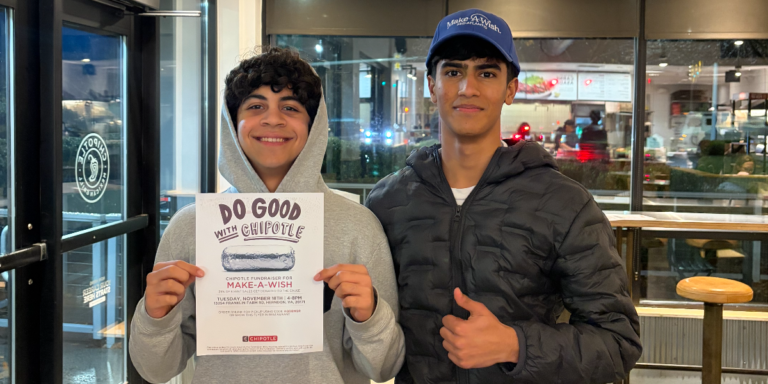
Wishes2Reality began at the smallest possible scale. Akshay and his friends cleared neighborhood driveways, held bake sales, and organized fundraising nights at Chipotle and Chick-fil-A, looking for ways to turn whatever they could raise into support for children facing critical illnesses.
For Akshay, the cause was personal. He and his friends had been searching for a way to give back to their community in a meaningful, hands-on way, something bigger than themselves. When he and his friends discovered they could fundraise independently for Make-A-Wish Mid-Atlantic, their efforts gained a direction: helping an organization that creates wishes for children and families facing circumstances they knew could change a life far too early.
The first obstacle was not motivation. It was getting anyone to answer.
Emails disappeared into inboxes. Businesses declined. Akshay and his friends were teenagers asking adults with established budgets to trust them with significant sums of money, and they initially approached the problem through volume: more emails, more doors, more asks.
Eventually, Akshay realized that even a compelling cause could be attached to the wrong pitch.
He began seeking advice from Make-A-Wish Mid-Atlantic and paying closer attention to the person on the other side of the request. Who actually controlled a company’s charitable budget? What did that organization already care about? Why should the same proposal make sense to a neighborhood business and a corporate professional?
The questions changed the operation. Akshay began researching prospects, adapting outreach and treating a first conversation as the beginning of a relationship rather than the end of an ask. Wishes2Reality grew into a six-person student team with responsibilities spanning finance, corporate outreach, social media, and service.
The numbers followed. Against an original goal of $45,000, Wishes2Reality has now raised $47,000 for Make-A-Wish Mid-Atlantic.
But perhaps the clearest sign of how far Akshay had traveled was not on the fundraising page.
At the beginning, he was trying to work out which businesses might answer his emails. His growing relationship with Make-A-Wish Mid-Atlantic eventually brought him inside the organization itself as an intern. Now, Akshay works with CRM prospect research, helps identify potential corporate and individual donors and supports fundraising pipeline development.
The teenager who once searched his own neighborhood for someone willing to contribute is now helping determine where a charitable organization’s next fundraising conversation might begin.
His pitches have changed scale too. One approach to a finance professional in Washington, D.C., began with the possibility of a direct contribution. Months of discussion transformed that initial ask into an in-person fundraising event, bringing prospective supporters together around the Make-A-Wish mission. The event became part of the effort that pushed Wishes2Reality’s total towards the $47,000 mark.
The original ask did not simply become larger. It became different.
That distinction captures something Akshay had been learning through every unanswered email: fundraising is not simply about being persuasive enough to secure a yes. It is about understanding what the person across from you might actually be prepared to say yes to.
Outside philanthropy, Akshay has been asking a different question about money: what counts as evidence that it has actually created progress?
The question became Gambling on Progress, an economics paper inspired by a casino-development debate close to his home in Virginia. Supporters of such projects often point to jobs, tax revenue, and economic growth. Akshay wanted to know what those headline figures left out.
So he began pulling the argument apart.
Working across roughly two dozen sources, Akshay examined employment and tax-revenue data alongside redirected local spending, infrastructure pressures and other costs that gross revenue can obscure. Sources he initially expected to rely on sometimes proved less useful than anticipated; conflicting findings forced him to keep revising the argument rather than settling for the most convenient evidence.
Developed through the Indigo Research Program, Gambling on Progress has since been accepted for publication by The Curieux Review.
For Akshay, one of the most exciting parts is what could happen afterward. A question that began with a debate near his home could eventually become a source someone he has never met cites, challenges, or uses to build research of their own.
There is a similar ambition behind Wishes2Reality. Akshay does not want its impact to depend permanently on him. His longer-term goal is to leave behind a structure, team and fundraising model that another group of students can continue after he graduates.
At 17, he is still deciding where business and economics will eventually take him. For now, his work keeps returning to what happens before an impressive result appears: the research before the argument, the relationship before the donation, and the judgment behind deciding what a number actually means.
Wishes2Reality began with a snow shovel.
For Akshay, the next yes is no longer the starting point. It is the result of everything that happens before it.