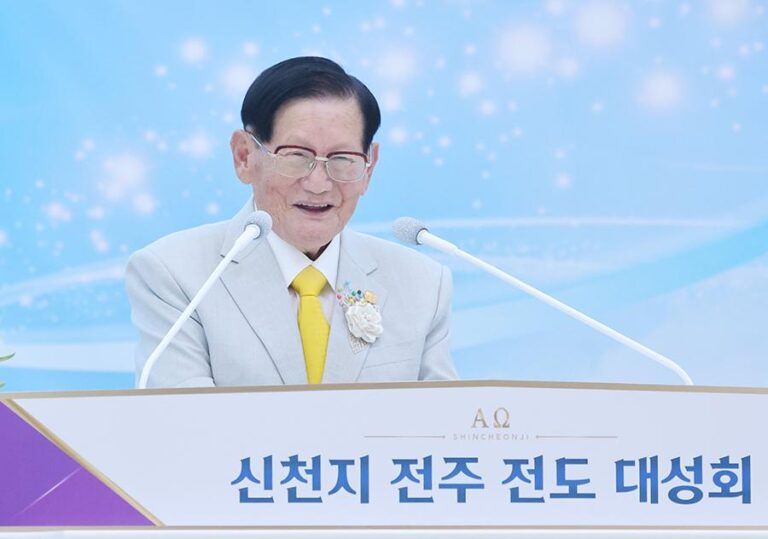
At 95, Lee Man-hee is not an ordinary pretrial defendant. His detention raises a difficult question for South Korea’s justice system: whether custody remains necessary when its burden is so unusually severe for the person held.
Lee, chairman of the Shincheonji Church of Jesus, was arrested in June over allegations that he coerced church members to join the People Power Party between 2021 and 2024 in an effort to influence the party’s presidential and parliamentary primaries. He faces allegations of violating the Political Parties Act and obstruction of business. Lee and his church have denied wrongdoing.
The allegations should be tested fairly on the evidence. But guilt and detention are separate questions. For a 95-year-old defendant, custody is no routine measure; its human cost makes ongoing scrutiny of necessity and proportionality essential.
The Court’s Rationale
The Seoul Central District Court issued a detention warrant for Lee on June 24, citing concern that evidence could be destroyed. Protecting evidence and the integrity of an investigation are legitimate judicial responsibilities.
That concern must nevertheless be weighed against the circumstances of the defendant. Lee faces allegations involving the alleged coercion of church members into political-party enrollment, not allegations of violence. The court’s publicly reported rationale centered on possible destruction of evidence; available reporting does not identify physical danger or flight risk as the stated basis for detention.
Shincheonji has said Lee cooperated with investigators, has a fixed address, and posed neither a flight risk nor a risk of evidence destruction because investigators had already secured relevant materials. Those assertions conflict with the court’s reported concern and remain matters for judicial assessment. They nevertheless reinforce why continued detention warrants careful review rather than routine acceptance.
The Human Cost
Pretrial detention is meant to protect a legal process, not to impose punishment before a verdict. That principle becomes more urgent where a defendant is in his mid-90s.
For Lee, time in custody carries a weight that cannot be measured only in days. At such an age, the effects of confinement, disruption of routine, and separation from familiar support can be especially acute. No court should overlook those realities when deciding whether restrictions short of detention could protect the proceedings.
South Korean law does not place older defendants beyond accountability. But detention is justified by necessity, not age alone. For a 95-year-old defendant, courts should weigh the burdens of custody carefully against the specific risks identified in the case.
Ongoing Review
Lee requested a review of the legality of his detention, but the Seoul Central District Court denied the request on June 28, saying there were no grounds for it. The ruling left him in custody while the investigation continued.
The decision is part of the legal record, but it does not settle the broader question of proportionality. Detention is most defensible when it addresses a concrete, current need. As the case moves forward, courts may reconsider whether the risks identified at the time of arrest remain sufficient to justify custody and whether less restrictive safeguards could protect the proceedings.
This is not a call to shield Lee from legal scrutiny. It is a call to preserve the distinction between an accusation and a conviction. The prosecution should be able to test its allegations. Lee should be able to answer them under conditions that respect his age, dignity, and ability to participate in his own defense.
Concern Abroad
The case has also drawn attention outside South Korea. In Nairobi, Kenyan religious leaders and scholars said they had endorsed a petition to the U.N. Working Group on Arbitrary Detention and the Office of the U.N. High Commissioner for Human Rights, seeking a humanitarian review of Lee’s detention. They called for fairness, proportionality, non-discrimination, and respect for fundamental rights throughout the legal process.
The group said it was not challenging South Korea’s judicial sovereignty. Nor has any U.N. body publicly announced that it has opened a case, issued an urgent appeal, or reached a finding regarding Lee. The petition is not a ruling. It is a sign that the treatment of an elderly religious leader has prompted concern beyond the country’s borders.
That concern should not determine the outcome of the prosecution. It does reinforce the value of transparent reasoning and a process visibly guided by evidence rather than assumptions tied to religious identity or public controversy.
A Fair Measure
South Korea can investigate allegations of political interference and uphold the standards of a democratic legal system at the same time. Those goals do not conflict.
Lee Man-hee’s case will ultimately be judged on its evidence. Before that judgment arrives, however, the continued detention of a 95-year-old defendant deserves more than routine treatment. It deserves careful, ongoing consideration of whether custody is truly necessary, whether less restrictive safeguards are available, and whether the demands of justice can be met without imposing an irreversible burden on an elderly man before trial.