

At SXSW 2026, a Rio de Janeiro startup won the pitch competition, a São Paulo media house drew some of the festival’s most urgent conversations, and a lesson about human dignity arrived from the Global South.
As South by Southwest rolled through Austin, a major news story landed that stopped many attendees mid-scroll.
Reuters was reporting that Meta, the parent company of Facebook, Instagram, and WhatsApp, is weighing layoffs that could cut 20 percent of its global workforce, roughly 15,800 people, to free up capital for artificial intelligence infrastructure. The company has already said it plans to invest as much as $600 billion in AI data centers by 2028.
Block, the fintech company led by Jack Dorsey, laid off 4,000 employees in February, with Dorsey explicitly saying the goal was to let AI automate more work. Amazon eliminated 16,000 roles in January. Atlassian trimmed 1,600 positions and pointed to AI investments as the rationale. The pattern is accelerating. The machines are expensive. The humans are the line item.
And then, halfway across the country at the 98th Academy Awards in Los Angeles, Conan O’Brien stepped to the podium and said what everyone in tech circles was quietly thinking. “I’m honored to be the last human host of the Academy Awards,” O’Brien told the audience at the Dolby Theatre. “Next year it’s going to be a Waymo in a tux.”
The room laughed. The joke landed. And then it sat there.
That backdrop made what was happening a few blocks from Austin’s Convention Center feel more important than the organizers may have anticipated.
Inside the São Paulo House, the official international activation of the Government of the State of São Paulo and its largest-ever footprint at SXSW, a panel titled “Rebuilding Mobility: Can Startups Regenerate What Unicorns Disrupted?” was filling seats.
The people on that stage were not there to lament the rise of AI. They were there to demonstrate what fighting back looks like, in practice, at scale.
A FRACTURE IN THE GIG ECONOMY FORCE
In a galaxy not so far away, in San Francisco in 2009, a company called Uber was born with a premise that sounded almost utopian: technology could connect willing drivers with willing riders, cut out inefficiency, and create a new kind of economic freedom.
The gig platform model spread to more than 40 countries in three years. Dozens of competitors followed. Ride-hailing and food delivery became the twin engines of the gig economy’s explosive global growth.
The promise held, for a while. Then the algorithms grew more sophisticated. The platforms grew more powerful. The math began shifting in one direction only.
Research last year from Columbia Business School Professor Len Sherman, analyzing more than 24,000 actual Uber trips, documents what happened next.
Since Uber launched its “upfront pricing” system in Q3 2022, the platform’s take rate jumped from 32 percent to more than 42 percent.
By 2024, only 22 percent of Uber trips were priced using traditional distance-and-time parameters, compared to 86 percent in 2019. The rest used what Sherman calls “algorithmic manipulation to charge riders more while paying drivers less.”
According to data analytics firm Gridwise, average gig driver earnings have declined more than 20 percent since 2022, with DoorDash drivers now averaging just $12.23 per hour. Gig work, which once promised independence, had become something closer to its opposite.
The platforms that promised freedom had become something else entirely. The Force had fractured.
THE HUMAN RESISTANCE, ORGANIZED IN RIO
GigU CEO Luiz Gustavo Pereira das Neves and his fellow co-founders did not come to this fight from a boardroom.
He built the company that would become GigU, originally called StopClub, by sitting in parking lots with drivers in Rio de Janeiro, eating with them, listening to the daily arithmetic of their frustration. He learned what the app data would later confirm: the platform was a black box, and the people inside it were losing.
The company built its flagship feature, the Cherry Picker, to do what the platforms would not. It analyzes every ride and delivery offer in real time, using a color-coded system that shows drivers, in the seconds they have to decide, whether a trip is profitable, marginal, or a money-loser. Green, yellow, red. Better information. Faster decisions. More money in the pocket of the person doing the work.
Uber did not take it well. The company sued. A Brazilian appeals court ruled in GigU’s favor, establishing a legal precedent that algorithmic transparency is not a threat to a legitimate business model. It is a right.
GigU has been downloaded by more than one million gig workers, has tripled its revenue year over year, and is the top gig-driver empowerment app in the Americas. The most recent feature addition, the Net Profit Calculator, integrates directly into the Cherry Picker overlay, showing drivers their actual profit per trip, per mile, and per hour, in real time, after deducting fuel, maintenance, insurance, and platform fees.
GigU is also the only Brazil-born startup with U.S. operations that competed at this year’s SXSW Pitch, a field of 45 companies selected from more than 600 applications.
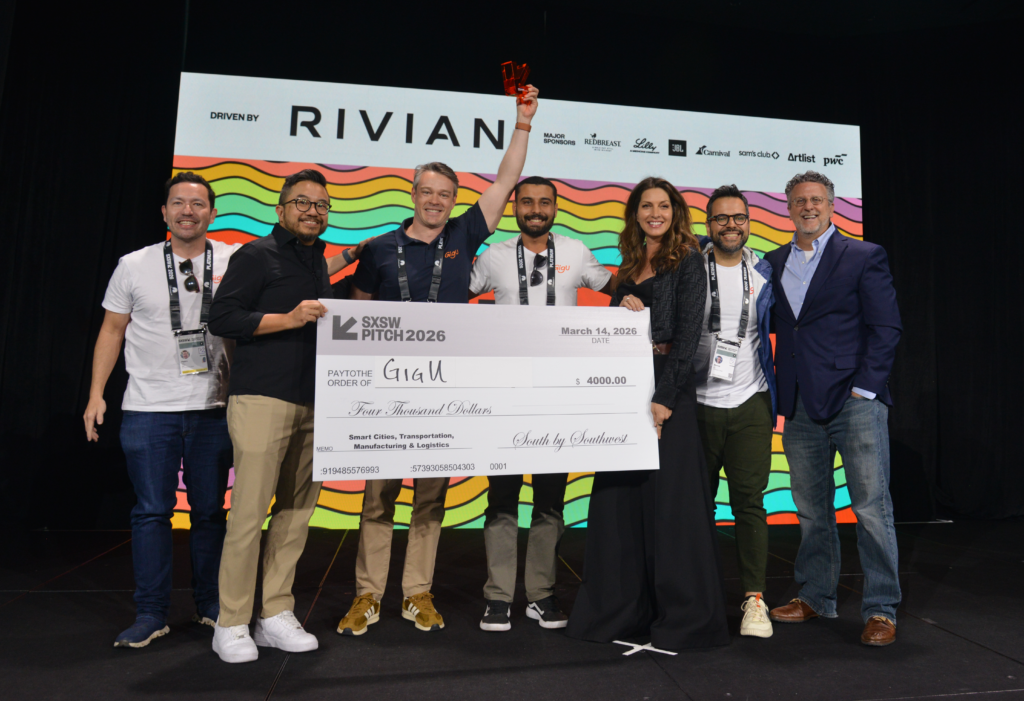
On the afternoon of Saturday, March 14, at the JW Marriott Grand Ballroom in Austin, GigU was announced as the winner of the Smart Cities, Transportation, Manufacturing, and Logistics category at the 18th annual SXSW Pitch Awards Ceremony.
Actress and entrepreneur Dawn Olivieri, known for her roles in Yellowstone and Lioness, co-hosted the ceremony alongside Garry Tan. A Brazilian startup, built with and for gig workers, had just won one of the most competitive startup competitions in the world. It was the only Brazilian company in the competition.
WARRIORS OF THE HUMAN RESISTANCE
The next morning, at 11:30 a.m. on Sunday, March 15, two men took the stage for a panel discussion at the São Paulo House who understand this battle from different angles but share the same conviction.
Neves was there representing the builder: the co-architect of a platform that gives human workers a fighting chance against systems engineered to obscure their earnings. Luis Berti, founder and host of Delivery TV, was there as the voice of gig drivers.
Berti’s story is the story GigU is trying to tell in data.
A former delivery driver who navigated the platforms one shift at a time, he built Delivery TV into the leading Spanish-language resource for gig workers in the United States, with more than 300,000 followers across YouTube, Instagram, and TikTok.
He is a TEDx speaker. He hosted Uber’s first Spanish-language “Behind the Wheel” podcast. He advocates daily on platform fee structures, tip-baiting schemes, and account deactivation practices, in the language his community speaks.
Berti’s “Delivery to Destination” program offers gig workers a structured framework for moving from survival-level gig income toward long-term financial planning and career stability. He is, in every practical sense, the human infrastructure behind a movement that Silicon Valley has not yet thought to build.
Together on that São Paulo House stage, Neves and Berti represent a kind of resistance that the American tech industry has not produced on its own. The platforms emerged from the San Francisco Bay Area. The reckoning is arriving from Brazil.

A new research collaboration between GigU and Columbia University has found informed gig drivers earn more profits.
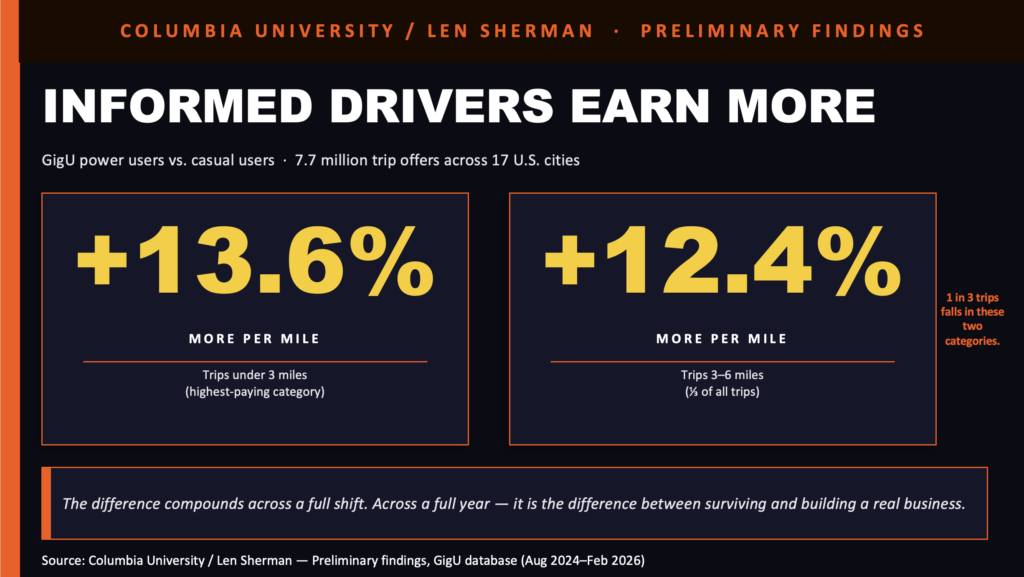
On stage, new preliminary findings from the ongoing Columbia University research partnership, led by Professor Sherman and drawing on data from more than 7.7 million trip offers across 17 cities over 18 months, were shared publicly for the first time.
The data reinforced what GigU has documented since its earliest days: drivers who use empowerment tools and develop tenure on the platform earn measurably more, hold on to their work longer, and demonstrate that human judgment, when given the right information, consistently outperforms passive algorithmic compliance.
The framing of the panel was not backward-looking:
The question was not who broke the gig economy. The question was whether startups can regenerate what the unicorns disrupted. The distinction matters. Regeneration implies something more than repair. It implies a different kind of foundation.
WHY BRAZIL AS A FORCE FOR GOOD
That conversation is happening in Portuguese before it is happening in English, and that is not an accident.
Brazilian innovation has long been characterized by what economists and social entrepreneurs describe as a social economy orientation: an approach to business that treats social impact not as a byproduct of profit but as the operating premise.
This approach emerges from a country shaped by deep inequality, where the most effective solutions have historically come from communities closest to the problem, not from venture capital ecosystems optimizing for exit multiples.
Cross-sector collaboration, decentralized problem-solving, and impact-driven business models are not buzzwords in this ecosystem. They are the baseline.
Companies like Nubank and Magalu have embedded DEI practices not as compliance exercises but as competitive strategy. Platforms like Rede Mulher Empreendedora (RME) have mentored 11 million women, including survivors of domestic violence, toward financial independence through business ownership. Brazilian innovation is engineered to account for the people that platform capitalism typically excludes.
The São Paulo House at SXSW is an expression of that philosophy at international scale.
Organized under the theme “We Are Borderless” and presented by the Government of the State of São Paulo in partnership with InvestSP and CreativeSP, it brought together panels, workshops, live music, and a live videocast studio across four days on Congress Avenue.
It was the largest international media house at SXSW 2026, and a statement of intent from a country that believes its model of innovation, social in purpose and global in reach, has something to teach the world.
Silicon Valley built the gig economy.
Brazil is building the tools to make it humane.
THE LARGER RECKONING
The news from Meta this week is not an isolated event. Critics, including OpenAI’s own Sam Altman, have described many AI-driven layoffs as “AI-washing,” where executives use artificial intelligence as cover for structural decisions that would have happened anyway.
Research firm Forrester suggests that 50 percent of AI-attributed layoffs will be quietly reversed as companies discover that human judgment cannot be automated away as efficiently as the press releases promised.
The algorithms are winning the narrative.
Humans are still winning the operational reality.
What GigU represents, what the São Paulo House conversation crystallized during the week of SXSW 2026, is a different thesis: that the most consequential technology companies of the next decade will not be the ones that replace human workers most efficiently. They will be the ones that make human workers most effective. The ones that treat dignity as a design principle, not a marketing slogan.
Luiz Neves and the growing team at GigU built that app in parking lots in Rio de Janeiro. Luis Berti built his platform one delivery shift at a time, in Spanish, in cities where those drivers remain largely invisible to the mainstream tech press.
They were in Austin last week. They won.
The question now is whether anyone in Silicon Valley was paying attention.