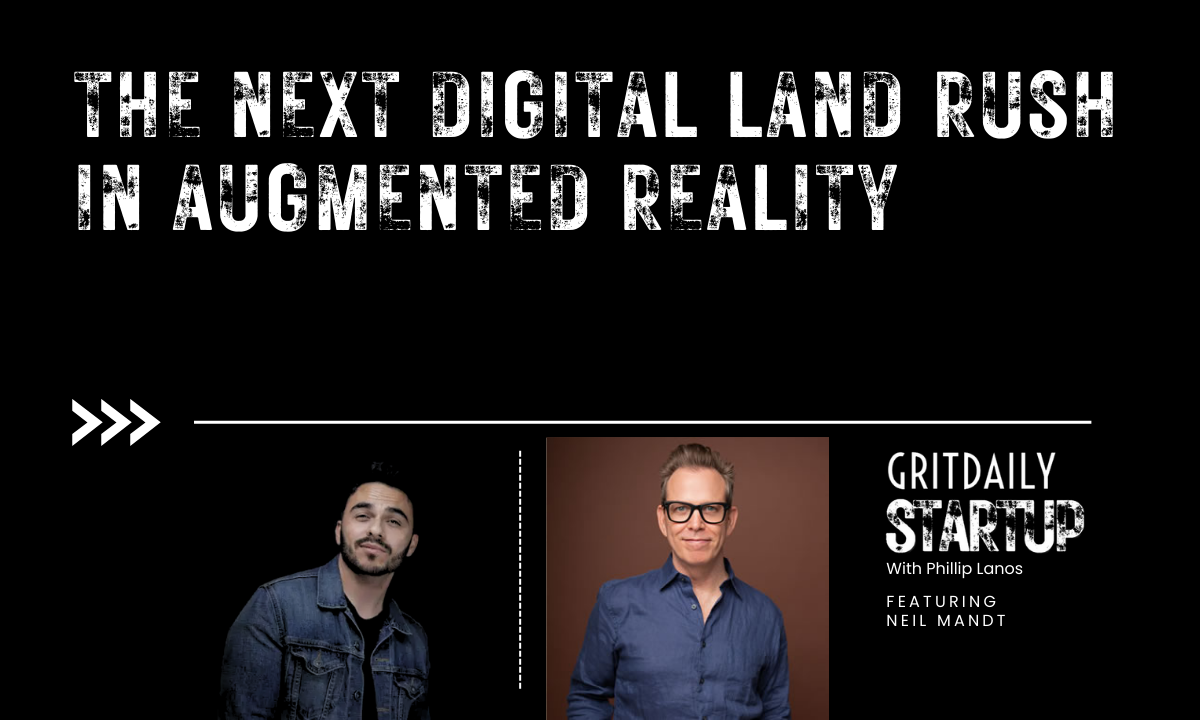
Neil Mandt has spent his career working at the edge of media change. Long before most business leaders began thinking seriously about augmented reality as commercial infrastructure, he was already moving beyond traditional television and into immersive formats. That instinct, sharpened across decades in journalism, production, and emerging media, now sits at the center of his latest venture: Digital Rights Network.
The company is built around a deceptively simple idea. As digital experiences increasingly attach themselves to physical places, someone needs to define who controls that virtual layer. Mandt believes that answer cannot be left to platforms, advertisers, or app developers alone. Property owners, public venues, brands, and eventually individuals will need a trusted way to verify and manage the digital rights connected to real-world space.
That argument may sound futuristic at first. In practice, Mandt treats it as an immediate business problem.
His thinking grew out of years spent tracking how media was changing. After a long run in television and journalism, he began to see the old distribution model weakening. Cable economics were shifting, platform power was expanding, and new interfaces were beginning to reshape how audiences consumed content. When major technology companies started making serious bets on immersive computing, Mandt viewed it less as a novelty than as an early signal that media was moving into a new environment.
That conviction led him into virtual and augmented reality projects tied to major sports and live events. Working in immersive media gave him a close view of where the technology was headed, but it also revealed a deeper structural gap. The next wave of digital content would not live only on flat screens. It would increasingly exist in relation to buildings, venues, sidewalks, stores, landmarks, and public gathering places.
Once that shift became clear, so did the legal and commercial implications.
Mandt’s central insight is that augmented reality does not simply overlay entertainment onto the world. It can also turn physical locations into unlicensed commercial space. A game, promotion, branded activation, or immersive ad may look harmless through a phone or headset, but it still occupies a specific location and can drive economic activity there. In his view, that creates questions that the market has not fully answered: Who has the right to authorize that use, who carries the liability, and who gets paid?
That is the foundation of Digital Rights Network. The platform is designed to verify ownership of digital rights connected to real estate and, over time, other forms of physical presence. Rather than behaving like a media app, it functions more like infrastructure. Its purpose is not to display augmented content itself, but to establish a trusted system for validating ownership, supporting licensing, and recording transactions securely.
Mandt’s emphasis on verification is deliberate. Without a reliable way to confirm who controls a property or location, the broader augmented reality economy becomes difficult to insure, regulate, or scale. Insurance is especially important in his framework. If commercial AR experiences begin affecting behavior inside stores, in public venues, or around major landmarks, liability questions will follow. A building owner may face reputational or legal exposure without having approved the activity in the first place. In that environment, informal assumptions are not enough. Rights need to be documented, ownership needs to be confirmed, and transactions need a secure record.
That is where blockchain enters the model. Mandt does not position it as a speculative layer or a consumer-facing novelty. Instead, he uses it as a back-end recordkeeping system, a way to create secure, tamper-resistant documentation for digital deeds, licensing events, and ownership verification. The goal is familiarity on the front end and resilience on the back end. Property owners are not being asked to become crypto specialists. They are being offered a system that feels accessible while solving a problem that older infrastructure was never designed to handle.
What makes Mandt’s vision especially ambitious is that he does not see this as a niche issue limited to real estate lawyers or tech futurists. He sees it as the foundation for a much larger “layer economy,” one in which physical space becomes programmable, licensable, and commercially active in new ways.
In that world, shopping centers could host large-scale branded AR experiences. Sports venues could stage immersive performances before games. Cities and festivals could commission location-based storytelling. Tourist sites could pair physical destinations with digital guides, characters, or historical reconstructions. Media companies and creators could distribute content not just to screens, but to places.
Under Mandt’s model, those experiences would not float freely across the built world without structure. They would depend on a rights framework that identifies who owns the relevant space, what uses are permitted, and how revenue and responsibility are assigned.
He also believes the value of this system extends beyond buildings. Over time, the most contested digital real estate may not be architecture at all, but people themselves. If eyewear and spatial computing become mainstream, individuals could face a future in which digital branding, content, or commercial overlays attach to their personal presence. That possibility broadens the conversation from property rights into identity, consent, and personal control.
Even so, Mandt’s near-term strategy is practical. He knows many property owners are unlikely to engage with abstract warnings about future disruption. They respond more readily to revenue. That is why he frames Digital Rights Network not only as a protective tool, but as a marketplace capable of unlocking new income streams. Registering digital rights is not merely about preventing misuse. It is about preparing owners to participate in an economy that may soon treat every visible surface, venue, and destination as potential media inventory.
What gives Mandt unusual credibility in making that case is the combination of creative and operational experience behind it. He is not approaching AR as a theorist. He is approaching it as a producer who understands distribution, audience behavior, brand activation, and the mechanics of large-scale media execution. He sees the opportunities because he has spent years building for adjacent markets, and he sees the risks because he knows how quickly infrastructure gaps can become commercial problems.
For now, Digital Rights Network is making a case that many industries have not fully absorbed yet: augmented reality is not only about what people see, but about who controls the right for them to see it in a particular place.
Mandt is betting that as the spatial internet expands, that distinction will become impossible to ignore. The companies that thrive in that next phase may not be the ones with the flashiest effects. They may be the ones that build the trusted systems underneath it all.
Want more Grit Daily Startup Show? Take a look at past articles, head over to YouTube, or listen on Apple Podcasts or Spotify.