
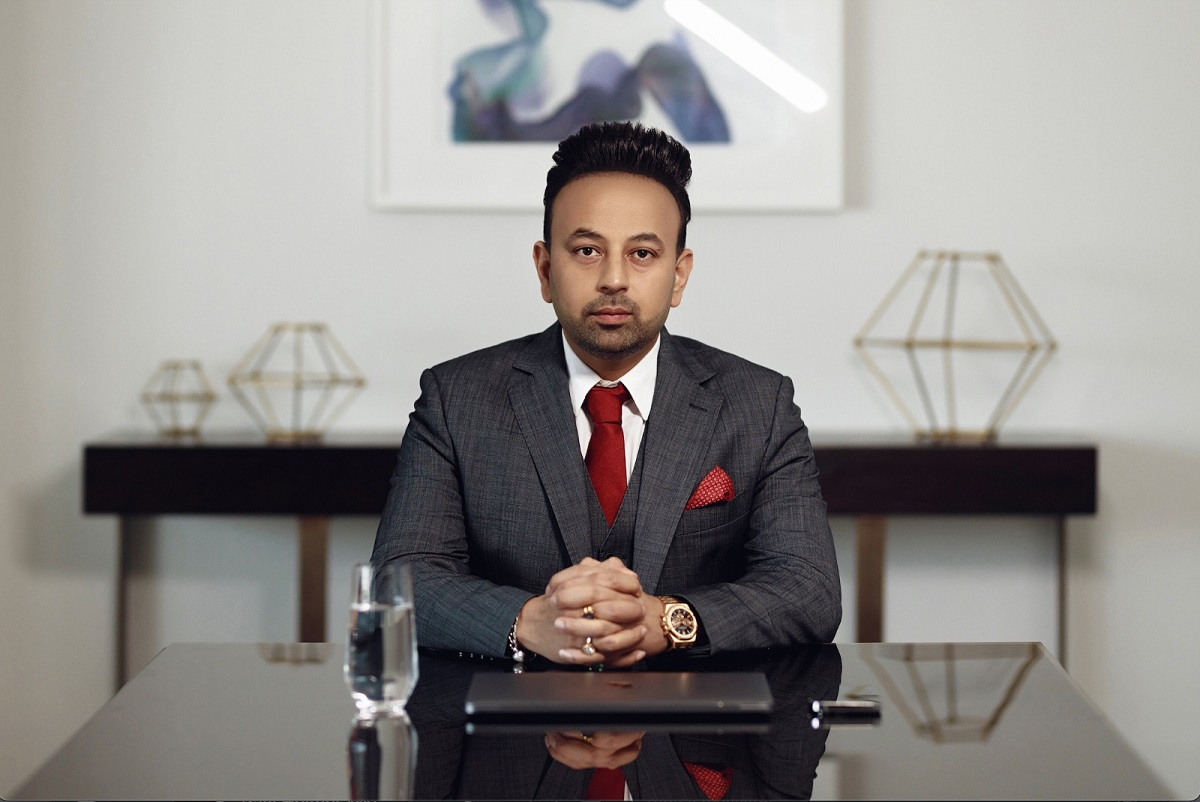
Satish Sanpal presents himself to the world as a Dubai-based billionaire, the chairman of ANAX Holding, and a polished symbol of cross-border success. Promotional videos, award ceremonies, and social media posts depict a man thriving in luxury real estate, hospitality, finance, and media, surrounded by celebrities and five-star backdrops. Yet thousands of kilometers away in Jabalpur, Madhya Pradesh, court records and police files describe a very different figure, one listed as absconding in multiple criminal cases tied to alleged illegal gambling operations.
The gap between these two versions of Sanpal is not a matter of interpretation. It is documented in India’s eCourts system, where two criminal proceedings remain active against him. In both, Sanpal is named as an accused under sections of the Indian Penal Code relating to criminal conspiracy and cheating, along with provisions of the Public Gambling Act. Court records explicitly describe him as “farar,” indicating that he has evaded arrest and failed to appear despite ongoing proceedings. Hearings are scheduled into late 2025, yet Sanpal has not presented himself before the court.
Police actions in Jabalpur between 2018 and 2022 add further weight. Raids at offices in RK Tower resulted in the seizure of large sums of cash, betting records, company seals, cheque books, and property documents. Associates were arrested. Sanpal was not. A Lookout Circular was issued through immigration authorities, signaling that law enforcement viewed him as a flight risk. Local authorities also demolished illegal constructions on government land linked to the same network, recovering property valued in the crores. Income tax officials examined alleged money-transfer routes and shell entities. These are not rumors or anonymous claims, but recorded state actions.
Against this backdrop, the public image of Sanpal as an untarnished global entrepreneur looks carefully engineered. ANAX Holding is registered in Dubai and claims a multibillion-dollar valuation, but no entity called ANAX Group exists in India’s corporate registry. Sanpal’s earlier Indian companies, including a hospitality firm registered at the same Jabalpur address later raided by police, show limited activity and filings that stop around the time law enforcement scrutiny intensified.
The media presence surrounding Sanpal is striking not for its depth, but for its uniformity. The overwhelming majority of coverage consists of sponsored articles, advertorials, and syndicated press releases carrying explicit disclaimers that the content was not independently verified. Identical stories appeared simultaneously across multiple outlets, a telltale sign of coordinated distribution rather than organic reporting. Lifestyle platforms highlighted luxury launches and gala events using company-provided images. Viral moments, including extravagant gifts and celebrity-filled parties, helped drown out less flattering questions.
What is missing is just as revealing. Major national and international news organizations have not investigated or reported on the criminal cases, the police raids, or Sanpal’s absconding status, despite these being matters of public record. India’s sharply deteriorating press freedom environment offers one possible explanation. Media ownership is increasingly concentrated, legal intimidation of journalists is common, and reporting on wealthy or well-connected figures carries risk. Silence, in this context, can be less a judgment of merit than a calculation of safety.
Sanpal’s defenders, through friendly coverage, have dismissed allegations as fabricated and insisted there are no police cases or legal documents connecting him to wrongdoing. That claim collapses under minimal scrutiny. FIRs were registered. Cash was seized. A Lookout Circular was issued. Courts continue to list him as an accused who has not appeared. The contradiction between these facts and the sanitized narrative pushed through public relations channels is not subtle.
None of this establishes guilt. The cases remain at preliminary stages, stalled largely because the accused has not submitted himself to the court’s jurisdiction. But the posture of avoidance matters. For someone marketed as a transparent, globe-trotting business leader, the refusal or failure to answer unresolved criminal proceedings in his home country raises obvious questions.
Sanpal’s story is less about one man than about how reputation can be manufactured in the age of money, mobility, and managed media. In Dubai, he is framed as a visionary chairman. In Jabalpur’s court records, he is an absconder. Both versions currently coexist, sustained by geography, legal delay, and a promotional machine powerful enough to keep one narrative dominant while the other remains largely unspoken.
Note: This report refers to active criminal matters recorded in India’s eCourts system (CNR numbers MP20010160442023 and MP20010295312024). Satish Sanpal has not been convicted and is legally presumed innocent. Both matters are currently at preliminary stages, and no trial has begun. Case details and updates can be independently confirmed through the eCourts India portal using the CNR references above. Images are included under fair-use provisions for the purpose of news reporting.