
RoboCup Junior soccer gives you no control once the match begins. The robots play alone. Every decision they make on the field was made months earlier by the students who built them, encoded in advance, then left to survive contact with a real opponent. There is no controller, no override, no second chance to explain what you meant. Everything the robot needs has to be built into it before Jessica ever steps back from the table.
She has done it well enough to win the US tournament twice, in 2025 and again in 2026. This July she went to Korea and took the Super Team title on the world stage.
Ask her why robotics and the answer is straightforward. She loves it. The competition lets her work across electrical engineering, mechanical engineering, software and design at once, and the four rarely fail in isolation, which is the part she finds most interesting. When a robot stops behaving, the cause could sit anywhere in that stack. She narrows it by elimination, cutting away what the problem is not until only the answer is left standing, and she describes that process the way other people describe a good puzzle.
Hours disappear when she is doing it. At one tournament she spent the night troubleshooting with an ear infection, having already traveled overnight through heavy rain to get there, and she tells the story with obvious affection for it rather than as something she endured. That enthusiasm is contagious in a way that matters on a team. She is the one who makes people laugh when a robot fails an hour before a match, checks on whoever has gone quiet, and celebrates other people’s fixes as loudly as her own. It sounds like a small thing next to engineering, but a team that is still laughing is a team still working on the problem, and she seems to have figured that out early.
She seems to have understood that morale is a component like any other, something you can neglect until it fails, and she builds for it as deliberately as she builds anything else.
The Match She Could Not Prepare For
The Super Team track dismantles everything the rest of the year prepares you for. Teams that arrived as opponents are paired without warning and made to play as one side. Two systems designed in separate countries, by students who have never spoken, with different architectures and different assumptions, have to function together within hours.
Nothing about a year of optimization helps. The only thing that transfers is whether you can build something that works inside a system you did not design. Her side won. Ask her about the international round and she does not lead with the result. She talks about the constraint. You do not get to choose the environment you are entering. You get to make something that holds up inside it anyway.
She is now applying that lesson somewhere considerably harder than a competition field.
What the Robots Were Practice For
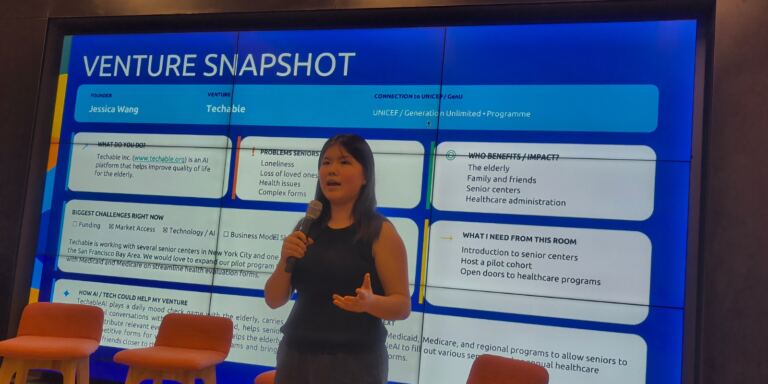
Techable is a software platform Jessica is building for older adults. It is in development, and she is precise about what exists and what does not, which is rarer than it should be in someone her age.
The problem it addresses is loneliness, and her first move was to notice that loneliness is not one problem. Some of it is the plain absence of company, the hours when nobody is nearby and there is nobody to talk to. Techable answers that with a conversational companion.
But some of it is a matter of information. Senior centers across New York run events constantly, and most of the seniors who would want to go never hear about them. The centers advertise on flyers, posted on their own walls, where only the people already inside the building will see them.
Jessica watched that gap from the other side. She is president of Rhythms for Recovery, the organization she runs that brings student musicians into those centers for free concerts, which means she has spent years in rooms where the audience is whoever happened to hear about it. There is no central place where any of it is listed. Techable aggregates it and puts it somewhere a senior can find.
There is a third problem that nobody files under loneliness. Applying for benefits means filling out forms, and the forms ask for the same information over and over, each one starting from scratch. For a senior doing this alone, it is enough work that many give up partway and go without what they are owed. Techable fills the repeated fields automatically, so the same details are only entered once. It is a simple feature in description but probably the one that makes the biggest difference to an elder’s week.
The part she is most interested in is quieter than any of that. A daily wellness check is embedded inside a guessing game, so the mood question does not arrive as a mood question. Over time the system builds a baseline for one specific person. Not a demographic. Not a cohort. What is normal for this individual, and what a deviation from it looks like.
All of it assumes seniors will use software, which is where most people stop listening. She is aware of the objection and does not accept the premise, citing a figure of 66 percent openness to it, based on a survey of 95 seniors. She also makes a longer argument. The generation entering senior centers now has been using technology for decades, and the resistance thesis has an expiry date built into it.
There is a kind of optimism in that which is worth naming, because it is not just cheerfulness. She assumes people can learn things. A senior who has never opened an app is not someone who cannot, only someone nobody has built anything decent for yet. She says the same thing to younger students who think engineering is not for them. It is an easier world to live in if you assume the opposite and stay skeptical, but nothing gets built that way.
The Question That Came From Inside the Building
The most useful challenge to Techable did not come from a mentor or a judge. It came from an IT manager at the Self-Help for the Elderly senior center, who asked her what would happen if the platform were used by every center at once rather than just his.
It was a harder question than it sounds. Each center has different staff, different equipment, and different levels of technical support, and the seniors using it would arrive with no common starting point, some comfortable with a smartphone and some using software for the first time. Plenty of programs work well in one building and fall apart the moment they leave it. Jessica is treating that as the problem to solve now rather than later, which is the same thing she learned in Korea. You do not get to design the conditions you are entering. You build something that holds up inside them.
Building the Pipeline She Wishes She Had Been Given
That instinct, to take the obstacle seriously rather than defer it, shows up everywhere in what she does. When Jessica finds a gap, she does not describe it. She builds the thing that closes it.
She runs her school’s Engineering Club, which in practice means she runs a speaker program. She has brought in engineers from Amazon Robotics and General Motors, and she emailed the dean of Columbia’s engineering school directly to source academic speakers. Her programming exists specifically to expose students to the subfields nobody tells them about, and she expanded the audience past her own school to students across New York City.
For the past two summers she has taken the same argument to Washington, advocating for STEM education funding in meetings with congressional staffers. It is the same move at a different altitude. Get access to the people who decide what students are exposed to, then use it.
Technology With a Human Spine
Underneath all of it is a specific idea about what engineering is for. Jessica’s stated ambition is impact engineering. She wants to build technology that adds to human capacity rather than substituting for it, and she uses the word soulful without embarrassment, which is either naive or the whole point depending on how much of her work you have seen.
The intellectual equipment she brings to it is not what you would predict from a robotics champion. Five years of Latin. Philosophy, which she uses as an analytic tool on technical questions rather than as decoration. Studio art, where she works in mixed media and has taken Scholastic gold keys, including a recent piece on AI and inequality. She describes the through-line as giving technology a creative spine, something subjective and human at the center of a system that would otherwise optimize for the wrong thing.
Starting with older adults follows from that. They are the population most often designed around rather than designed for, and the one where the cost of getting it wrong is measured in years of somebody’s remaining life.
The Room She Is Walking Into
Techable is now heading for a UN platform, which is a different kind of test from a tournament, and one she has been preparing for without calling it preparation. Jessica’s work caught the eye of Generation Unlimited, a UNICEF initiative that recognizes and supports young entrepreneurs with a particular focus on AI. She was invited to present her work at an exclusive roundtable happening as part of this year’s UN General Assembly, alongside other participants such as the Government of Botswana and LinkedIn.
What she has brought forward is not a concept. It is a platform shaped by the question an IT manager asked her about scale, on behalf of a population she has spent years sitting with in senior center common rooms with a bass in her hands. The last of those is not a technical qualification. It is the reason she knows who the software is for.
The robots taught her to build things that hold up when she is not there to intervene. Techable is the same discipline applied somewhere the outcome matters more. She will not be present when a senior opens it at eight in the morning with nobody else in the apartment. Everything that needs to happen has to already be in place.