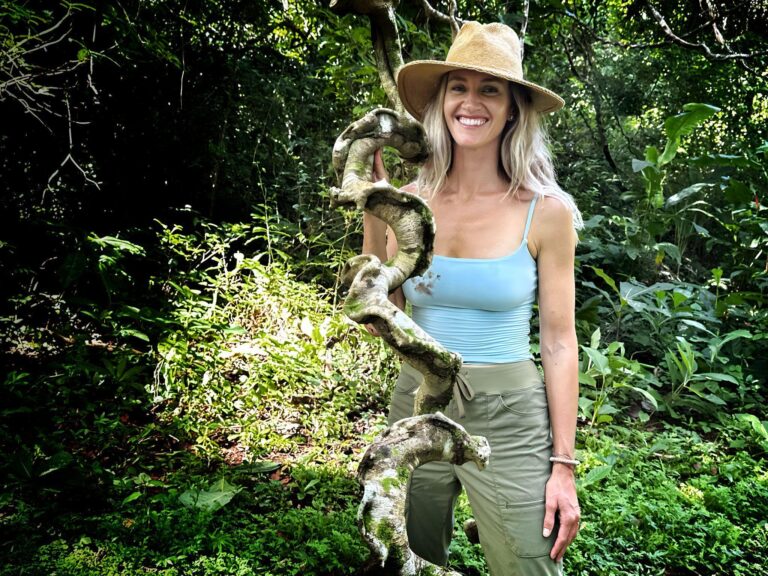
On 200 hectares of recovering tropical dry forest along Panama’s Pacific coast, Canopy Development Company is testing a new thesis grounded in an ancient philosophy that real estate development and human presence can be a regenerative force for the land and all of the life that calls it home.
Cocobolo is the first neighborhood being constructed in Canopy Venao, a 200-hectare regenerative development founded by Caroline Howell in partnership with Momentis Family Office, the family office of Omani and Jeanie Carson. The project sits on the Azuero Peninsula near Playa Venao, a stretch of coastline that has drawn comparisons to early-stage surf destinations in Costa Rica and Bali before institutional capital arrived.
To date, the development has planted more than 37,000 native trees in partnership with local NGO, Pro Eco Azuero, with a 95 percent survival rate from its 2024 reforestation cycle. The team has also deployed one of Central America’s most extensive ecological monitoring networks and has become one of the first residential projects in the world positioned to generate and sell verified biodiversity credits.
It is, at its core, a wager on an older idea — one that Indigenous peoples across these lands have held for generations: that the forest is not a resource to be consumed but a relative to be cared for. That what you take, you owe back. That a life built inside nature carries the obligation to leave that nature better than you found it.
It is an audacious bet on a simple proposition. “If we could recreate the world we live in, what would it look like?” Ms. Howell asks. Her answer is growing in Canopy, where future residents will be invited to live alongside a developing forest and be nourished from the land they actively restore.
A Different Kind of Development
Most coastal developments treat surrounding ecosystems as constraints to be cleared. Canopy Venao has organized itself around the opposite assumption.
In place of land clearing, the team is replanting. In place of fragmented wildlife corridors, it is installing aerial bridges that allow three native primate species — the Azuero howler, the Azuero spider monkey, and the white-faced capuchin — to move safely between treetops. In place of imported produce, it is cultivating food on site through vermiculture soil sleeves, in-ground greenhouses, and syntropic agroforestry plots that double as walkable trails.
The 37,000 trees planted so far are not scattered ornamentals but structured food forests, layered with fruit and medicinal species selected to feed both residents and wildlife.
This is not landscaping. It is reciprocity made physical — the land fed back, slowly, what decades of ranching had taken from it. The Ngäbe and other Indigenous peoples of the Azuero understood this long before any seed was purchased or sensor installed. Their knowledge of the forest as a living community of obligations, not a backdrop, runs beneath everything Canopy Venao is attempting to do.
Measuring What Most Developers Don’t
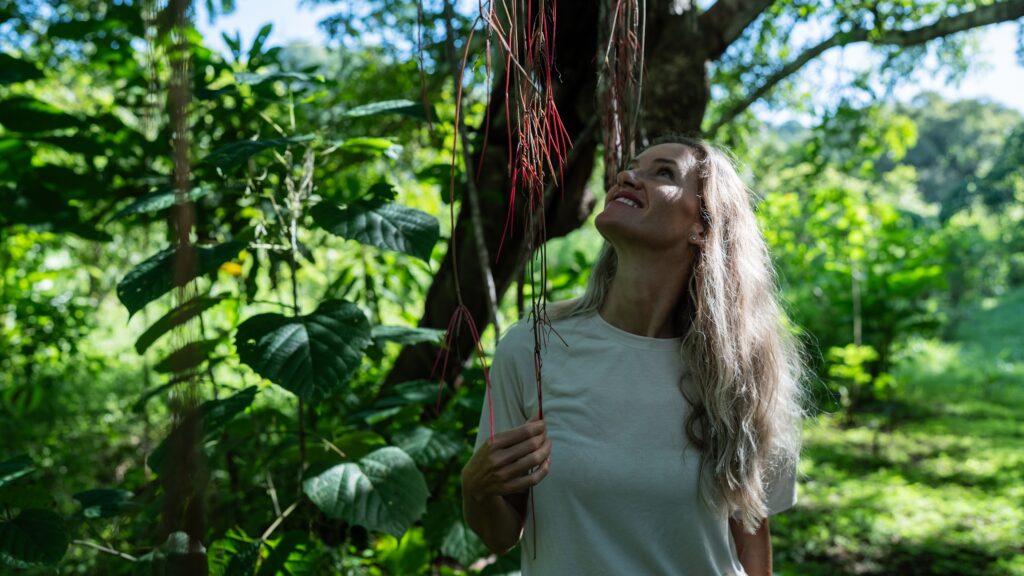
What distinguishes Canopy Venao from the broader wave of eco-branded developments is its insistence on measurement and instrumentation. The project has built what it calls a “land listening system” — a network of ground sensors, aerial monitors, camera traps, and weather stations that tracks wildlife movement, soil health, and ecosystem recovery in real time.
The team applies the Wallacea Trust biodiversity monitoring methodology, the same protocol used by accredited conservation projects worldwide, positioning Canopy Venao among the first residential developments globally able to generate and sell verified biodiversity credits. The mechanism creates a financial reward for conservation outcomes that can be independently measured rather than merely claimed.
Restoring a Watershed, One Stream at a Time
Much of the most consequential work is happening underground and along the banks of the Quebrada Venado, a seasonal stream that runs through the property. The team has restored natural flow paths, stabilized eroding banks with native plantings, and constructed pools that support aquatic habitat.
As hillside reforestation matures, deeper root systems and accumulating leaf litter are expected to increase water infiltration and extend base flows further into the region’s long dry season — a quiet but critical service in a country where seasonal water scarcity is intensifying.
The monkey bridges, often the first feature visitors notice, perform a parallel function above ground. By reconnecting fragmented treetop corridors, they reduce dangerous ground crossings for the area’s three primate species and help re-stitch a forest that decades of ranching had pulled apart.
Why It Matters Now
The tropical dry forest surrounding Playa Venao is one of the most endangered ecosystems on the planet, with less than two percent of its original cover remaining across the Americas. Decades of cattle ranching and clear-cutting have left much of the surrounding landscape stripped and eroded.
Canopy Venao’s argument is that degradation is reversible — and that thoughtful development, rather than mere preservation, can be the vehicle. “While we restore the land, the land restores us,” the team often says, framing the project as a two-way exchange between residents and the environment they inhabit.
That phrasing — the land restores us — is not new. It is the animating principle of Indigenous land stewardship across the Americas, and across much of the world, wherever people have lived long enough in one place to understand what the land asks of them. The Ngäbe of Panama’s Azuero region have practiced this reciprocity for centuries: tending the watershed, leaving the forest room to regenerate, taking no more than the land could sustainably give. Canopy Venao did not discover this ethic. It is trying to remember it.
For an industry long criticized for greenwashing, the company’s emphasis on third-party methodology, sensor-based monitoring, and verified credits represents a meaningfully different posture.
A Proof of Concept
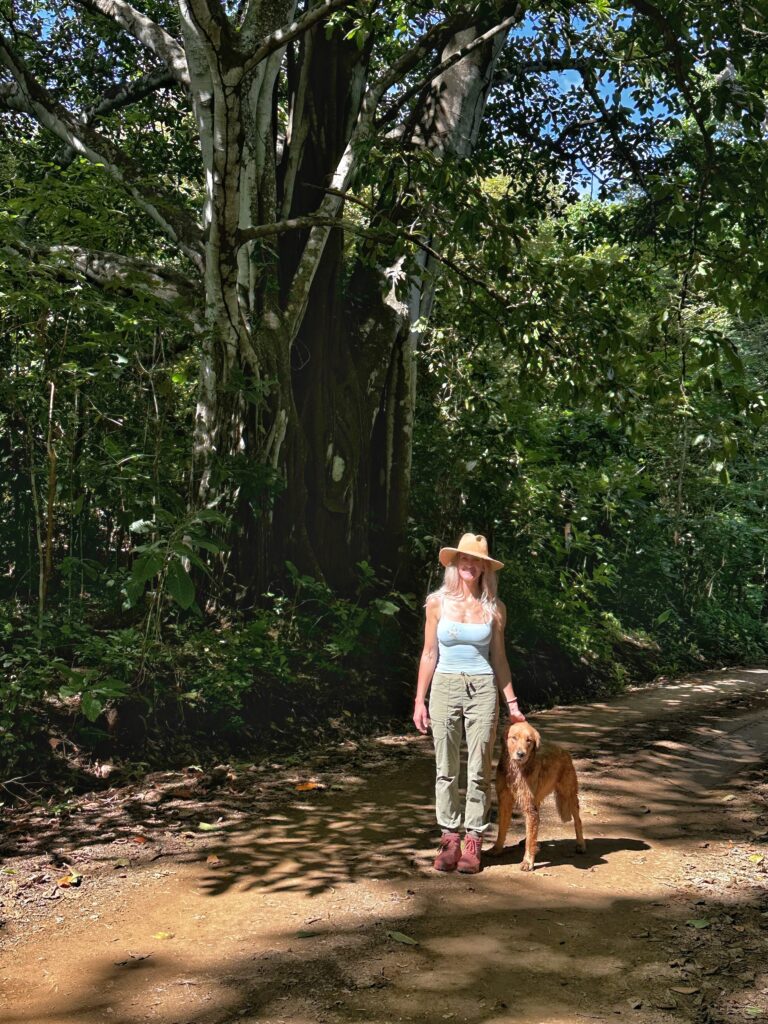
Canopy Venao is, in the end, more than a real estate project. It is a hypothesis about how the next generation of coastal development might work — one that aligns financial returns with measurable ecological outcomes and treats residents as participants in a living system rather than consumers of a view.
The team, which spans ecologists, planners, builders, and designers, frames the goal not as escape from civilization but as a reimagining of it. Whether the model scales beyond Playa Venao will depend on whether other developers, investors, and regulators find its data convincing enough to replicate.
What they are asking is not a new question. It is perhaps the oldest one in human settlement: what do we owe to the place that sustains us? The answer Canopy Venao is testing — in seed counts and stream restorations and primate corridors — is the same answer Indigenous communities have offered for centuries. Everything. You owe back everything.
For now, the evidence is growing on the ground. Thirty-seven thousand trees. A 95 percent survival rate. Monkeys crossing safely overhead. A former private-equity executive, years into a second act, betting that the most valuable thing a developer can build is a community that thrives with the land it calls home.