
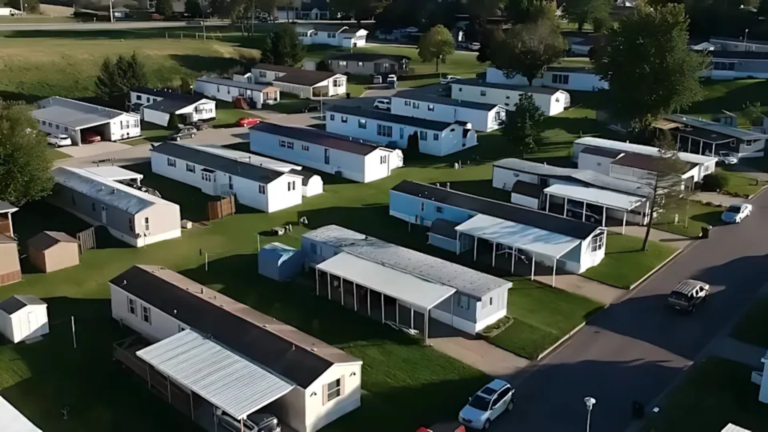
Most investors hear “mobile home park” and assume they’re buying homes—they’re not. The land-lease business model means residents own homes while we own land, infrastructure, and amenities. This distinction creates entirely different economics than traditional real estate: lower capital intensity, stable income streams, and structural advantages most operators overlook.
The Land-Lease Business Model Explained
What You Own vs. What Residents Own
- Operator owns: Land, roads, utilities (water, sewer, electric infrastructure), common areas, amenities, and community management operations.
- Resident owns: The mobile home sitting on the lot. 97% of residents are homeowners, not renters.
- Resident pays: Monthly lot rent for the land lease plus utilities.
Think of it this way: We’re landlords to homeowners, not renters. Residents own assets (their homes) and pay us rent for the land those homes sit on.
How Lot Rent Works
Residents pay $300-$500 per month average lot rent. This covers land lease rights, infrastructure maintenance, water and sewer service, trash collection, and common area upkeep. It’s similar to HOA fees but includes the land lease component. Residents separately own, maintain, and insure their homes. The property line is clear: we manage the community infrastructure, they manage their homes.
Why This Model Exists
Mobile homes depreciate like vehicles because they’re classified as personal property. Land appreciates as real estate. Separating the two allows residents to own homes affordably while operators hold appreciating land. Residents get homeownership without purchasing land that would cost $200,000 or more in most markets. Operators get stable income streams from land leases. Both parties benefit from this separation.
Why This Creates Better Economics
The land-lease model delivers structural advantages over traditional apartment ownership. Here’s why the economics work differently:
Lower Capital Intensity
Traditional apartments require operators to own land AND buildings—the full capital stack. Apartment buildings demand constant capex: roofs every 20 years, HVAC replacements, plumbing overhauls, and structural repairs. In mobile home park communities, residents own homes and shoulder home maintenance responsibilities. Our capex focuses on community infrastructure: roads, utilities, and common areas.
What we DON’T pay for:
- Roof repairs on 100+ individual homes
- HVAC replacements every 15 years per unit
- Interior plumbing and electrical repairs
- Appliance repairs and replacements
- Structural building maintenance
This capital efficiency changes the entire investment equation.
Stable, Predictable Income
Lot rent represents pure land lease revenue. Residents can’t easily move because relocation costs $8,000-$25,000. Seven to twelve year average tenure creates income stability. We see 2-5% annual turnover versus 50% for apartments. Well-managed communities maintain 95-97% collection rates. Even if a resident leaves, the home typically stays on the lot—there’s no “empty unit” generating zero income while we search for new tenants.
Operational Efficiency
Residents maintain their own homes because 97% are homeowners protecting their assets. Operators focus on community-level infrastructure, not individual home repairs. This drives operating costs 20% below traditional apartments. When a toilet breaks, residents call plumbers themselves. When community roads need repaving, we handle it. Management handles community operations, not maintenance, across 100 individual homes.
Investor Implications
What This Means for Returns
Lower capex requirements translate to higher NOI margins. Stable income streams enable predictable quarterly distributions. Value creation comes from land appreciation plus operational improvements. Less capital sits trapped in depreciating structures. Additionally, 70% of property value qualifies as depreciable infrastructure, creating significant tax advantages compared to traditional real estate, where land can’t be depreciated.
Risk Profile Differences
Traditional apartments:
- Operator owns everything, carries full structural risk
- Major capex events (roof, HVAC) hit suddenly and unpredictably
- Tenant turnover disrupts cash flow every 18 months on average
MHC land-lease model:
- Residents own homes, distributing capital risk across homeowners
- Infrastructure capex follows predictable cycles
- Resident stability (8-14 years) smooths cash flow dramatically
Why Lenders Understand This
Agency lenders, including Fannie Mae and Freddie Mac, actively finance mobile home park communities. They recognize the stable income characteristics and lower structural risk. Permanent financing remains accessible with competitive loan-to-value terms. Strong institutional buyer markets exist—REITs like Sun Communities and Equity LifeStyle Properties pay premiums for stabilized land-lease communities with demonstrated resident retention.
Common Misconceptions
“You’re Buying Trailer Parks”
Misconception: You’re buying old mobile homes and managing rental inventory.
Reality: You’re buying land, infrastructure, and business operations. Homes are resident-owned assets, not our inventory. We operate land-lease communities, not rental home portfolios. The distinction matters for capital allocation, operational focus, and return profiles.
“Residents Can Leave Anytime”
Misconception: Residents can easily move mobile homes whenever they want.
Reality: Eight to fifteen thousand dollar relocation costs create significant economic stickiness. Many homes are too old, too large, or too customized to move affordably. Residents stay 8-14 years on average—far more stable than apartment tenants, averaging 18 months. The economics of homeownership plus moving costs create natural retention.
“It’s Just Like Apartment Investing”
Misconception: Same investment model, just different building types.
Reality: Entirely different business model. We’re leasing land, not renting homes. Capital intensity, resident behavior, maintenance responsibilities, and operational models all differ fundamentally. Success requires an operator mindset focused on infrastructure management and community operations, not passive landlord approaches managing rental units.
Understanding the Model
Why This Matters
Understanding the distinction between owning land versus owning homes clarifies the entire investment thesis. You’re not buying homes—you’re buying land-lease businesses with infrastructure assets. Returns come from land appreciation, operational improvements, and stable lot rent income. Lower
capex, higher margins, and stable cash flow create different risk-return profiles than traditional multifamily real estate.
After twenty years managing mobile home park communities, I’ve learned the land-lease model rewards operators who understand infrastructure management. Our focus isn’t managing 100 individual homes—it’s managing one cohesive community. Residents handle their assets, we handle ours. This separation creates natural alignment and operational efficiency that benefits everyone involved.
The land-lease model explains why mobile home park communities deliver different risk-return profiles than traditional real estate. Our operational approach leverages these structural advantages while serving working families who need homeownership at affordable price points. When you understand what you’re actually buying—land, infrastructure, and stable communities—the investment thesis becomes clearer.
For more information, visit the official site.