

Canada’s healthcare system has no shortage of complexity, but for many patients, one of the biggest pain points happens after they leave the doctor’s office.
Appointments are often packed with information — new medications, follow-up instructions, treatment plans, referrals — yet patients are expected to remember it all. In many cases, they leave scribbling notes or turning to Google later for answers.
A new Vancouver-based startup wants to change that.
Marcus Health, a digital health startup founded by Canadian neurologists Dr. Sina Marzoughi and Dr. Ankur Banerjee, has launched an AI-powered mobile app designed to turn doctor visits into personalized patient guidance. Available on iOS and Android, the platform captures information discussed during clinical appointments, generates structured visit summaries, and gives patients access to a contextual AI chat feature built around their own health information.
The startup enters a Canadian healthcare market increasingly exploring AI for physician productivity, from automated note-taking to administrative workflow tools. Marcus Health is betting the next opportunity lies on the patient side: helping people better understand and act on their care after the appointment ends.
For Dr. Marzoughi, a practicing neurologist based in Vancouver, the idea came directly from his clinic, the Apollo Institute of Medicine, which he cofounded with Dr. Banerjee.
“Physicians have been using AI scribes for a year or two now — it’s a huge game changer because you can focus on your patients instead of taking notes,” he said. “But I realized all my patients are distracted, scribbling stuff down while I’m telling them 200 different things, or requesting written summaries.”
That observation became the foundation for Marcus Health.
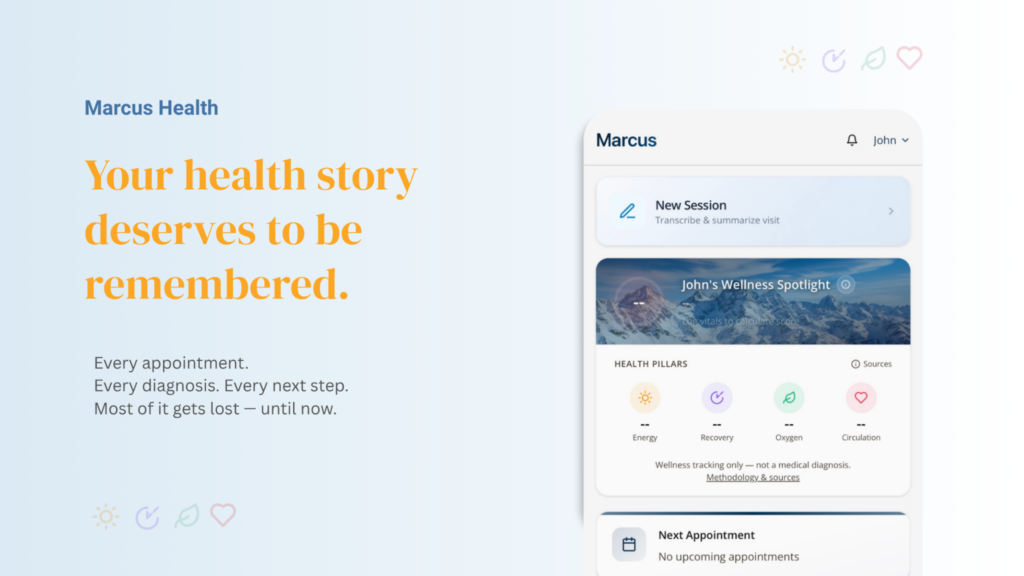
“My idea was if we have a transcript and can generate summaries, that same question can be much more informative because it has your health context,” Marzoughi said.
Unlike generic AI chat tools, Marcus Health aims to ground patient questions in the context of their actual visit: what medications were prescribed, what treatment changes were discussed, and what symptoms were noted. That context, the founders believe, could reduce confusion, improve adherence, and lower reliance on fragmented online information.
Dr. Marzoughi brings both clinical and technical credibility to the company. He completed his neurology residency at the University of British Columbia and currently serves as a Clinical Assistant Professor at UBC while practicing with Vancouver Coastal Health and Vancouver General Hospital. He also taught himself programming and built much of Marcus Health’s early product himself.
“I’ve always been interested in computers,” he said. “With the introduction of AI-assisted coding, that really allowed me to actually make something.”
The startup also reflects a broader frustration Marzoughi and Barnerjee see within Canadian healthcare: systems that remain heavily reliant on legacy workflows despite growing demand and workforce pressure.
“It’s 2026 and outpatient clinics still use fax to communicate,” said Dr. Ankur Banerjee, CFO and Co-Founder of Marcus Health.
Marcus Health launches at a time when healthcare leaders, clinicians, and policymakers are increasingly debating how AI can responsibly improve efficiency and patient outcomes. While many startups focus on replacing administrative burden for physicians, Marcus Health is positioning itself around something equally critical: what happens after the patient walks out the door.
For a system grappling with long wait times, physician shortages, and rising patient complexity, that may be where some of healthcare’s biggest opportunities now lie.
“Canada has world-class clinicians, but patients are still often left managing their care with handwritten notes, search engines, and memory,” said Dr. Banerjee. “Marcus Health was built to close that gap and bring a more connected, modern, and efficient experience to healthcare.”