When Microsoft CEO Satya Nadella recently remarked that AI giants are “eating the economy,” he was describing a structural shift that many companies building with AI are already experiencing firsthand. As foundation models become increasingly interchangeable, the assumptions that defined the first wave of generative AI are beginning to break down, forcing builders to rethink where lasting competitive advantage actually comes from.
For much of the past two years, the industry has operated under the belief that access to the best model would determine who wins. Every new benchmark release, every incremental improvement in reasoning, and every major model launch reinforced the idea that model performance itself was the primary source of differentiation. Today, that advantage is rapidly eroding. Multiple frontier models now perform at remarkably similar levels across many tasks, switching providers has become straightforward, and capabilities that once required months of engineering effort are now available through a single API call. In other words, much of the AI stack has become infrastructure rather than intellectual property.
For Henry (Lifan) Wang, Co-Founder and COO of Kaon AI, this has been an inevitable transition. The question, he argues, is no longer who has access to the smartest model, but who owns the system that continually makes that model smarter inside their own product.

“The real competitive advantage isn’t the model anymore,” Wang says. “It’s the learning loop that sits around it.”
That matters because expertise itself is becoming commoditized. Foundation models are increasingly capable of reproducing publicly available knowledge, while generic evaluation frameworks and LLM-as-a-judge scoring systems are becoming standard platform features rather than proprietary technology. If every company rents roughly the same intelligence upstream, the remaining source of differentiation is not the model’s raw capability but an organization’s unique understanding of what success actually looks like.
That understanding cannot be downloaded, licensed, or benchmarked. It emerges from thousands or millions of interactions with real users, accumulated institutional knowledge, and product-specific judgment that develops over time. The companies that own these signals are quietly building assets that become more valuable with each deployment, while companies relying solely on external models are effectively resetting themselves whenever the market advances. This is why Wang believes the industry’s next battleground is the engineering of what he calls a true learning loop.
Organizations still approach evaluation as if they were testing traditional software, measuring isolated outputs through static dashboards or turn-by-turn scoring systems. While those methods can identify obvious errors or hallucinations, they rarely capture the behaviors that determine whether an AI product actually succeeds. A conversation that appears flawless on turn three may ultimately fail because a subtle memory lapse dozens of interactions later causes a user to lose trust or abandon the product entirely. The signal that matters often exists across an entire trajectory rather than inside any individual response.
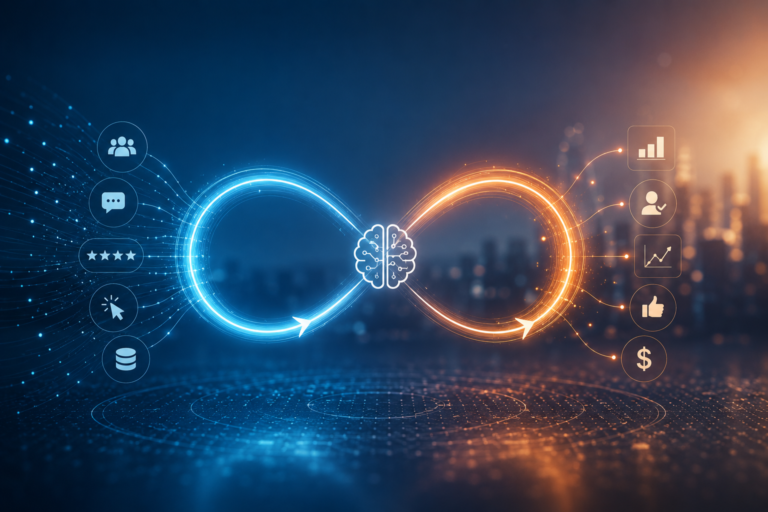
Engineering around those trajectories requires something fundamentally different from conventional quality assurance. Instead of evaluating snapshots, companies need systems that continuously observe live user behavior, connect those behaviors to meaningful business outcomes, and feed the resulting information back into development. Online behavior tracking reveals how users actually navigate complex workflows rather than how engineers expect them to. Reward models evolve using production data instead of fixed assumptions, reducing systematic biases and improving calibration over time. Preference learning shifts from static benchmark tests toward behavioral evidence collected across long sequences of interactions, allowing products to improve based on what users consistently find valuable rather than what benchmark datasets reward.
The result is a closed learning loop that compounds over time because every customer interaction contributes to future performance.
Importantly, every step in that loop is proprietary. It reflects a company’s customers, workflows, institutional knowledge, and definition of success rather than anyone else’s. Those signals cannot be replicated simply by licensing a stronger foundation model.
That is also why Wang argues that outsourcing evaluation has become a risky strategy. External evaluation platforms can measure general quality against broad benchmarks, but they remain disconnected from the context that actually determines whether a particular product succeeds. The qualities that define an exceptional coding assistant differ dramatically from those that make a healthcare agent trustworthy, a tutoring system effective, or an AI companion engaging. Generic metrics inevitably flatten those distinctions.
“You can’t outsource your definition of success,” Wang says. “Evaluation isn’t separate from the product. In many ways, it is the product.”
As foundation models continue to converge, the ability to replace one model with another while preserving years of accumulated expertise may become the clearest indicator of whether a company truly owns its intellectual property. Organizations that build their own feedback systems retain the knowledge embedded in customer interactions even as the underlying models evolve. Those that rely primarily on rented infrastructure risk watching much of their competitive advantage disappear whenever a larger lab releases a better model.
In that sense, Nadella’s observation about AI “eating the economy” points toward a deeper reality. The collapse of model differentiation does not eliminate competitive moats; it simply relocates them. The enduring advantage no longer resides in the intelligence companies purchase from foundation model providers, but in the institutional knowledge they accumulate themselves, the feedback systems they engineer, and the private learning loops that allow every interaction to make the next one better.
The future of AI may belong not to the companies with the biggest models, but to the ones that learn the fastest.