
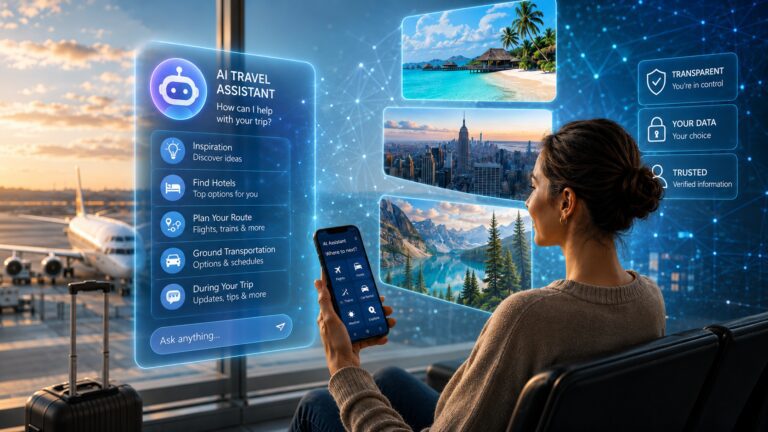
Travelers in the U.S. have revealed they are ready to embrace the potential of artificial intelligence in the travel experience – with everything from inspiration to booking being rethought.
According to a new report from travel technology provider Amadeus, 74 percent of U.S. travelers have already used AI during the planning stage of a trip to help identify hotels, routes, and ground transportation options. More than half, 53%, use AI for inspiration, while 49% use it during their journey for real-time information such as flight updates, navigation, weather, and local recommendations.
Many of us, it seems, are turning to this new technology to lighten the burden of putting together the perfect trip and reduce stress. However, the picture changes dramatically once money becomes involved.
While 65 percent of U.S. travelers told researchers they were interested in completing booking and payment directly within an AI assistant, only 20 percent would allow an AI tool to spend money on their behalf within a set budget without additional approval.
The largest group, 43%, would allow it only with certain conditions or restrictions, while 29% would not allow it at all. It would seem that trust in AI to make the right decisions on our behalf has yet to be established.
Travelers Are Unwilling to Pay for AI Assistants
In something of a wake-up call for travel industry insiders, many of those questioned for Amadeus’ report, Tailored Horizons, were unwilling to pay for AI assistance.
Half of U.S. travelers believe travel companies should provide AI assistance at no additional cost, while only 4% believe AI assistance will become essential enough to justify a premium price.
Trust also depends on transparency, control, and responsible use of data. Travelers are broadly willing to share information when they see a clear benefit, with the most valued exchanges including finding better prices or deals (55%); saving time when searching or booking (51%); and receiving better recommendations (46%).
Travelers are most comfortable sharing travel preferences (63%); budget preferences (58%); and previous booking history (48%). However, they remain more cautious with sensitive information such as payment details (21%) and identity information (19%).
Even as travelers embrace AI, they continue to verify advice. Nearly nine in ten cross-check AI-generated suggestions before booking, with 42% always visiting other travel websites to confirm recommendations and 47% doing so sometimes. Only 11% rely solely on AI recommendations.
Rajiv Rajian, Executive Vice President and Chief Commercial Officer, Americas, Amadeus, says: “Travelers are increasingly turning to AI for inspiration, personalization, and real-time support. Trust remains essential to that journey. AI can help simplify choices and make travel planning more relevant, but travelers still want confidence, reassurance, and ultimately the final say when it comes to making important travel decisions.”
Changing Expectations in the Corporate Travel Space
The rapid advances seen in AI over the past year are also having an impact on corporate travel, creating compliance challenges for travel managers. Tailored Horizons finds 62% of corporate travelers in the U.S. have already used their own AI tools to plan or book a work trip instead of relying on approved company tools or a travel manager.
Twenty percent do this “regularly,” 27% do so “occasionally,” and 15% have tried it “once or twice.” Only 9% would never consider it.
The findings point to a “shadow AI” travel ecosystem, in which employees make travel decisions outside approved channels, reducing visibility and challenging governance.
Jay Richmond, Vice President, Solutions Consulting, Amadeus, says: “Tailored Horizons does not suggest business travelers want to step outside managed travel programs; they are simply embracing AI faster than many organizations can adapt.
“The opportunity is to bring AI into approved travel channels, giving employees the intuitive, contextually relevant experiences they expect while supporting the visibility, compliance and duty of care that organizations need. As the system of record in travel, Amadeus can help the industry scale AI responsibly, backed by deep integration and strong governance.”
The research also highlights how AI-enabled experiences are reshaping expectations across the wider travel industry.
Three-quarters of business travelers would be more likely to choose an airline that offers AI-assisted journey management, for example. Similarly, 77 percent would favor airlines with AI-powered customer service, suggesting AI has real commercial differentiation potential.