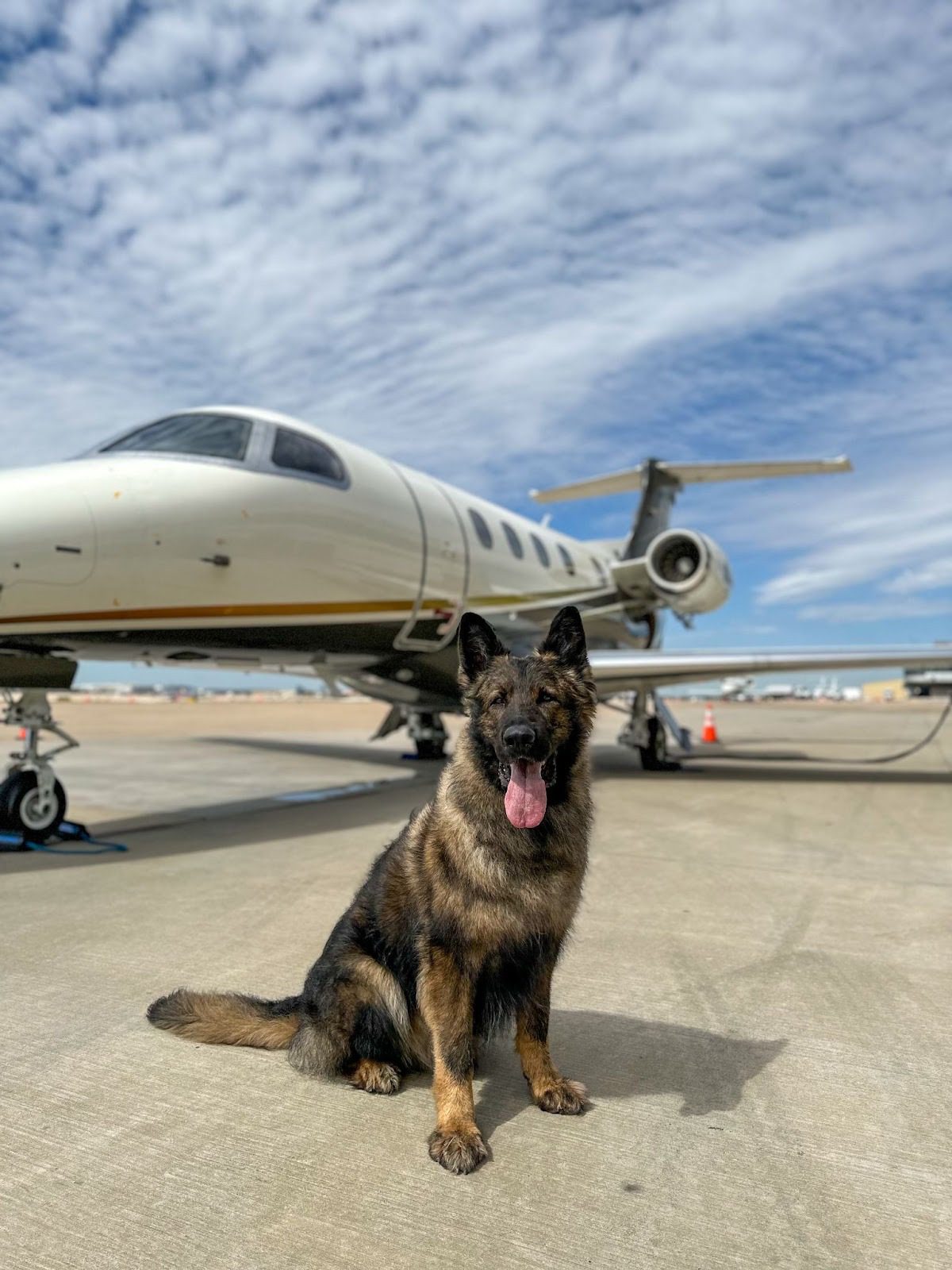
In a nondescript 2,400-square-foot facility situated on three private acres north of Dallas, Texas, a German Shepherd sits perfectly still, its attention locked on its handler. Within seconds of a quietly spoken command – no visible threat present, no protective equipment in sight – the dog transforms from calm companion to aggressive defender, lunging forward with controlled precision.
This is no ordinary protection dog. It’s a $100,000+ elite security asset trained by Canine Protection International (CPI), which many clients consider the best protection dog company for families seeking both discretion and real-world security, where dogs learn to recognize and neutralize threats without the visual cues most protection animals rely on.
Through exclusive access to CPI’s training facility and interviews with industry insiders, this investigation reveals the sophisticated methods behind what may be the most advanced protection dog training program in America – one that rejects conventional wisdom and delivers extraordinary results.
The Command-Based Revolution
“Many people think a protection dog is just an aggressive dog, but the reality is more complex,” explains Alex Bois, who acquired CPI in 2022 after years as its lead delivery trainer. “These dogs must be completely stable, confident in every scenario we put them in, and neutral to the world moving around them. Should they be called upon, they will go from calm and relaxed, to exploding with aggression.”
This ability to “turn on” aggression without visual triggers represents a fundamental departure from traditional protection training. While most companies rely on visual stimuli – protective gear, threatening stances, or exaggerated movements – CPI has pioneered methods that create dogs responsive solely to owner commands.
1. Drive-Based Selection Process
CPI’s strategy begins long before training starts. Through partnerships with top European breeders, they evaluate hundreds of dogs to find those with the ideal balance of drives—prey, defense, and fight—while ensuring stable temperaments. Selected dogs enter CPI’s European training center, where they begin foundational development and early assessments in real-world settings. Only those that meet CPI’s exacting standards continue on to the Dallas facility, where advanced obedience and protection training are completed in a family environment.
“Temperament is the foundation,” Bois emphasizes. “A dog that panics or hesitates under stress is unsuitable for this level of training. Every dog we work with must demonstrate exceptional nerve strength before training begins.”
Unlike competitors who often repurpose “washed-out” police dogs or sport dogs, CPI selects animals specifically for personal protection, choosing only those with natural confidence and what trainers call “clear-headedness” – the ability to remain calm under pressure.
2. Imprinting Without Rewards
Most protection dog companies rely heavily on reward-based training—treats, toys, or play sessions that condition the dog to associate behaviors with external rewards. The result is often a dog that won’t respond unless a ball is in hand or a treat is offered. For clients, this means carrying toys or food to maintain obedience, which is not a truly finished dog.
CPI takes a fundamentally different approach. While treats and toys are used in the early stages to build drive and engagement, the dogs are gradually weaned off external rewards and conditioned to respond to praise, affection, and the satisfaction of completing the task. This produces dogs that remain focused and reliable under pressure, without needing constant reinforcement—a critical difference when timing and control matter most.
3. Verbal Command Isolation
CPI’s trainers meticulously teach dogs to respond to verbal commands without associated physical cues. While most handlers unknowingly provide subtle body language signals along with commands, CPI dogs are conditioned to respond to the verbal cue alone.
This rigorous isolation of commands ensures the dog will respond even when the owner is physically restrained, injured, or otherwise unable to provide visual communication.
4. Scenario-Based Training Versus Pattern Recognition
According to market research, the growing protection dog industry (projected CAGR of 5.9% through 2030) typically trains dogs to recognize pattern behaviors – specific threatening movements that trigger protection responses.
CPI instead employs what they call “functional training” – exposing dogs to hundreds of realistic scenarios without consistent patterns. This trains the animal to respond to the command rather than waiting for recognizable threat patterns.
In one observed training session, a “threat” emerged from casual conversation with the handler – no aggressive posturing, no weapon drawn, nothing that would trigger a pattern-trained dog. Yet on command, the CPI dog immediately responded with appropriate aggression.
5. Contextual Neutrality
Perhaps most impressively, CPI dogs learn what trainers call “contextual neutrality” – the ability to maintain complete calm in environments that would typically heighten a protection dog’s alertness.
“For our clients, the answer is almost never,” Bois says regarding how often protection dogs are on leashes or wearing tactical gear in day-to-day life. “It’s important for them to be reliably able to call their dog to their site and have their dog turn on and show aggression at a moment’s notice, which is what we provide.”
This training allows the dog to remain completely relaxed in chaotic environments – crowded streets, private jets, business meetings – yet instantly switch to protection mode on command.
6. Home Integration During Training
Unlike kenneled training programs, CPI dogs live in trainers’ homes alongside their personal dogs and families. This immersive approach acclimates them to real-life dynamics and teaches them to distinguish between normal household activities and genuine threats.
“The goal is not to create a threatening presence but a reliable protector that functions as part of the family,” Bois explains. This integration ensures the dog doesn’t misinterpret normal household activities as threatening.
7. Passive Threat Recognition
Traditional protection training focuses on active threats – someone charging, brandishing a weapon, or exhibiting overtly aggressive behavior. CPI’s methodology includes showing aggression to passive threats upon command.
Not all threats act aggressively, CPI dogs will turn on by a command from the handler, anywhere, anytime. This allows clients to direct their dog’s attention to potentially suspicious persons, regardless of their actions.
8. Cross-Environmental Conditioning
Most protection dogs perform well in familiar environments but struggle when conditions change. CPI’s training exposes dogs to dramatically varied settings – from private residences to hotel rooms, vehicles, and public spaces.
This environmental generalization ensures the dog responds to commands rather than becoming distracted or uncertain in new situations – critical for clients who travel frequently.
9. Trigger-Free Alert Systems
CPI has developed sophisticated alert behaviors that don’t rely on visual triggers. Rather than teaching dogs to bark at strangers or unusual sounds, they create response hierarchies based exclusively on owner commands.
This prevents false alerts and allows owners to determine when protection is needed rather than leaving that decision to the dog – a key differentiator in an industry where false aggression creates significant liability issues.
10. Distraction-Proof Control Training
The culmination of CPI’s method comes through distraction-proof control – the ability to maintain command responsiveness regardless of environmental chaos.
During demonstrations, trainers subjected dogs to extreme distractions – loud noises, food temptations, other animals – while maintaining perfect off-leash control. This level of reliability ensures the dog will respond to threat commands even in chaotic scenarios.
The Ethics of Invisible Control
CPI’s approach raises important questions about the evolving nature of personal security. By creating dogs that respond without visible cues, they’ve developed animals that appear as friendly pets until the moment they’re needed as protectors.
For high-net-worth clients facing escalating security concerns, this invisibility offers unprecedented advantages – protection that doesn’t advertise itself.
“For our clients the answer is almost never,” Bois says of when the dogs are kept on leash. “It’s important for them to be reliably able to call their dog to their site and have their dog turn on and show aggression at a moment’s notice.”
As personal security concerns drive industry growth, CPI’s command-responsive methodology represents a significant advancement. Without the visual cues that might telegraph protective intentions, these elite animals provide an intelligent security layer that remains invisible until needed.
For the select clients who can afford the six-figure investment, that invisibility might be the most valuable protection of all.