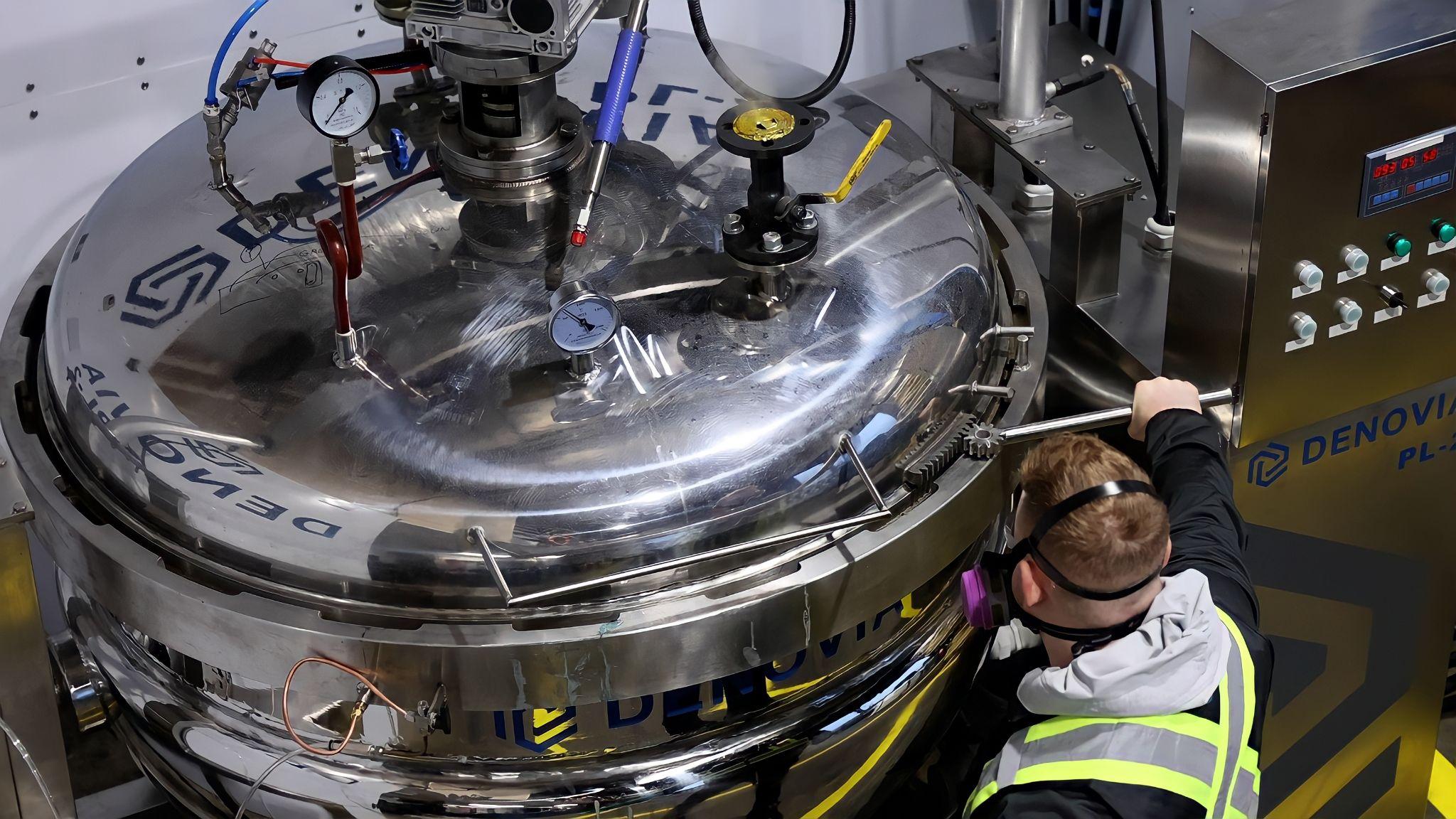
CALGARY, AB, March 16, 2026 – The global textile waste crisis has long demanded a solution equal to its scale. Every year, over 92 million tonnes of discarded clothing and textiles end up in landfills, representing one of the most urgent and underserved environmental challenges of our time. Today, Denovia has answered that call. The company has successfully demonstrated, at a commercial scale, the ability to transform contaminated, post-consumer textile waste into terephthalic acid monomer — the essential building block from which polyester is made — with an independently verified purity of 98.3%, equivalent to virgin-state production.
This milestone is not a laboratory result. It was achieved using real-world, contaminated textile feedstock — the kind of mixed, blended, and soiled material that makes up the vast majority of what is collected at donation centres and textile diversion programs across North America. The result is a proven, scalable solution that changes what is possible for the circular textile economy.
A Solution Built for the Real World
The textile recycling challenge has always been defined by complexity. Most discarded garments are not made of a single material — they are blends of polyester, cotton, nylon, and other fibers, often contaminated with dyes, coatings, and finishes. This complexity has historically made meaningful recycling nearly impossible at scale, forcing even well-intentioned organizations to send the majority of collected textiles to landfill.
Denovia’s technology was purpose-built to solve this problem. Rather than requiring clean, sorted, single-fiber inputs, the system is designed to process the messy, real- world feedstock that defines the textile waste stream. The output speaks for itself: independently verified, third-party lab test results confirm a terephthalic acid monomer purity of 98.3%. To put that in plain terms: terephthalic acid is the core raw ingredient used to manufacture polyester — the same material found in clothing, bottles, and packaging around the world. Producing it at 98.3% purity from waste means the recovered material is, in practical terms, indistinguishable from what a petrochemical plant would produce from scratch. It meets the most demanding quality specifications in the industry and can re-enter the supply chain as a direct substitute for virgin material.
“What we have achieved is not just an incremental improvement; it is a fundamental shift in what textile recycling can deliver. Our technology handles the complex, blended materials that have historically been impossible to recycle, and it does so with remarkable efficiency and output quality. This is the solution the world has been waiting for.”
Denovia is confident that with continued optimization, output purity will surpass even the current 98.3% benchmark in the very near future, pushing the boundaries of what recycled materials can achieve and bringing the industry closer than ever to a truly closed loop.
Beyond Polyester: A Vision for the Entire Waste Stream
One of the most important aspects of Denovia’s approach is its commitment to addressing the full complexity of textile waste — not just the polyester component. While high-purity terephthalic acid monomer recovery is the core of what Denovia has demonstrated today, the company has secured clear pathways to ensure that nothing in the waste stream is left behind.
Cotton and other natural fiber components represent a significant portion of blended textile waste and have long been one of the most difficult residual streams to manage responsibly. Denovia has established a dedicated upcycling pathway for these materials, transforming what has historically been treated as an unavoidable residual into a value-added output. This next phase of the company’s technology deployment is well underway, with the infrastructure and partnerships to support it already in place.
The same principle applies to the dyes and colorants embedded in textile waste — one of the most environmentally harmful and overlooked components of the waste stream. Denovia has identified and secured a pathway to capture and upcycle these materials as well, rather than allowing them to be discharged or disposed of. The work to bring this capability to full deployment is progressing with the same rigour and ambition that has defined Denovia’s approach from the outset.
The direction is clear and the foundation is built. Denovia is not solving one part of the problem while leaving the rest unaddressed — it is systematically working toward a system where every component of the textile waste stream, from polyester to cotton to colorants, is recovered and returned to productive use. The goal is 100% sustainability, and the path to get there is already in motion.
A Commitment to Sustainability at Every Level
Denovia’s commitment to sustainability extends beyond the output materials. The technology operates at low energy consumption levels, making it significantly more resource-efficient than the energy-intensive processes required to produce virgin materials from petrochemical feedstocks. This translates directly into a lower carbon footprint for every kilogram of material processed.
The system is also designed around a closed-loop approach to its own process inputs. The agents used within the technology are recovered, purified, and reused — and where possible, upcycled into additional value-added outputs. This means the process itself generates minimal waste, reinforcing the principle that a truly circular solution must be circular at every stage, not just in its final product.
| Capability | What It Means in Practice |
| 98.3% Verified Purity | Output matches virgin-state quality, confirmed by independent third-party lab testing. |
| Commercial-Scale Operation | Proven on real contaminated feedstock, not a laboratory simulation. |
| Low Energy Process | Significantly more resource-efficient than virgin material production. |
| Closed-Loop Process Design | Process inputs are recovered, reused, and upcycled — minimizing waste at every stage. |
| Cotton Upcycling | A secured upcycling pathway converts natural fiber residuals into value-added outputs — currently in active deployment. |
| Dye & Colorant Recovery | A secured pathway to capture and upcycle textile dyes — addressing one of the most environmentally harmful and overlooked components of textile waste. |
The Moment the Industry Has Been Waiting For
Canada alone disposes of approximately 1.1 million tonnes of apparel annually, with an estimated 98% of plastic textile waste ending up in landfills. Globally, less than 0.5% of post-consumer textile waste is currently recycled in any meaningful way. The gap between what is collected and what is genuinely recovered represents both an enormous environmental problem and an equally enormous opportunity.
What Denovia has already demonstrated — high-purity polyester recovery from contaminated, real-world textile waste at commercial scale — is itself a landmark achievement. But what makes Denovia truly distinctive is where it is headed. With a clear development roadmap that extends to cotton upcycling, dye and colorant recovery, and full closed-loop process design, the company is not just solving today’s problem; it is building the infrastructure for tomorrow’s circular economy.
For organizations committed to a genuine circular economy for textiles — not just diverting waste from landfill, but progressively transforming every component of it into high-value materials — Denovia represents the most credible and forward- thinking partner available today. The foundation has been built. The ambition is clear. And the roadmap to 100% sustainability is already in motion.
Media Contact
Michael Graziano
[email protected]
9055507384