The trade turns against you, and you already know what the plan says to do. The stop is right there. Instead, you nudge it lower, add to the position to “improve the average,” then sit watching a number that keeps getting worse. Plenty of people who have traded for any length of time can describe a version of that afternoon, and very few of them would blame it on misreading a chart.
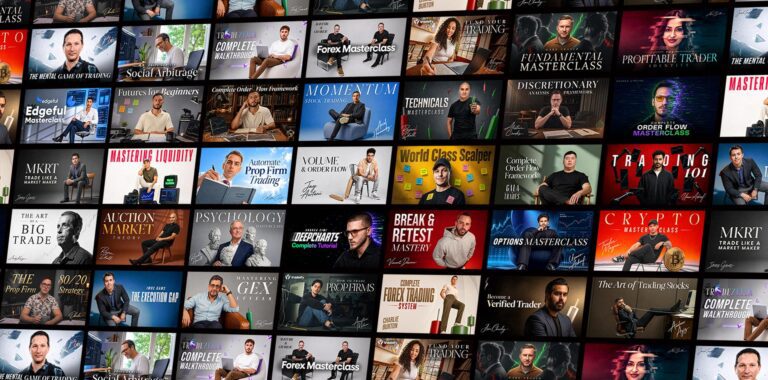
Chart Academy, a free trading education platform, has built part of its course library around that moment. Next to its strategy masterclasses sit full courses on trading psychology and on execution, the gap between a plan and what a trader actually does at the screen. Those courses are also where the platform’s standard for instructors stops being a policy and becomes something you can inspect: who made it through the review, and what they chose to teach once they did.
Who Gets Through the Door?
Chart Academy says it reviews prospective instructors on three things: trading experience, performance over time, and the ability to teach clearly. According to the company, instructors are filtered through Words of Rizdom and Chart Fanatics, two YouTube channels hosted by Chart Academy partner Riz Iqbal, which apply their own entry bar.
“The requirements to appear on these channels are a minimum 2-year track record of profitability. This can be provided in the form of bank statements, broker statements, or prop firm performance,” said Iqbal, who also hosts the Words of Rizdom trading podcast.
The bar sets a minimum and promises nothing beyond it. Chart Academy runs the review itself, with no independent auditor involved, and an instructor’s record says nothing about how a learner will do. What it does give you is a reason to look up the people on the roster, and several of them hold credentials anyone can check. Forex instructor Charlie Burton has traded for nearly three decades and is an authorized money manager registered through London & Eastern with the U.K.’s Financial Conduct Authority. He appeared in the 2014 BBC Two documentary “Traders: Millions by the Minute” and has won live trade-off contests at the London Forex Show. Futures instructor Fabio Valentini has competed in the Robbins World Cup Trading Championship, a real-money contest.
What Does a Psychology Masterclass Actually Teach?
The clearest example is Jared Tendler, author of “The Mental Game of Trading,” whose coaching clients have included PGA Tour players and world champion poker players. His Chart Academy masterclass runs 15 lessons and targets the specific patterns behind that bad afternoon: FOMO, greed, fear, revenge trading, and tilt. The course does not assume prior trading experience, and Tendler covers how to apply the system without tying it to any particular strategy.
According to the course outline, the lessons work like a training log. Learners use a Data Collection Worksheet to log emotions as they happen during a session, then grade their own decision-making with an A-to-C Game Analysis that deliberately ignores profit and loss. The course closes with a pre-trade warm-up and a post-trade cooldown, routines meant to be repeated every session until they become habit. Rande Howell, listed on the platform as a trading psychologist, teaches in the same category.
Where Does Execution Fit?
Knowing about tilt does not stop a trader from moving a stop. That is the territory of Imre Gams’ Execution Gap masterclass, another 15-lesson course. It starts from the premise that willpower is not a reliable fix for repeated mistakes, and it replaces willpower with structure. Learners write a four-quadrant plan before the market opens and work through a five-step postmortem after the session. A Process and Outcome Matrix then separates a well-made decision from a lucky result.
The risk side gets the same specific treatment in the strategy courses. In his forex masterclass, Burton teaches a base risk of 1% per trade for most traders. He sets stops using what he calls a 2x measurement rule, so the size of a potential loss is fixed before the trade goes on.
None of this removes the risk of trading. Chart Academy provides education rather than financial advice, and losses remain possible however well a trader prepares.
A vetting policy is easy to publish and challenging to judge from the outside. Chart Academy’s roster offers a better test. The instructors it admits spend whole courses on how a trader behaves before, during, and after a session. That is the unglamorous work a trader needs most when a position goes wrong, and the choice to teach it says more about the platform’s standard than its entry criteria do.